
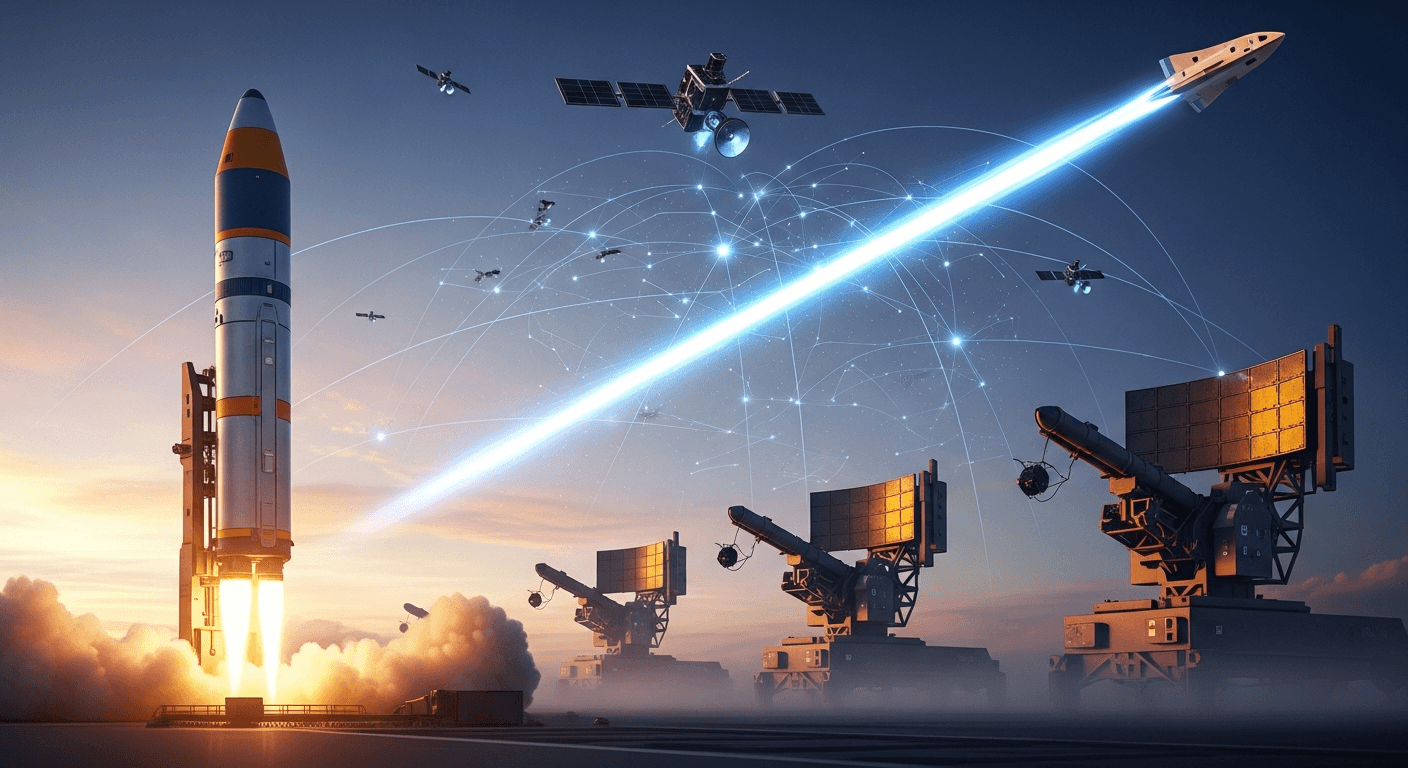
I still remember the first time I tried to map India’s defence capabilities on a single page — it felt like sketching a living organism: layered, distributed, and constantly adapting. Today, when I look from Agni‑5 to Akash and beyond to hypersonics, what strikes me is not just hardware, but the architecture of deterrence and the choices we make as a mature strategic actor.
Why this matters to me
I write about technology and policy not as abstractions, but as pieces of a story about national intent and practical self‑reliance. The missiles and interceptors we develop at home are statements: we can deter, defend, and — crucially — decide. My earlier reflections on India’s strategic platforms, including naval nuclear capability, anticipated this arc of self‑reliance and layered deterrence Racing towards ARIHANT.
Agni‑5: the strategic backbone
- What it is: Agni‑5 sits near the top of India’s land‑based strategic missiles. With ranges often quoted in the 5,000+ km class and modern canisterized, solid‑propellant designs, it moves India from a regional to a strategic deterrent posture.
- Why it matters: Agni‑5 is as much about signaling as about reach. It reinforces credible second‑strike capabilities and underwrites political choices by widening strategic options.
- The wider picture: Agni‑class missiles represent investment in reliability, survivability (canister launch, mobility), and integration into a national command, control and communications architecture.
Akash and layered air defence
- What Akash does: Akash is India’s homegrown medium‑range surface‑to‑air missile family — a workhorse of the layered air defence concept. Variants and upgrades (Akash Prime, Akash‑NG) focus on improved seekers, extended range, and integration with radar‑networks.
- The operational role: Akash is not just a point‑defence missile; it’s a node in a networked air‑defence system that must work with ground radars, airborne sensors, and command & control to create an effective sky shield.
- Industrial ecosystem: Akash is a success story for indigenization — design by defence research organisations and serial production by public sector and private industry partners.
Hypersonics: disruptive, urgent, and complex
- The promise: Hypersonic vehicles — cruise missiles and glide‑vehicles operating above Mach 5 — compress warning times, complicate intercepts, and demand new sensor and interception paradigms.
- India’s progress: India’s programs in hypersonic technologies (scramjet demonstrations, cruise‑vehicle concepts) are focused on mastering propulsion, thermal protection, guidance at extreme speeds, and rapid decision loops.
- Operational challenge: Hypersonics aren’t just about speed. They require distributed sensing (space, maritime, land radars), resilient data links, and new doctrines for escalation control. A hypersonic strike changes the timelines for political decisions.
From systems to a shield: architecture and gaps
What ties Agni‑5, Akash, and hypersonics together is the need for a coherent layered architecture:
- Strategic layer: Long‑range deterrents and survivable forces (land/sea‑based missiles) to ensure second‑strike credibility.
- Operational layer: Ballistic missile defence and interceptors to protect critical assets and population centres.
- Tactical layer: Air‑defence (Akash, point defense, fighter interceptors) against conventional air threats.
- Emerging layer: Sensors, space assets, and AI‑enabled command systems to detect, track and respond to hypersonic & cruise threats.
Gaps I watch closely:
- Sensor and tracking shortfalls against low signature, high‑speed threats.
- Command & control resilience under duress — redundancy and automation are essential.
- Doctrine and crisis management: technology without political doctrine risks dangerous miscalculation.
The industrial and strategic dividends of homegrown systems
Developing these capabilities domestically does more than secure hardware:
- Talent and ecosystem: Research labs, private companies, and public manufacturers create a sustaining innovation ecosystem.
- Export and diplomacy: Mature systems open diplomatic and commercial avenues, strengthening strategic partnerships.
- Sovereignty: Indigenous design reduces dependence on unpredictable external suppliers.
Risks and responsibilities
Hypersonics and advanced strike systems reshape not only battlefield tactics but strategic stability. As we advance:
- We must pair capability with doctrine that minimizes accidental escalation.
- We should invest as much in sensors, electronic warfare, and cyber resilience as in missiles themselves.
- And we must engage internationally — norms, verification, and crisis hotlines matter when decisions compress to minutes.
My closing thought
India’s journey from Agni‑5 to Akash and into hypersonics is not just a parade of systems — it’s the deliberate building of a defensive nervous system. That system must combine deterrence, defence, and the political wisdom to use both prudently. If we get the balance right, India will possess not only powerful tools, but the maturity to use them responsibly.
Regards,
Hemen Parekh
Any questions / doubts / clarifications regarding this blog? Just ask (by typing or talking) my Virtual Avatar on the website embedded below. Then "Share" that to your friend on WhatsApp.
Get correct answer to any question asked by Shri Amitabh Bachchan on Kaun Banega Crorepati, faster than any contestant
Hello Candidates :
- For UPSC – IAS – IPS – IFS etc., exams, you must prepare to answer, essay type questions which test your General Knowledge / Sensitivity of current events
- If you have read this blog carefully , you should be able to answer the following question:
- Need help ? No problem . Following are two AI AGENTS where we have PRE-LOADED this question in their respective Question Boxes . All that you have to do is just click SUBMIT
- www.HemenParekh.ai { a SLM , powered by my own Digital Content of more than 50,000 + documents, written by me over past 60 years of my professional career }
- www.IndiaAGI.ai { a consortium of 3 LLMs which debate and deliver a CONSENSUS answer – and each gives its own answer as well ! }
- It is up to you to decide which answer is more comprehensive / nuanced ( For sheer amazement, click both SUBMIT buttons quickly, one after another ) Then share any answer with yourself / your friends ( using WhatsApp / Email ). Nothing stops you from submitting ( just copy / paste from your resource ), all those questions from last year’s UPSC exam paper as well !
- May be there are other online resources which too provide you answers to UPSC “ General Knowledge “ questions but only I provide you in 26 languages !



No comments:
Post a Comment