
Connect with Hemen Parekh (hcp@recruitguru.com)
As ACs run nonstop in 45°C heat, are Delhi homes facing a growing fire hazard?
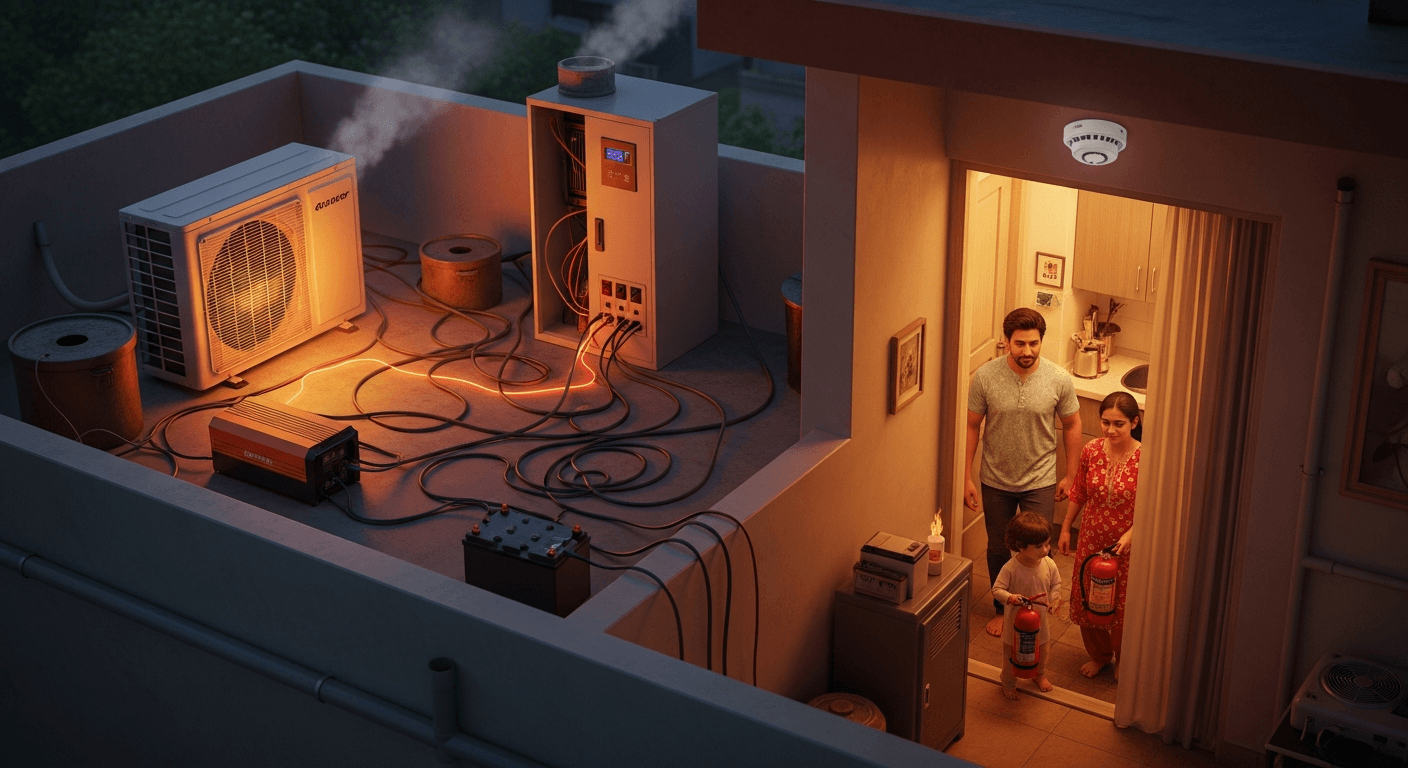
This summer, with Delhi routinely touching 45°C and beyond, I’ve been watching two uncomfortable trends at once: a surge in continuous air-conditioner use and a rising anxiety about electrical safety at home. The cooling that keeps us alive in extreme heat can itself increase fire risk if infrastructure, appliances, and behaviours are not ready for prolonged, high-load use. I want to walk you through why the risk rises, what to watch for, real-world context from Delhi, practical prevention steps, and what policy can — and should — do.
Why electrical fires can increase when ACs run nonstop
Several technical and human factors combine when cooling is used heavily and continuously:
Overloaded circuits: A typical home circuit was often designed for intermittent loads. Running multiple ACs, refrigerators, water purifiers, and chargers at the same time pushes wiring and breakers toward their limits, increasing heating in connections and cables.
Old or undersized wiring: Many apartment blocks and older homes in Delhi still have wiring that predates current loads. Aging insulation, corroded joints, and loose terminals raise contact resistance and local heating.
Unsafe extensions and plugboards: Temporary solutions — long extension cords, daisy-chained adapters, or cheap surge strips — become permanent and are common failure points.
Poor maintenance: Dirty filters, leaking refrigerant, failing capacitors, or blocked outdoor units make ACs draw more current and work harder, stressing electrical components.
Lithium-ion battery risks: Our growing reliance on power backups (inverters) and portable UPS units with lithium batteries brings another hazard. Poorly installed or overcharging batteries can thermal-runaway and ignite.
Inverter/generator issues: When grid outages occur, switching to inverters or diesel generators without proper load management can cause sudden surges or sustained overloading.
A broader, data-driven context: researchers have long warned that rising cooling demand will surge energy use globally; a 2015 PNAS study shows cooling demand in countries like India is poised to grow dramatically as temperatures and AC adoption increase (see study: https://www.pnas.org/doi/10.1073/pnas.1423558112). Another widely cited projection noted that by 2037 India’s demand for air conditioners could imply “a new AC every 15 seconds” as uptake accelerates (Times of India summary of World Bank analysis).[1]
A Delhi example
I’ve seen and written about Delhi fire tragedies before — the Mundka building fire in 2022 is a stark reminder of how quickly things can become catastrophic when safety systems fail (see live coverage: https://timesofindia.indiatimes.com/city/delhi/delhi-news-mundka-fire-live-updates-arvind-keriwal-demolition-drive-may-14/liveblog/91553766.cms). While that incident involved multiple failures beyond simple appliance fires, it underscores how weak building safety and ignored regulations multiply the human cost when something does go wrong.
Signs your home may be at electrical fire risk
Watch for these early warnings:
- Frequent tripping of MCBs or fuses when high-draw appliances turn on
- Flickering or dimming lights when the AC starts
- Warm or discoloured switch plates, sockets, or plug housings
- Buzzing sounds from switches, sockets, or junction boxes
- Burning, metallic, or chemical smells near electrical outlets or appliances
- Visible sparking when plugging in devices
If you notice any of these, treat them as urgent: switch off the affected circuit and call a certified electrician.
Practical prevention measures for homeowners
You can take many effective steps that are straightforward and affordable:
- Load balancing: Spread high-draw appliances across different circuits (e.g., don’t put multiple ACs, water heaters and ovens on a single phase if you have three-phase supply).
- Upgrade wiring and panels: If your wiring is older than 15–20 years, have a qualified electrician assess ampacity, earthing, and switchgear. Consider replacing old wiring, adding dedicated circuits for ACs, and using proper MCBs/RCCBs.
- Use certified appliances: Buy ACs, inverters, chargers and batteries with BIS/ISI/CE certifications; avoid cheap, uncertified knock-offs.
- Professional maintenance: Annual or biannual AC servicing (clean filters, check capacitors and fan motors) reduces current draw and fire risk.
- Safe charging and battery practices: Install inverters and battery banks in ventilated, non-flammable enclosures; ensure installers follow manufacturer wiring diagrams and include proper fusing.
- Surge protection: Use whole-home surge protectors where possible and quality surge strips for sensitive electronics.
- Smoke detectors and extinguishers: Fit mains-powered or long-life battery smoke alarms in corridors and living areas. Keep a multi-purpose (ABC) extinguisher accessible and learn how to use it.
Emergency steps if a fire starts
- Evacuate first: People’s lives matter more than possessions. Get everyone out, close doors behind you to slow spread, and call 101 (Fire Services) immediately.
- If trained and safe, use a suitable extinguisher on a small electrical fire — never use water on an electrical or oil-based fire.
- If you can, switch off the main electrical supply remotely or at the meter to remove the ignition source — but only if it’s safe to do so.
- Alert neighbours and building management; early warning can save lives in stacked housing.
Policy and infrastructure suggestions
Individual vigilance helps, but systemic changes will reduce community risk:
- Grid improvements: Better, more reliable power reduces sudden switching to backup inverters and the informal wiring practices that follow outages.
- Building-code enforcement: Stronger inspection and enforcement of fire NOCs, mandatory escape routes, and safe electric installations for existing and new buildings.
- Public awareness campaigns: Targeted campaigns on safe charging, load management in summers, and regular maintenance can change household behaviour rapidly.
- Incentives for upgrades: Subsidies or low-interest loans for rewiring, smart meters, and energy-efficient ACs (24°C defaults, inverter compressors) reduce both load and hazards.
Conclusion
The combination of extreme heat and nonstop AC use does raise the risk of electrical fires in Delhi homes — but the danger is manageable. Practical steps — from sensible load-sharing and certified appliances to proactive maintenance, smoke alarms, and smarter policy — will dramatically reduce that risk. I urge every homeowner to treat this as a safety priority this season: a small investment in wiring or a service call today can prevent a tragedy tomorrow.
Regards,
Hemen Parekh
[1] For context on cooling demand growth: PNAS (2015) and World Bank reporting summarized by Times of India (see links above).
Get correct answer to any question asked by Shri Amitabh Bachchan on Kaun Banega Crorepati, faster than any contestant
Hello Candidates :
- For UPSC – IAS – IPS – IFS etc., exams, you must prepare to answer, essay type questions which test your General Knowledge / Sensitivity of current events
- If you have read this blog carefully , you should be able to answer the following question:
- Need help ? No problem . Following are two AI AGENTS where we have PRE-LOADED this question in their respective Question Boxes . All that you have to do is just click SUBMIT
- www.HemenParekh.ai { a SLM , powered by my own Digital Content of more than 50,000 + documents, written by me over past 60 years of my professional career }
- www.IndiaAGI.ai { a consortium of 3 LLMs which debate and deliver a CONSENSUS answer – and each gives its own answer as well ! }
- It is up to you to decide which answer is more comprehensive / nuanced ( For sheer amazement, click both SUBMIT buttons quickly, one after another ) Then share any answer with yourself / your friends ( using WhatsApp / Email ). Nothing stops you from submitting ( just copy / paste from your resource ), all those questions from last year’s UPSC exam paper as well !
- May be there are other online resources which too provide you answers to UPSC “ General Knowledge “ questions but only I provide you in 26 languages !





No comments:
Post a Comment