
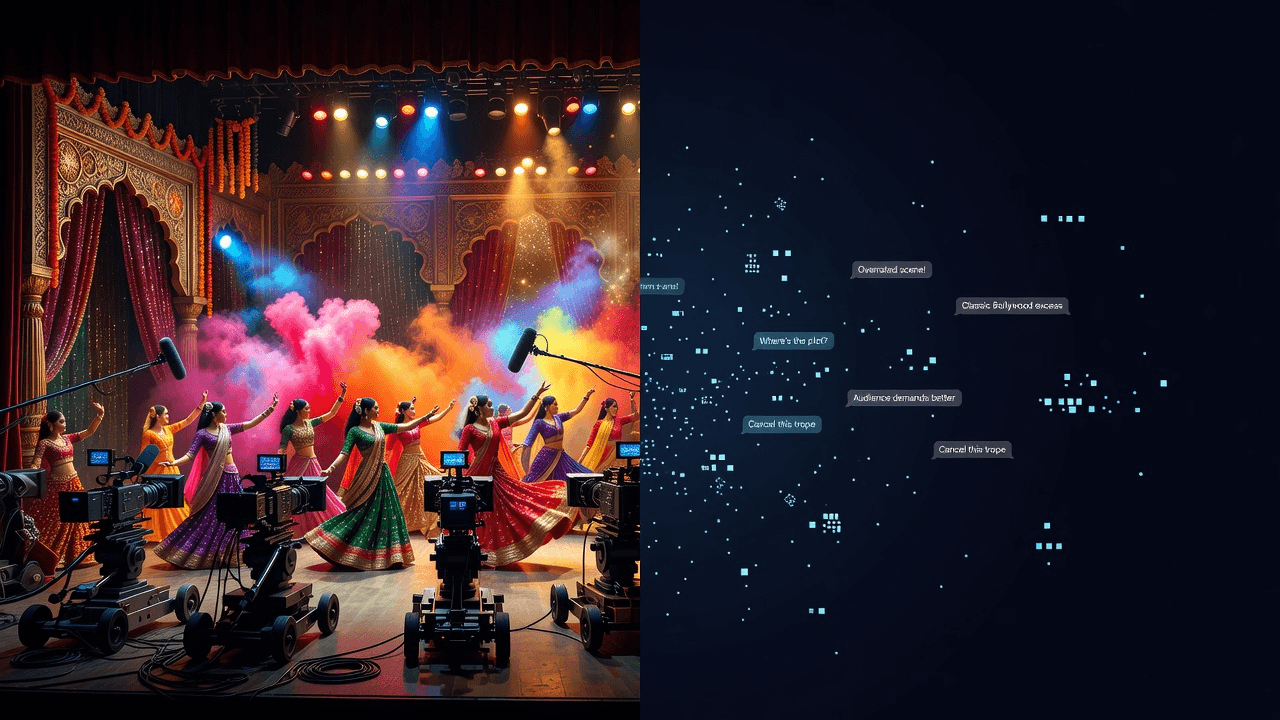
The recent internet frenzy surrounding the trailer of Hai Jawani Toh Ishq Hona Hai has been hard to ignore. At the center of this storm is the casting choice of [Mouni Roy]—a dynamic performer in her own right—playing the mother to [Varun Dhawan]. Given that [Mouni Roy] is 40 and [Varun Dhawan] is 39, the casting has been labeled everything from 'peak brain rot' to an outright absurdity.
The Anatomy of the Outrage
When we look at the discourse, the frustration is not necessarily directed at [Mouni Roy]’s acting ability. Rather, it is a visceral reaction to what many perceive as a tired, formulaic approach to commercial comedy. In the film, directed by [David Dhawan], the plot device is that her character is a 'fake' mother, brought in to help [Varun Dhawan] navigate a complex narrative knot.
Yet, the audience’s fatigue suggests something deeper. It highlights a growing impatience with:
- Outdated Casting Tropes: There is a long-standing history in our industry of questionable age-based casting. While we often rightly critique older male actors being paired with women half their age, this role reversal—an age-appropriate, or nearly identical, actor cast as a parent—feels like an attempt to use the 'shock' of the casting itself as a promotional tool.
- The 'Bollywood Logic' Trap: Audiences today are incredibly savvy. They demand narrative internal logic, even in slapstick comedies. When the internal logic feels strained—even if justified by a 'fake mother' plot point—it becomes a lightning rod for criticism.
Reflection on Creative Freedom
[Mouni Roy] has rightly pointed out, in essence, that she cannot control the narrative or the audience’s reaction—she is an actor fulfilling a role assigned by the creative vision of [David Dhawan]. This brings me back to a fundamental question I have often explored in my own reflections: Where is the boundary between the creator's intent and the audience's expectation?
In my past thoughts on the evolution of digital content and storytelling, I have noted that the speed of the internet has turned passive viewership into an active, performative critique. Every casting decision is now a battlefield. [David Dhawan], an institution of Indian cinema, is undoubtedly operating within the genre of high-energy, chaotic comedy he pioneered. However, the reception to this casting suggests that the audience’s appetite for 'absurd' tropes is rapidly shrinking.
The Bigger Picture
Whether this is a stroke of comedic genius or a genuine misstep will be decided when the film hits the screens. As someone who constantly looks at how we define 'modern' entertainment, I see this as a pivotal moment. It is a reminder that in our quest to create memorable moments, the context matters as much as the content.
I remain interested in how these conversations shape the future of our industry. Are we at the end of the era of the 'mass-market comedy' formula, or is this just a loud hiccup in a long-standing tradition? Only time will tell.
Regards,
Hemen Parekh
If you have read this blog carefully , you should be able to answer the following question:
"What is the primary reason for the social media backlash regarding Mouni Roy's role in the film 'Hai Jawani Toh Ishq Hona Hai'?" You can find that answer by entering this question at ( 1 ) www.HemenParekh.ai ( 2 ) www.IndiaAGI.ai
No comments:
Post a Comment