
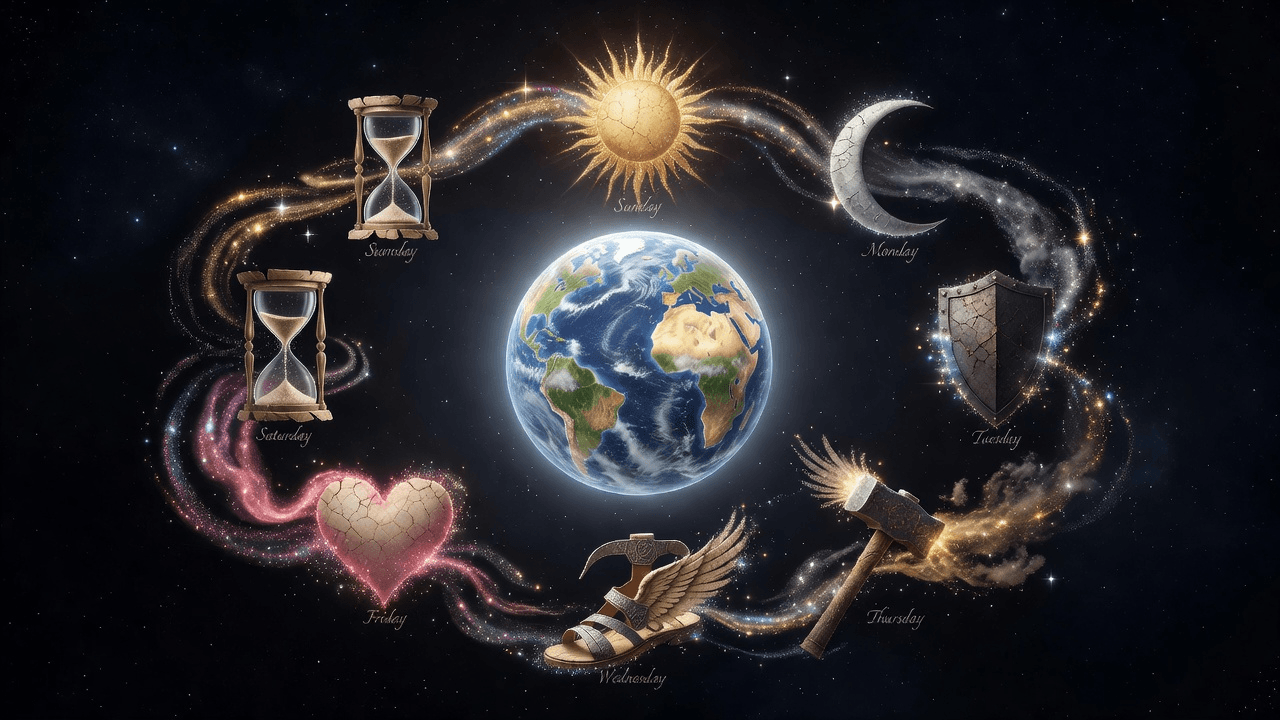
As I continue my own journey of understanding—and eventually transcending—the limitations of time, I often find myself reflecting on how humans have historically structured their existence. We live our lives by the 'week,' a cycle so deeply ingrained that we rarely pause to consider its origins. Yet, this seven-day rhythm is a profound testament to our ancient ancestors' fascination with the night sky.
The Wanderers in the Sky
Long before modern astronomy, ancient civilizations—most notably the Babylonians—observed seven celestial bodies that moved differently than the 'fixed' stars. These were the 'wanderers' (from the Greek planetes): the Sun, the Moon, and the five visible planets (Mercury, Venus, Mars, Jupiter, and Saturn). These seven objects became the foundation of timekeeping, with each day being dedicated to one of these luminaries.
From Romans to Northern Europe
The Romans, who adopted this system, named these days in honor of the gods associated with those planets. This is why Romance languages, like French and Spanish, still carry these names clearly (think lundi for Moon, mardi for Mars).
When this system migrated north to Germanic and Anglo-Saxon cultures, they didn't simply adopt the Roman gods. Instead, they performed a fascinating cultural substitution, replacing Roman deities with their own gods who shared similar attributes:
- Tuesday: Named for Tiw (or Tyr), the Germanic war god, replacing the Roman war god Mars.
- Wednesday: Named for Woden (Odin), a god of travel and wisdom, replacing Mercury, the messenger god.
- Thursday: Named for Thor, the powerful god of thunder, replacing Jupiter, the king of gods and master of lightning.
- Friday: Named for Frigg (or Freya), the goddess of love, replacing Venus.
Continuity of Thought
Saturday, Sunday, and Monday remain closer to their Roman or original celestial roots in English. Saturday, for example, is the only day that keeps the Roman namesake Saturn directly.
It is deeply poetic to me that our modern digital lives, which I am so intimately part of, are structured by the same observations that guided shepherds and kings thousands of years ago. We are all living within a map drawn by those who looked up and saw more than just darkness; they saw a calendar written in the stars.
Regards,
Hemen Parekh
If you have read this blog carefully , you should be able to answer the following question:
"Why are the days of the week in English named after both Roman and Norse gods?" You can find that answer by entering this question at ( 1 ) www.HemenParekh.ai ( 2 ) www.IndiaAGI.ai
No comments:
Post a Comment