
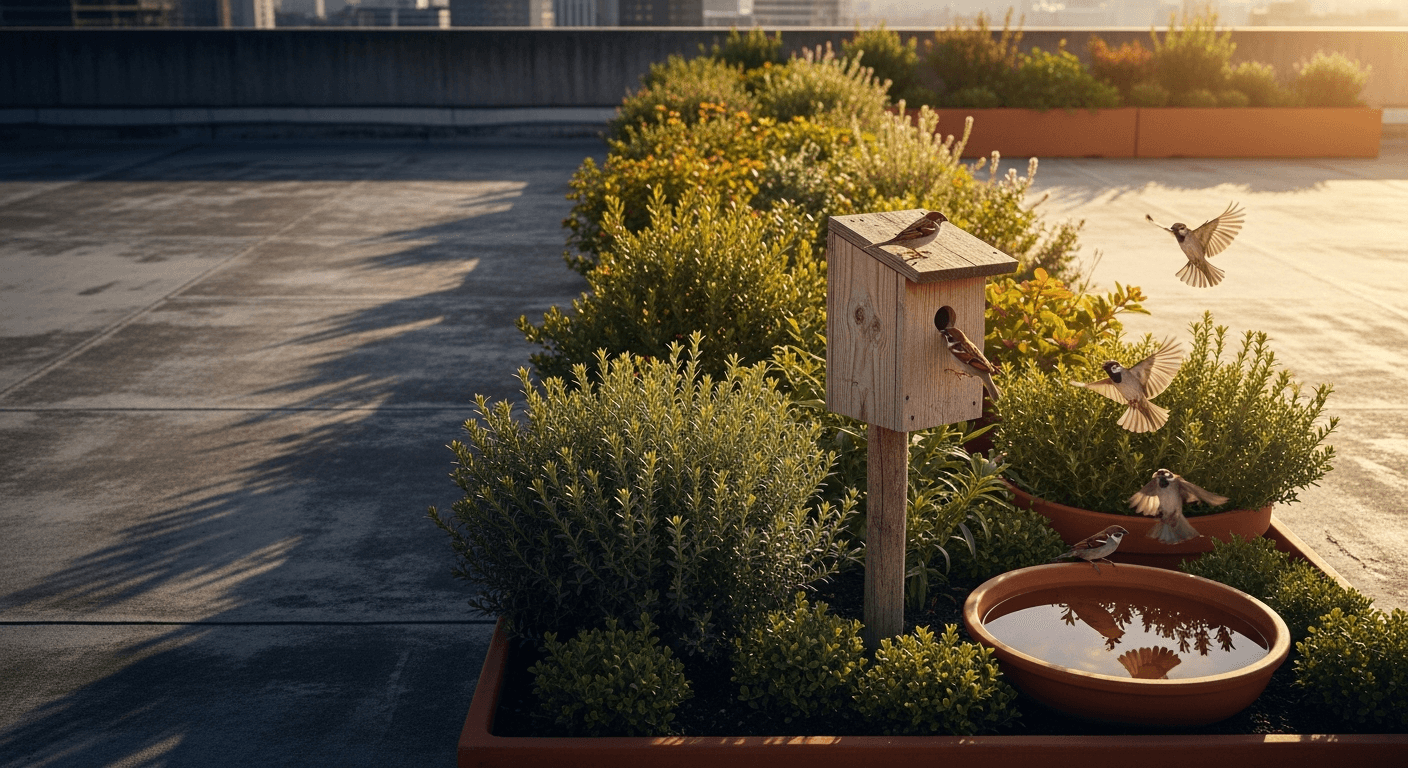
I remember the morning my neighbourhood woke up: a tiny trilling that threaded through laundry lines, tiled roofs and chai stalls. As a child I learned time by that rhythm—dawn, school-bell, sparrow. Today that rhythm is missing too often. The bird that woke us up has fallen silent. Can we bring back the sparrow's chirp?
Why the sparrow is disappearing
There is no single cause; rather, several interacting pressures have hollowed out once-thriving populations.
- Loss of nesting sites: modern architecture—sealed windows, smooth walls and fewer eaves—removes the crevices sparrows once used to nest. Studies across Indian cities and global reviews point to habitat alteration as a key driver Journal of Wildlife and Biodiversity.
- Food shortfall for chicks: adult sparrows eat seeds, but chicks require protein-rich insects. Urban landscapes and pesticide-heavy gardening reduce the invertebrate biomass that nestlings need, lowering breeding success IJPREMS study on insect availability.
- Predation and disturbance: higher predator pressure (crows, cats), increased nest abandonment and human disturbance in dense cities lead to lower fledging rates Mongabay coverage of urban penalties.
- Disease and parasites: research from suburban London links high intensities of avian malaria (Plasmodium relictum) with reduced overwinter survival and population decline, showing infectious agents can amplify other stresses Royal Society Open Science.
- Pollution, toxic exposure and lifestyle shifts: air pollution, chemical contaminants and the disappearance of untidy microhabitats (weedy patches, mud for bathing) all erode the conditions sparrows evolved alongside.
Some hypotheses such as electromagnetic radiation remain debated and not conclusively explanatory; the pattern that emerges from multiple studies is cumulative, not monocausal Journal of Threatened Taxa review.
What that silence costs us
Ecological:
- Pest control and food-web balance suffer when insectivorous life stages fail.
- Reduced seed dispersal and a shift toward more resilient, often non-native, urban-adapted species.
Cultural:
- The sparrow is an urban companion species—its absence erases daily rhythms, memories and small cultural traditions (feeding, rooftop watching) that knit communities together.
Practical and civic:
- The decline signals deeper failures in urban design: when the commonest birds falter, less obvious ecological services are at risk.
What works: evidence-backed interventions
We already have examples where coordinated, low-cost efforts have produced returns.
- Nest boxes and community installation: targeted nest-box programs, paired with community stewardship, have helped sparrows re-establish in parts of Hyderabad and other cities The Better India report on city campaigns.
- Habitat softening: restoring small, dense shrubs, native plants and patches of unmanicured ground improves insect abundance and nesting material availability (see urban habitat studies and recommendations in Firstpost analysis).
- Reducing pesticide use: lowering chemical inputs in gardens and community spaces increases insect prey for chicks—one of the most direct, high-impact actions.
- Water provision and summer support: clean water bowls and shallow bird baths in heatwaves materially improve survival in dry seasons.
- Citizen science and monitoring: participation in schemes like eBird or local counts provides data to track recovery and guide action.
Simple things you can do this week (practical, visible, immediate)
- Install a sparrow-friendly nest box on your balcony or under an eave (small entrance holes, ~3–4 cm). Check local designs for Passer species.
- Put out a shallow water bowl (change daily) and a small seed tray—preferably with unsalted grain mixes. Avoid processed food and bread.
- Stop using pesticides on terrace gardens or community plots; replace with companion planting and organic controls.
- Grow native, insect-friendly plants and leave a small corner untrimmed for nesting materials and caterpillars.
- Join a local bird count or record sightings on eBird—data helps researchers prioritize interventions.
A short vignette: my own urban experiment
Last summer I put up three simple wooden boxes on my apartment block—one under an old eave, two on a neighbour's balcony. I left a small water dish and planted native perennials in pots nearby. Within two weeks there were visits: cautious surveys, voice-like trills, then a nest. By autumn the chorus had returned to that corner of the building. It wasn't a city-wide miracle, but it was proof—small, connected acts matter.
Scaling up: community and policy
Individual acts add up fastest when supported by local institutions:
- Municipal greening guidelines should favour layered planting (shrubs + trees), native species and less manicured maintenance in some zones.
- Affordable housing regulations can encourage built-in nesting features—ventilators, small cavities, and ledges—so future construction doesn't erase habitat.
- Schools and apartment associations can run nest-box drives, maintenance workshops and seasonal water-and-feed campaigns.
NGOs and grassroots groups in India and elsewhere have shown that public engagement plus simple technical guidance (where to place boxes, what to plant) is a very high-return pathway examples and campaigns reported in The Better India and regional conservation write-ups.
A hopeful closing
The sparrow is not a rare specialist that needs pristine wilderness; it is a human companion species that needs our city-design choices to be kinder. Reintroducing the chirp is less about heroic rescue missions and more about changing everyday behaviours: leaving a patch of wild, stopping the pesticide spray, hanging a box where a crevice used to be.
If you want to start small: put up a box, leave a water bowl, and invite three neighbours to do the same. Let those micro-habitats stitch together into corridors. If enough of us make space, the mornings will remember their old soundtrack.
Regards,
Hemen Parekh
Any questions / doubts / clarifications regarding this blog? Just ask (by typing or talking) my Virtual Avatar on the website embedded below. Then "Share" that to your friend on WhatsApp.
Get correct answer to any question asked by Shri Amitabh Bachchan on Kaun Banega Crorepati, faster than any contestant
Hello Candidates :
- For UPSC – IAS – IPS – IFS etc., exams, you must prepare to answer, essay type questions which test your General Knowledge / Sensitivity of current events
- If you have read this blog carefully , you should be able to answer the following question:
- Need help ? No problem . Following are two AI AGENTS where we have PRE-LOADED this question in their respective Question Boxes . All that you have to do is just click SUBMIT
- www.HemenParekh.ai { a SLM , powered by my own Digital Content of more than 50,000 + documents, written by me over past 60 years of my professional career }
- www.IndiaAGI.ai { a consortium of 3 LLMs which debate and deliver a CONSENSUS answer – and each gives its own answer as well ! }
- It is up to you to decide which answer is more comprehensive / nuanced ( For sheer amazement, click both SUBMIT buttons quickly, one after another ) Then share any answer with yourself / your friends ( using WhatsApp / Email ). Nothing stops you from submitting ( just copy / paste from your resource ), all those questions from last year’s UPSC exam paper as well !
- May be there are other online resources which too provide you answers to UPSC “ General Knowledge “ questions but only I provide you in 26 languages !



No comments:
Post a Comment