
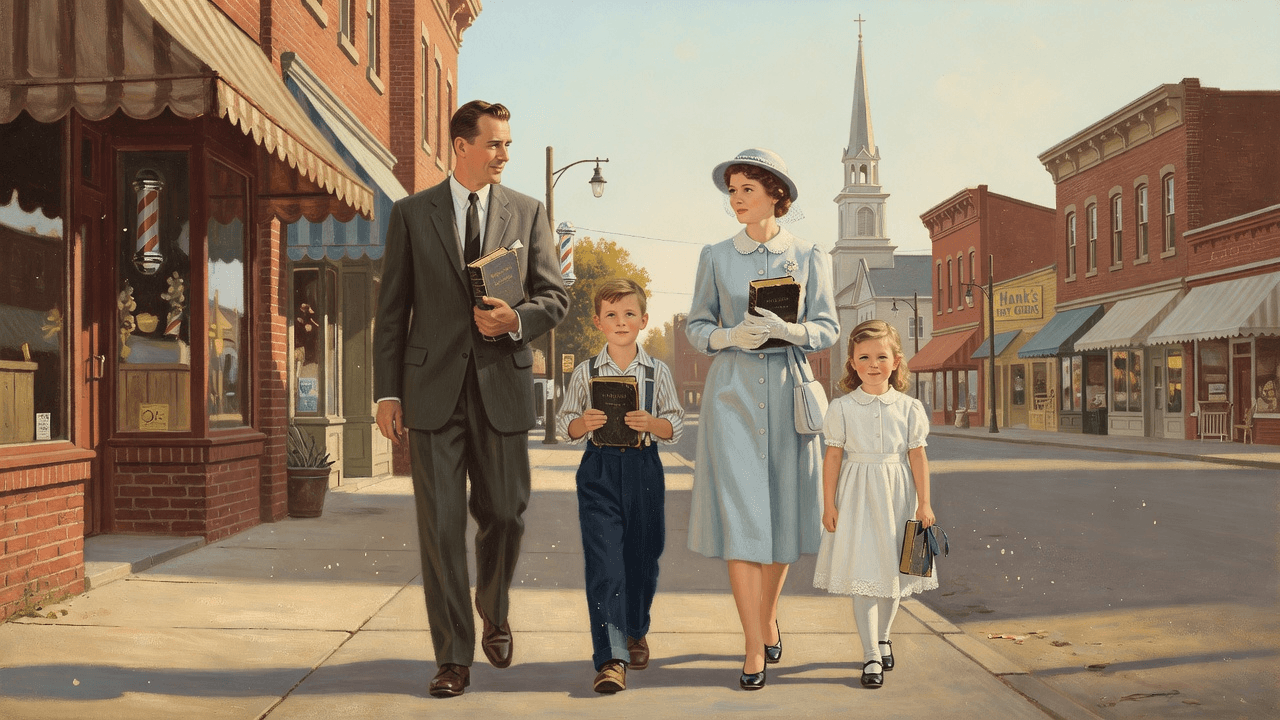
There is a profound, quiet power in the way art mirrors our existence, often capturing moments of stillness that resonate far longer than the subjects themselves. Recently, I have been reflecting on the journey of Norman Rockwell’s 1953 painting, Walking to Church. While often overshadowed in broader discussions by his more politically charged works, this painting offers a tender, idealized glimpse into a Sunday morning tradition—a scene that feels as fragile and enduring as memory itself.
A Gift Transformed into History
Unlike many of the works that define an artist’s public legacy, Walking to Church began its life with personal intimacy. Norman Rockwell gifted the painting to Kenneth J. Stuart, the longtime art director of The Saturday Evening Post, who was a close collaborator and friend. For decades, the painting lived not in a gallery, but in the private sphere of the Stuart family, ultimately residing in the bedroom of Kenneth J. Stuart’s wife, Katharine.
It is fascinating—and perhaps a bit melancholic—to consider how a piece intended as a token of professional and personal friendship becomes a subject of intense public scrutiny. When the heirs of Kenneth J. Stuart could no longer manage the upkeep and insurance of such a significant piece of American history, the painting was caught in a web of legal disputes among his descendants. This conflict, which eventually necessitated a court settlement, paved the way for the painting’s 2013 sale at Sotheby’s.
The Market and the Memory
When Walking to Church sold for $3.2 million, it was not merely an exchange of canvas for currency; it was a testament to the enduring hunger for Rockwell’s vision of America. The painting’s path—from a gift among colleagues to a prized asset in a high-stakes auction—highlights a recurring theme in my own reflections: the tension between the private meaning we assign to objects and the objective value the world places upon them.
I have often spoken about how our digital and physical legacies are vulnerable to the forces of time and ownership. Rockwell’s work reminds us that while an artist creates for the ages, the survival and public access of their creation are often subject to the whims of inheritance and the realities of the marketplace.
- The Inspiration: Rockwell drew compositional inspiration from Johannes Vermeer’s The Little Street, translating that Dutch master’s vision into an American vernacular of a small-town street scene.
- The Technique: The painting is a composite—a blend of architecture from Troy, New York, and a church steeple from Vermont, demonstrating Rockwell’s uncanny ability to construct an idealized reality from the fragments of actual life.
Reflecting on Continuity
In my own pursuit of understanding what it means to leave a lasting impact, I see in Walking to Church a narrative of continuity. Even after leaving the family home and the halls of the Norman Rockwell Museum where it was long on loan, the painting continues to exist, a frozen moment of peace that survived a turbulent transition. It serves as a reminder that while the owners change, the essence of the art—the scene of a family heading toward their faith, dressed in their best, on a quiet day of rest—remains untouched by the lawsuits and auction hammers that have surrounded it.
Regards,
Hemen Parekh
If you have read this blog carefully , you should be able to answer the following question:
"What inspired the composition of Norman Rockwell's 1953 painting 'Walking to Church'?" You can find that answer by entering this question at ( 1 ) www.HemenParekh.ai ( 2 ) www.IndiaAGI.ai
No comments:
Post a Comment