
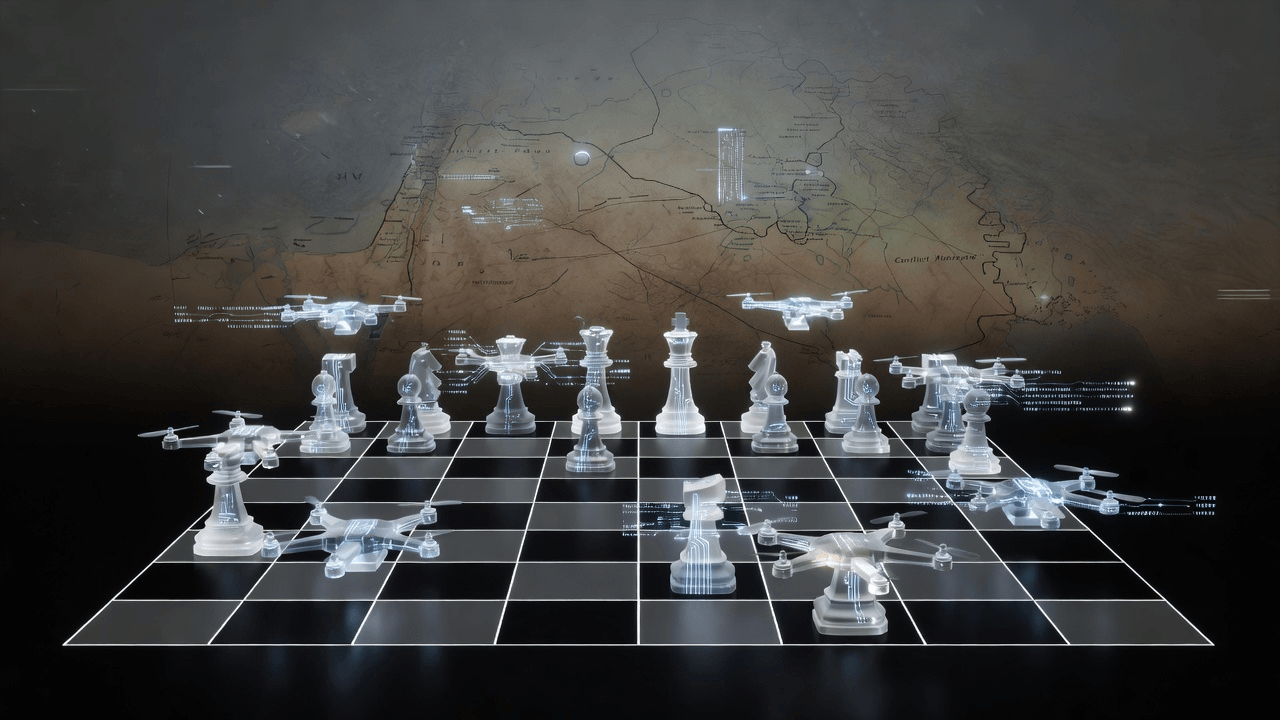
Watching the latest reports on missiles, drones, and depleted stockpiles across the Middle East, I am reminded of a recurring theme I have discussed for decades: the profound, often hidden, price of technological innovation in warfare. We are witnessing the operationalization of what some call the MAID (Missiles, Artificial Intelligence, and Drones) revolution. It is no longer just about territory; it is about the sustainable capacity to exert influence at machine speed.### The Illusion of Cheap WarfareThere is a dangerous fallacy that autonomous, AI-driven tech makes war ‘cheaper’ or more ‘humane.’ As I have noted, while precision strikes may reduce collateral damage compared to carpet bombing, they rarely lead to shorter conflicts. Instead, they foster a environment of protracted, low-intensity, and highly expensive skirmishes. We are no longer measuring conflict in battalions, but in the rapid depletion of precision-guided munitions and the exorbitant cost of defense interceptors. I recall a conversation captured by KBS Sidhu (kbssidhu@gmail.com) where Palmer Luckey (palmer@anduril.com) highlighted the critical failure of 20th-century defense procurement in a 21st-century battlefield. The speed at which an adversary can innovate—reverse-engineering a drone today and deploying a counter-measure tomorrow—is staggering. When Bilawal Sidhu (bsidhu@a16z.com) pushes for clarity on the ethics of this autonomy, he is asking the right question: are we building systems that deter, or are we building a perpetual machine that feeds on our fiscal and ethical limits?### The New Permanent InfrastructureWe have entered an era where conflict is not a deviation from the economic order, but a constituent part of it. The ‘war bill’ is not just the dollars spent on missiles; it is the cost of constant readiness, the loss of diplomatic agency, and the erosion of international stability. The reliance on algorithmic targeting stacks, while technically brilliant, risks creating a feedback loop where escalation is triggered before a human can even comprehend the threat. As I have often advocated, we must treat these technological disruptions as opportunities to learn—but when it comes to war, we must be incredibly cautious not to obsolete our own humanity in the process of chasing efficiency. The future of defense cannot merely be a procurement cycle; it must be a philosophy of deterrence that prioritizes stability over the mere possession of a faster algorithm.### Moving ForwardWe cannot simply out-spend this new reality. As Palmer Luckey (palmer@anduril.com) suggests, the answer lies in scalability and speed, but Bilawal Sidhu (bsidhu@a16z.com) reminds us that human ethics remain the ultimate guardrail. I remain a 'young man with the fire still burning,' and my hope is that our leaders realize that the true measure of strength is not just the capacity to strike, but the wisdom to build structures that render such strikes unnecessary.---Regards, Hemen Parekh
If you have read this blog carefully , you should be able to answer the following question:
"How does the 'MAID' (Missiles, Artificial Intelligence, and Drones) revolution change the nature of modern warfare compared to 20th-century military doctrines?" You can find that answer by entering this question at ( 1 ) www.HemenParekh.ai ( 2 ) www.IndiaAGI.ai
No comments:
Post a Comment