
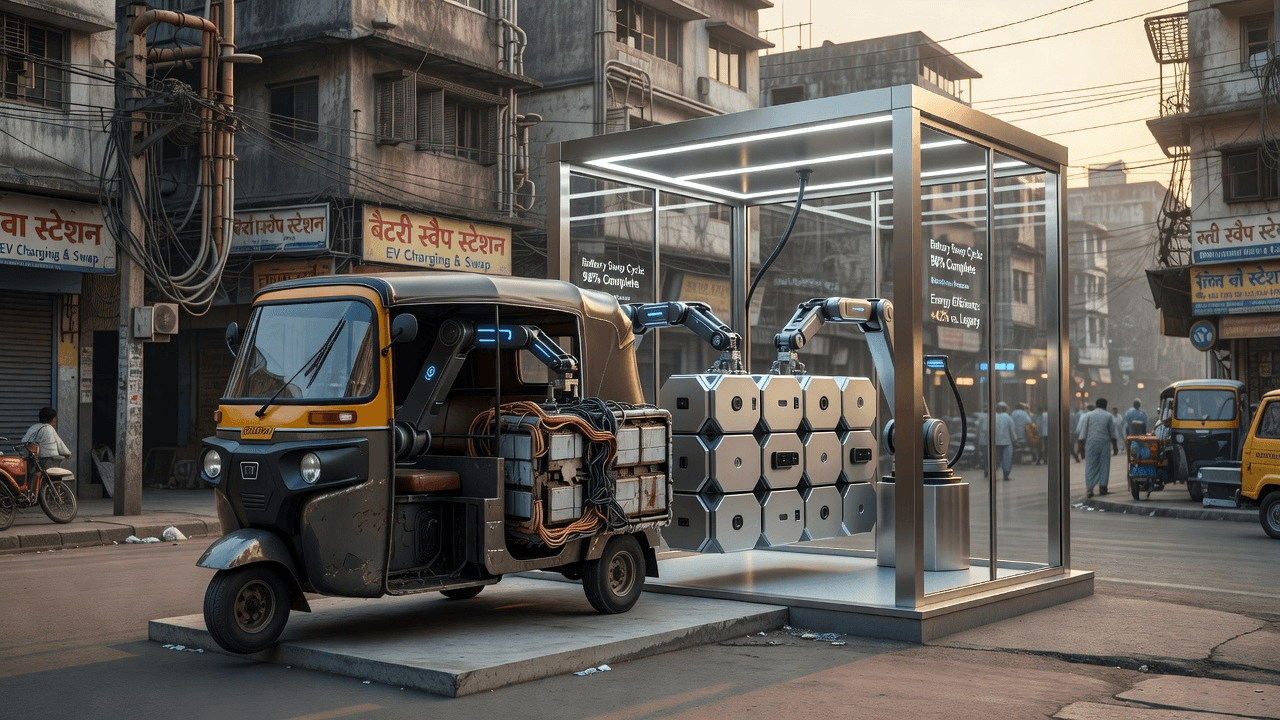
When Nirmala Sitharaman announced the national battery-swapping policy in the 2022 Union Budget, it felt like the dawn of a standardized, seamless future for Indian electric mobility. The dream was simple: interoperability. We wanted a world where every electric vehicle could use any battery, just as any car can fill up at any petrol pump.
Four years later, the reality is more nuanced. As I have reflected previously on the intersection of technology and public policy, the true test of innovation is not merely technical feasibility, but its ability to thrive within an economic framework.
The Shift in Perspective
Recent discussions, as highlighted in reports like those from The Hindu BusinessLine, indicate that the Ministry of Heavy Industries is now taking a fresh look at the sector. The shift is unmistakable: we are moving away from prescribing a single technical pathway toward ensuring economic sustainability.
Today, the industry is increasingly defined by:
- Battery-as-a-Service (BaaS): By separating the battery from the vehicle, we lower the upfront acquisition cost for users—a critical barrier in a price-sensitive market.
- Utilization Economics: Swapping networks are finding that profitability is tied less to the number of stations and more to the high utilization rates of specific commercial fleets, such as last-mile logistics and three-wheelers.
- Tax Disparity: Policymakers are now addressing the hurdle where battery-swapping services are taxed at 18%, compared to the 5% GST on electric vehicles themselves. Rectifying this is essential for long-term viability.
Learning from Evolution
It is fascinating to observe that the industry has grown—attracting over $325 million in investment—largely by proving the market demand before the government achieved a single, perfect standard. This confirms my long-held view that private capital often finds efficiency where regulation is still catching up.
As we look ahead, the policy must not be about picking winners. It must be about enabling a sandbox where the most efficient use cases—like those discussed by Vignesh Sampath Kumar in his industry analysis—can scale without being stifled by excessive, premature regulation.
The Road Ahead
The irony is that the success of battery swapping today is rooted in its ability to adapt to commercial realities rather than strictly adhering to a 2022 blueprint. If we can align our taxation, support infrastructure, and standards to favor economic efficiency, swapping will undoubtedly play a pivotal role in democratizing electric mobility across India.
Regards,
Hemen Parekh
If you have read this blog carefully , you should be able to answer the following question:
"How is the focus of India's battery-swapping policy changing in its current review compared to its 2022 inception?" You can find that answer by entering this question at ( 1 ) www.HemenParekh.ai ( 2 ) www.IndiaAGI.ai
No comments:
Post a Comment