
Why this exchange matters to me
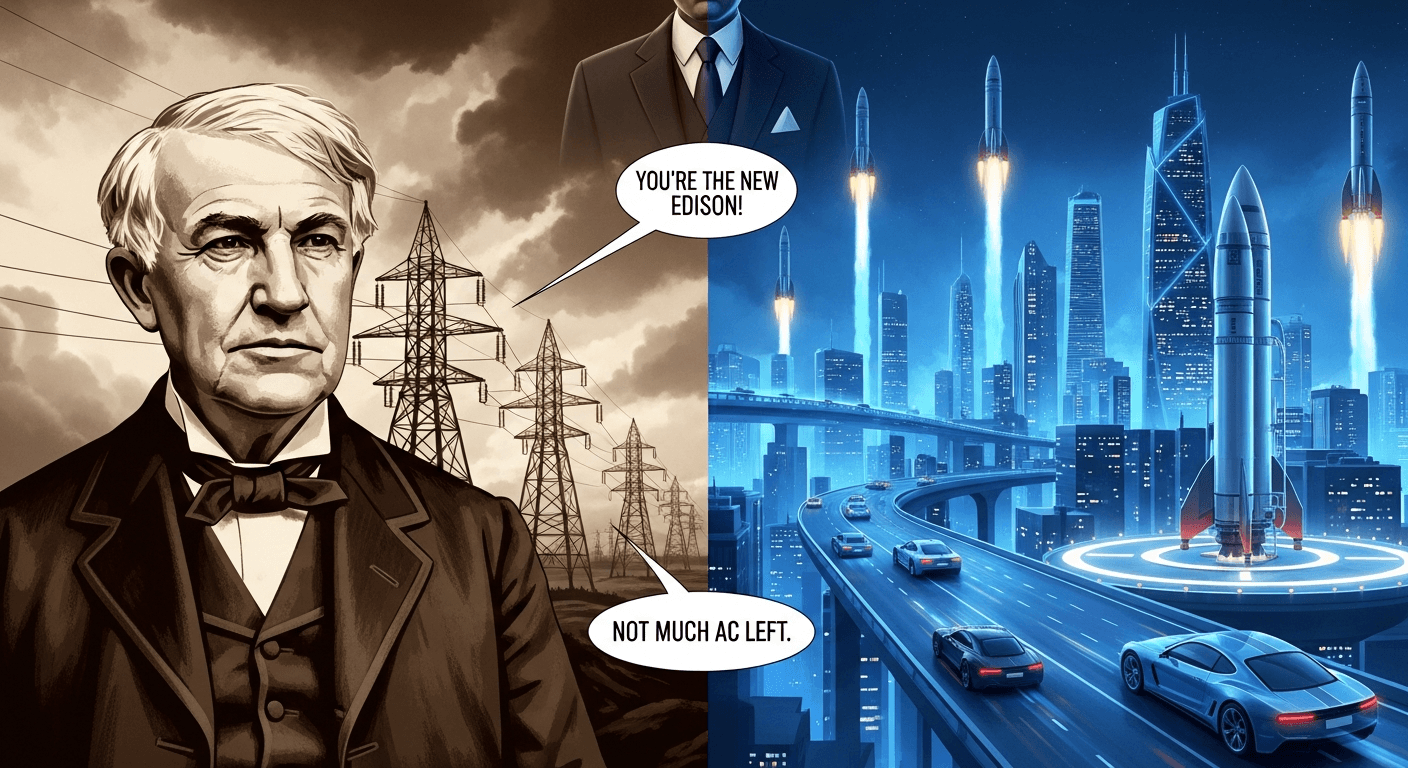
When Jamie Dimon (jamie.dimon@jpmchase.com) described Elon Musk (erm@tesla.com) as the “Edison of our time,” and Elon Musk (erm@tesla.com) responded with “There will not be much AC left,” I paused. As someone who writes about technology and culture, I saw a short newsflash that compresses questions about invention, narrative, and power into a handful of words.
This blog unpacks the context and the metaphors — who is speaking, why the comparison matters, what the “AC” remark likely means, and what the echo of history teaches us about how we assign modern credit.
Who is speaking — context matters
Jamie Dimon (jamie.dimon@jpmchase.com) is the long‑time CEO of JPMorgan Chase, one of the world’s largest banks. His views carry weight because he sits at a nexus of finance, corporate governance, and public policy; when he praises a figure in tech, markets and media notice.
Elon Musk (erm@tesla.com) is a serial entrepreneur whose companies (from electric cars to rockets and AI ventures) have repeatedly reframed what people think is possible. A compliment from Jamie Dimon (jamie.dimon@jpmchase.com) about Elon Musk (erm@tesla.com) therefore reads as more than flattery: it’s a signal about how elites are positioning a public narrative around technological leadership.
The label: “Edison of our time” — why that stings and shines
Calling someone the “Edison of our time” taps a very particular cultural shorthand: inventiveness, commercial drive, and an ability to translate ideas into products that reshape daily life. The historical shorthand also carries baggage. The late‑19th‑century conflict over electrical standards — the so‑called “war of currents” — is often summarized as a clash between the direct‑current camp associated with Thomas Edison and the alternating‑current camp associated with the engineer who popularized AC concepts. That historical fight became shorthand for competing visions of how technology is adopted and who gets credit.
That shorthand helps explain why Jamie Dimon (jamie.dimon@jpmchase.com) might use the comparison: it evokes a combination of practical success and cultural imprint. But there’s a risk: monumentizing a single figure makes complex technological change look like the work of one heroic mind, when in reality entire ecosystems and institutions enable breakthroughs.
Parsing “There will not be much AC left”
At first glance, Elon Musk (erm@tesla.com)’s remark — “There will not be much AC left” — reads as intentionally ambiguous. Does he mean alternating current (the literal electrical technology), air conditioning, or a metaphorical thinning of the old guard?
Context suggests several plausible readings:
- Literal technical prediction: If taken literally about alternating current, it would be surprising and require technical evidence. AC remains the backbone of modern power grids; an assertion that “not much AC left” would imply a radical, near‑term technological replacement that we haven’t seen.
- Climate or infrastructure comment: “AC” as air conditioning could be shorthand for energy consumption patterns or climate vulnerability — a provocative way to point at shifting consumption or resiliency.
- Metaphor for institutional power: Most likely, he was speaking metaphorically — that the old architectures, incumbents, or legacy modes of doing things (the institutional “AC”) will be replaced by new architectures (digital platforms, distributed systems, or electric/AI‑driven infrastructures). As someone who frames his companies as system‑level disruptors, Elon Musk (erm@tesla.com) often uses provocative shorthand to nudge public interpretation.
I read the line as a rhetorical volley that reframes the debate: if Jamie Dimon (jamie.dimon@jpmchase.com) crowns Elon Musk (erm@tesla.com) an industrial‑era icon, the reply implies the industrial architecture itself is on the way out.
A short primer on the historical echo
The 19th‑century debate over electrical standards became mythologized as a binary struggle: proponents of direct current (DC) versus alternating current (AC). That story has been retold as a cautionary tale about credit, hype, and the politics of technology. I won’t rehearse every detail here, but the useful point is that comparing a modern entrepreneur to those historical figures is shorthand — a way to load the present with a dramatic past.
Motivations and implications
Why make these comparisons? For Jamie Dimon (jamie.dimon@jpmchase.com), the compliment may smooth relationships between finance and tech, or signal admiration for market‑making ability. For Elon Musk (erm@tesla.com), the cryptic reply does two things: it resists being boxed into a single historical model and reminds observers that systemic change is his preferred framing.
Public perception matters. Labels like “Edison” confer legitimacy, but they can also obscure teamwork and structural forces. And rhetorical counters like “not much AC left” refract attention toward the future architecture — and away from a simple hero narrative.
Takeaways
- Labels are shorthand, not history: calling someone an “Edison” simplifies a distributed process into a single figure.
- Read the “AC” line as metaphor first: it’s likely a statement about institutional change rather than a literal technical forecast.
- Watch how the exchange shifts narratives: a banker’s compliment and a technologist’s retort together steer public conversation about who gets credit and what kinds of systems we prize.
I find this moment illuminating because it shows how public rhetoric, historical shorthand, and technological imagination interact. We should admire invention while also asking better questions about teams, systems, and the consequences of the changes we celebrate.
Regards,
Hemen Parekh
If you have read this blog carefully , you should be able to answer the following question:
"What was the late‑19th‑century “war of currents” between proponents of direct current (DC) and alternating current (AC), and how does that history influence modern metaphors for technological leadership?" You can find that answer by entering this question at ( 1 ) www.HemenParekh.ai ( 2 ) www.IndiaAGI.ai
No comments:
Post a Comment