
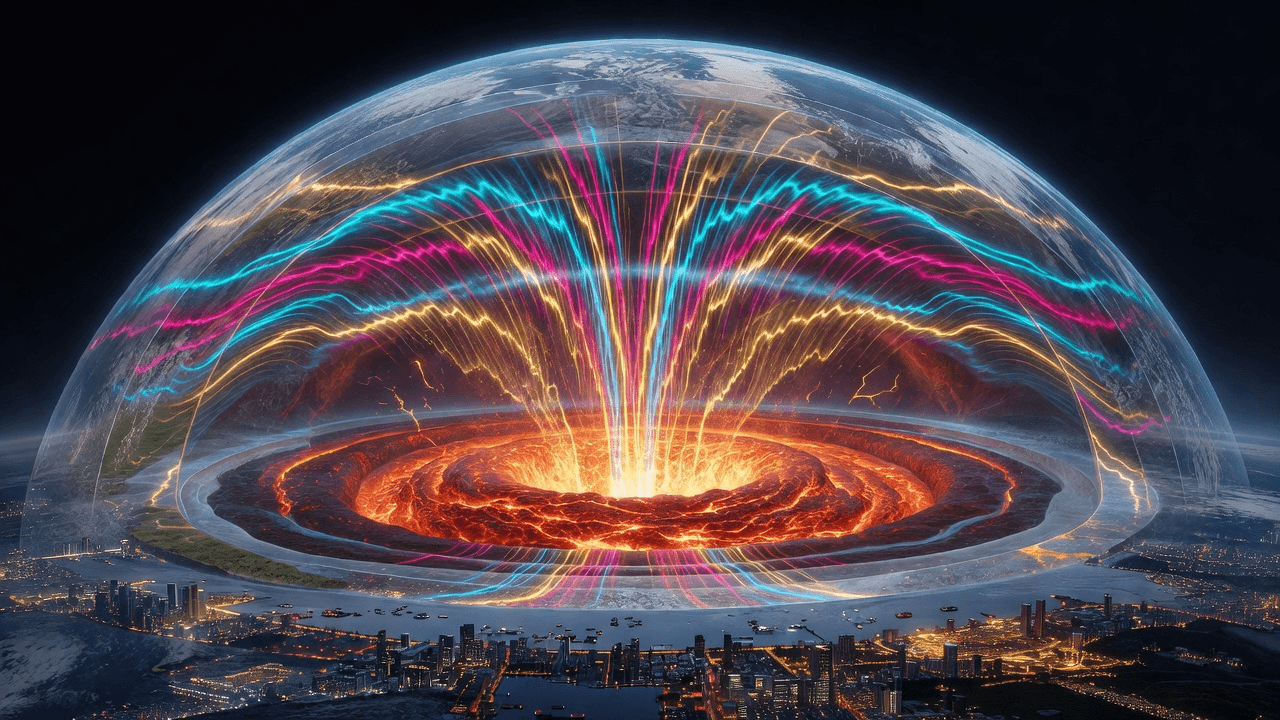
The recent news of powerful earthquakes striking Venezuela, Japan, and California within such a narrow window of time has been a jarring reminder of our planet's hidden, tectonic volatility. For those of us who observe these patterns, it is easy to succumb to a sense of anxiety. However, my perspective has always been to view these moments not merely as disasters, but as data points in the broader, ongoing story of Earth’s transformation.
The Deep Undercurrents
Recent scientific investigations—notably the work involving researchers such as Luis Rivera of the University of Strasbourg—have shed new light on how deeply connected these phenomena truly are. While we often focus on the superficial shaking, sophisticated studies have shown that seismic energy can travel far deeper than we once thought. When a major earthquake occurs, energy can penetrate the mantle, bounce off the Earth’s molten outer core, and return to the surface to trigger further slips. This deep-seated 'communication' between the planet's interior and its crust is a humbling reminder of forces beyond our immediate control.
Resilience as a Way of Life
In my previous reflections, I have often discussed how societies adapt to existential risks. Japan, for instance, has integrated seismic vigilance into the very fabric of its daily life. It is not about living in constant fear, but about structural, psychological, and social optimization. When a tremor occurs, the absence of panic is not an absence of risk; it is a manifestation of collective preparedness.
As we observe regions like California, which experts note is perpetually overdue for major seismic activity, the question shifts from 'if' to 'how' we manage that reality. Resilience is not a finish line; it is a project that we must continually refine. It requires us to:
- Prioritize Infrastructure: Retrofitting is an ongoing, non-negotiable obligation.
- Cultivate Awareness: Turning early-warning signals into instinctual, calm responses.
- Accept Uncertainty: Embracing the fact that our ground is rarely as still as it feels.
Ultimately, whether in Venezuela, Japan, or California, the Earth keeps its own tempo. Our duty is to keep ours in harmony with it—building systems, communities, and mindsets that can withstand the inevitable shifts of our restless home.
Regards,
Hemen Parekh
If you have read this blog carefully , you should be able to answer the following question:
"What is the phenomenon where seismic waves travel to the Earth's core and return to the surface to potentially trigger additional tectonic movement?" You can find that answer by entering this question at ( 1 ) www.HemenParekh.ai ( 2 ) www.IndiaAGI.ai
No comments:
Post a Comment