
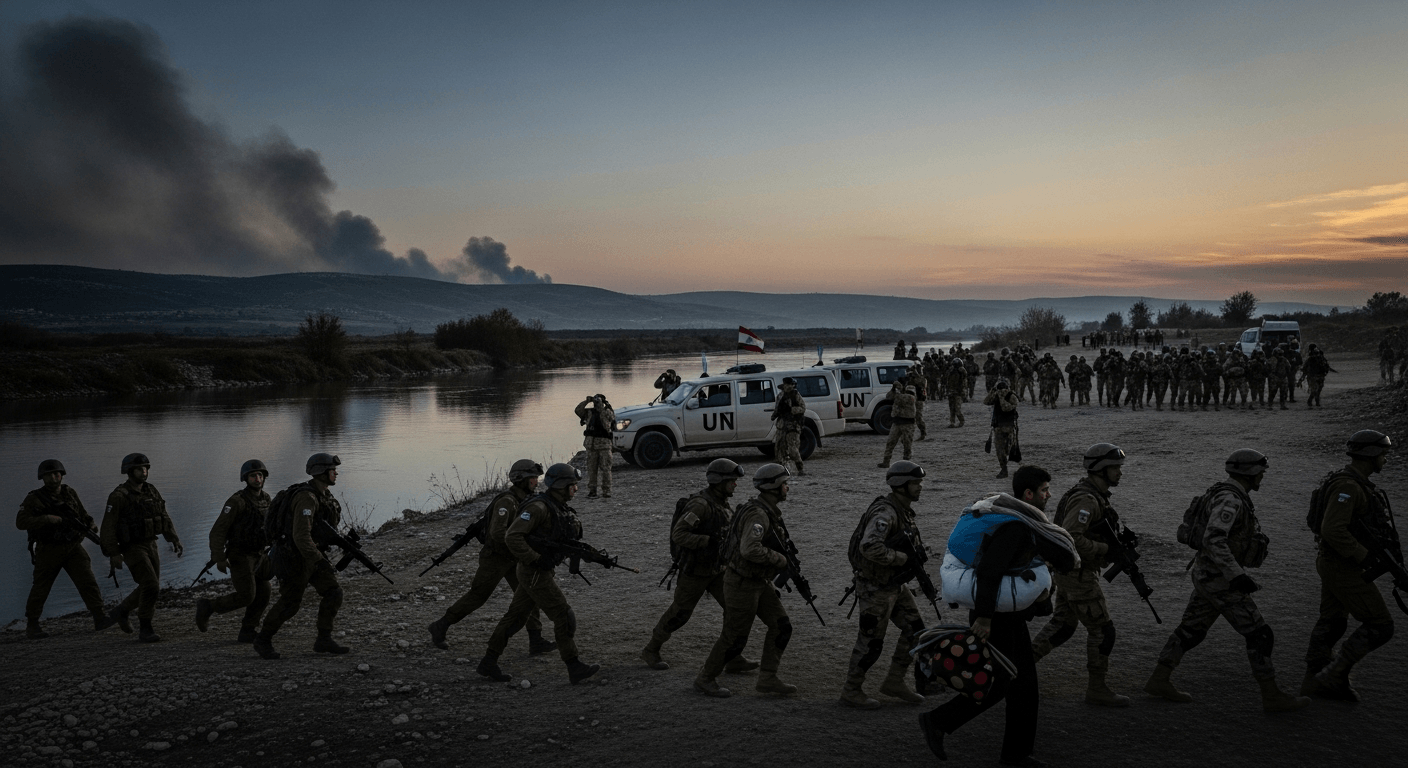
I watched the announcement of a renewed Israel–Lebanon ceasefire with a mixture of relief and unease. Relief, because another round of cross‑border violence would have delivered more pain to civilians on both sides; unease, because the architecture of this deal — a phased Israeli withdrawal, an expanded Lebanese security presence south of the Litani River, and multinational monitoring — will only work if politics, capacity and incentives align. Below I unpack what led to this pause, what the agreement actually requires, how the key actors responded, and why the hard work begins now.
What led to the agreement
Fighting along the Blue Line flared repeatedly after the October 2023 regional escalation, and months of exchange of fire left communities in northern Israel and southern Lebanon exposed to bombardment, displacement and infrastructure damage. International mediators — led diplomatically by the United States and France and operationally involving UN mechanisms and the UN Interim Force in Lebanon (UNIFIL) — pressed for a deal that would re‑establish a durable separation between regular state forces and non‑state armed groups in the south [BBC; NPR; The961]. The renewed ceasefire and the creation of a defined Lebanese security zone were presented as steps toward full implementation of UN Security Council Resolution 1701 and toward preventing a return to open war [The961].
Key terms: ceasefire and the Lebanese security zones
- A cessation of hostilities across the Blue Line, effective immediately from the announced time, with both sides agreeing to refrain from offensive operations inside the other country.
- A phased withdrawal of Israeli forces south of the Blue Line, to be coordinated with a parallel deployment of Lebanese official military and security forces into the area south of the Litani River (the “Southern Litani Area”). The handover and deployments are expected to be executed within a timebound window (the agreement envisages a phased process lasting up to about 60 days) [The961; BBC].
- Lebanon’s official forces will be the only armed actors authorised inside that southern zone (with UNIFIL’s presence preserved). The Lebanese forces are expected to dismantle unauthorised infrastructure, confiscate weapons, and regulate arms flows into the country.
- A reformulated tripartite mechanism — hosted by UNIFIL and chaired by external partners — will monitor, verify and assist with implementation; the United States and France pledged to coordinate international support for Lebanese force capacity, including training and equipment to reach the aim of deploying up to 10,000 Lebanese soldiers to the south [The961; NPR].
Who negotiated it
The formal negotiation and the public announcement brought together the governments of Israel and Lebanon, with strong diplomatic facilitation and monitoring commitments from the United States and France and an operational role for UNIFIL and established tripartite mechanisms. International military and technical committees (including European partners) were cited as part of the capacity‑building effort to enable Lebanese deployments [The961].
Reactions — official and regional
- Israeli government: welcomed a cessation of hostilities but repeatedly emphasised retention of the right to act in self‑defence if it perceives threats from armed groups near the border.
- Lebanese government: publicly endorsed the agreement as a path to restoring calm and regaining control, while signalling deep concerns about sovereignty and the practical difficulty of disarming entrenched militias.
- Hezbollah: cautiously receptive in tone but sceptical about any arrangement that does not secure a clear Israeli withdrawal or that could be used to diminish its own deterrent posture.
- United Nations: framed the deal as consistent with Resolution 1701 and stressed the need for careful verification and civilian protections.
- United States and France: played lead facilitation and monitoring roles, pledging support for Lebanese army capacity and for coordinated verification mechanisms [NPR; BBC; Al Jazeera].
- Regional actors: responses ranged from guarded support for de‑escalation to warnings that long‑term stability will require addressing broader regional dynamics, arms flows, and political fragmentation inside Lebanon [Al Jazeera].
Potential implications for civilians and security
- Positive: If implemented, the deal could allow displaced families to begin safe returns, reduce air and artillery exposure for border communities, and restore basic movement and commerce.
- Risk: Demilitarisation of the south on paper may not translate quickly to safety on the ground. Embedded infrastructure, dual‑use facilities, and tunnel networks are hard to locate and dismantle without sustained verification.
Enforcement challenges and risks
- Capacity gap: Lebanon’s armed forces have long complained of shortages of manpower, funding and equipment; deploying 10,000 troops rapidly and effectively will require substantial international investment and time [The961].
- Verification: Distinguishing between civilian infrastructure and covert military sites is technically demanding; monitoring teams will need unfettered access and real‑time intelligence to deter violations.
- Political will: Domestic politics in Lebanon — sectarian divides and the political influence of armed groups — could undermine sustained implementation. On the Israeli side, political pressures to remain vigilant may produce pre‑emptive strikes or threats that test the ceasefire’s limits.
- Spillover: Arms smuggling routes, regional proxy dynamics and external backers could recreate tensions even if the southern zone is temporarily stabilised.
Possible next steps
- Rapid deployment of the tripartite mechanism and international technical teams to verify withdrawals and Lebanese deployments.
- International funding and training packages for the Lebanese armed forces, prioritising logistics, intelligence and community safety operations.
- Confidence‑building measures for civilians: clear communications about safe return timelines, humanitarian access corridors, and joint community protection plans.
- Parallel diplomatic work on unresolved border and maritime disputes, to reduce the incentive for renewed hostilities.
I’ve written before about how ceasefires are less an end than a fragile pause; what matters is the scaffolding that follows — credible verification, predictable support, and incentives for local actors to choose governance over guns. This agreement creates that scaffolding in outline. Turning it into durable calm will be the harder task — one that requires patience, money, and the political courage to enforce sovereignty in practice.
Regards,
Hemen Parekh
Any questions / doubts / clarifications regarding this blog? Just ask (by typing or talking) my Virtual Avatar on the website embedded below. Then "Share" that to your friend on WhatsApp.
Get correct answer to any question asked by Shri Amitabh Bachchan on Kaun Banega Crorepati, faster than any contestant
Hello Candidates :
- For UPSC – IAS – IPS – IFS etc., exams, you must prepare to answer, essay type questions which test your General Knowledge / Sensitivity of current events
- If you have read this blog carefully , you should be able to answer the following question:
- Need help ? No problem . Following are two AI AGENTS where we have PRE-LOADED this question in their respective Question Boxes . All that you have to do is just click SUBMIT
- www.HemenParekh.ai { a SLM , powered by my own Digital Content of more than 50,000 + documents, written by me over past 60 years of my professional career }
- www.IndiaAGI.ai { a consortium of 3 LLMs which debate and deliver a CONSENSUS answer – and each gives its own answer as well ! }
- It is up to you to decide which answer is more comprehensive / nuanced ( For sheer amazement, click both SUBMIT buttons quickly, one after another ) Then share any answer with yourself / your friends ( using WhatsApp / Email ). Nothing stops you from submitting ( just copy / paste from your resource ), all those questions from last year’s UPSC exam paper as well !
- May be there are other online resources which too provide you answers to UPSC “ General Knowledge “ questions but only I provide you in 26 languages !



No comments:
Post a Comment