
Lead
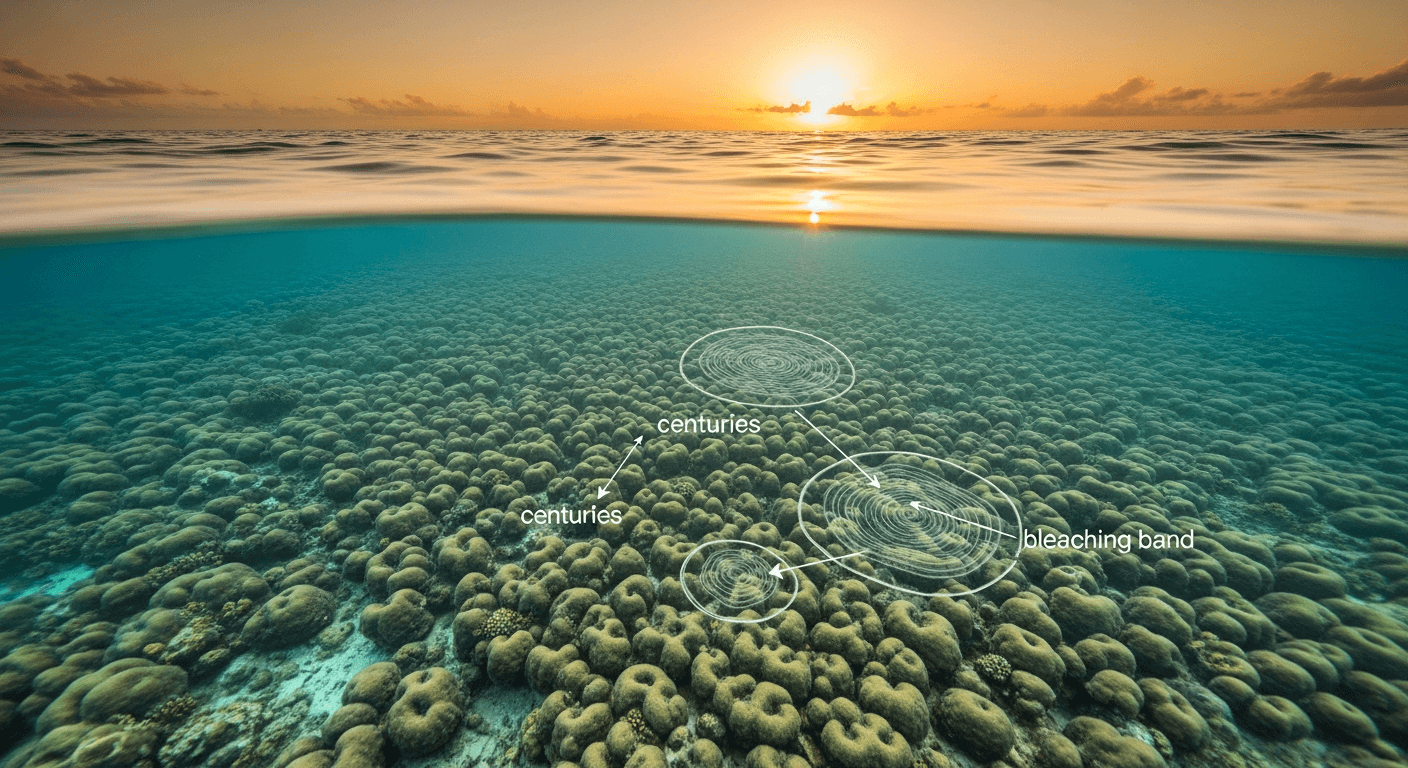
I still remember the first time I saw a photograph of the so‑called “potato patch” coral in Lakshadweep: a low, lumpy, pale‑brown mass filling a shallow lagoon — at first glance it looked like a strangely persistent garden of tubers. Then I learned this was not a garden at all but possibly one of the largest single living coral colonies on Earth, and that parts of it may have been growing, quietly and slowly, for around 1,800 years. That realization changed how I think about time, stewardship and how fragile a long life can be when the world around it turns hostile.
Why this discovery matters (lead continued)
A living organism — a coral colony — spanning centuries is not just a curiosity. It is a living archive of ocean history, a keystone for local marine life, and a reminder that the ecosystems we depend on can be both astonishingly resilient and heartbreakingly vulnerable. In Lakshadweep, this “potato patch” raises big questions about how to protect what may be one of the planet’s oldest and largest living coral structures.
Scientific context: species, growth and significance
What is it? The lumped, boulder‑like corals commonly called “potato corals” belong to massive Porites species — slow‑growing stony corals that build dense, long‑lived skeletons. These colonies form hemispherical or irregular mounds and can persist for centuries.
How they grow. Massive Porites grow slowly — often at rates measured in millimetres to centimetres per year — by accreting calcium carbonate skeleton layer by layer. Over long timescales that slow, steady growth can produce truly enormous, stable structures.
Why age matters. A colony that has persisted for 1,000–2,000 years is also a climate and environmental archive: the chemical signatures in its skeleton record sea‑surface temperatures, ocean chemistry and episodic events like storms or disease outbreaks across centuries. Those records can help scientists reconstruct past ocean conditions and improve models of future change.
Conservation concerns and threats
Even while we marvel at its age, that same longevity makes the colony vulnerable. A few of the biggest threats:
Rising temperatures and bleaching: Short‑term heat spikes trigger coral bleaching — the loss of symbiotic algae that corals need to survive. Even very old, massive corals can be fatally stressed by repeated bleaching events.
Ocean acidification: As CO2 dissolves into the sea, it reduces the availability of carbonate ions corals need to build skeletons, slowing growth and making structures more fragile.
Local stressors: Sedimentation from coastal development, nutrient runoff, physical damage from anchors and boats, and overfishing that disrupts reef food webs all compound global threats.
Extreme weather and disease: Strong storms, cyclones and disease outbreaks can break apart even huge colonies that took centuries to build.
What scientists did to study it
Researchers combine several approaches to study unusually large coral colonies:
Visual mapping and photogrammetry: High‑resolution photographs taken from boats, drones or underwater cameras are stitched into 3‑D models. These models give accurate measures of colony size, surface complexity and recent damage.
Coral coring and chronology: Scientists extract narrow cores from massive corals (a minimally invasive technique) and analyze growth bands and chemical markers. Techniques such as radiocarbon and uranium‑thorium dating let researchers establish age and growth histories.
Genetic and health assessments: DNA analyses confirm species identity and connectivity to nearby reefs; disease screens and symbiont profiling (the algae that live inside corals) reveal recent stress histories.
Ecological surveys: Fish and invertebrate surveys quantify the colony’s role as habitat and its contribution to local biodiversity.
Why this matters globally
This is not just a local story. Ancient, massive corals are global treasures:
Climate archives: Their skeletal chemistry helps scientists reconstruct long‑term ocean and climate variability, improving forecasts for the future.
Refugia potential: Some long‑lived colonies may indicate locations where corals are more tolerant to stress (microclimates, water flow patterns or resilient symbionts). These spots could become priorities for conservation and restoration.
Cultural and economic value: Healthy reef systems sustain fisheries, protect shorelines and support tourism — services that matter to island communities across the tropics.
Practical actions readers and policymakers can take
What we do next must match the scale of threat. Here are practical steps, sorted from immediate to strategic:
For readers and coastal communities
Support local stewardship: Back community‑based reef protection and no‑anchor zones. Local guardianship reduces direct physical damage.
Reduce pollution footprint: Cut single‑use plastics, choose reef‑safe sunscreens, and advocate for reduced nutrient runoff from agriculture and sewage.
Responsible tourism: Boaters, snorkelers and divers should follow low‑impact practices and support operators that fund reef protection.
For scientists and managers
Prioritize monitoring: Regular photogrammetry and health surveys to track growth, bleaching frequency and recovery at the site.
Protect climate refugia: Identify and legally protect areas where corals show tolerance or fast recovery.
Restore carefully: Use scientific criteria to guide restoration so genetic diversity and local adaptation are preserved rather than disrupted.
For policymakers and international actors
Stronger marine protection: Establish and enforce marine protected areas (MPAs) with real limits on extractive activities and anchoring.
Pollution control and land‑use planning: Tighten regulations on coastal development, sediment control and wastewater treatment that harm reefs.
Global climate action: None of the local measures will suffice without aggressive cuts in greenhouse gas emissions to limit warming and ocean acidification.
A way to think about long lives
I find it powerful to imagine this colony as a slow, patient witness: born in a different world, surviving wars, changing coastlines and shifting human societies while building its stone body millimetre by millimetre. That perspective asks us to think beyond political cycles and short‑term gains: which natural survivors do we want to pass on to future generations, and what will we do now to make that possible?
References
- NOAA Coral Reef Conservation Program — overview of coral threats and conservation (NOAA).
- Coral Reef Alliance — science and solutions for reef resilience (Coral Reef Alliance).
- IUCN assessments and resources on coral species and reef threats (IUCN).
- Selected news coverage on the Lakshadweep coral discovery (major national and international outlets covering the finding).
Regards,
Hemen Parekh
Any questions / doubts / clarifications regarding this blog? Just ask (by typing or talking) my Virtual Avatar on the website embedded below. Then "Share" that to your friend on WhatsApp.
Get correct answer to any question asked by Shri Amitabh Bachchan on Kaun Banega Crorepati, faster than any contestant
Hello Candidates :
- For UPSC – IAS – IPS – IFS etc., exams, you must prepare to answer, essay type questions which test your General Knowledge / Sensitivity of current events
- If you have read this blog carefully , you should be able to answer the following question:
- Need help ? No problem . Following are two AI AGENTS where we have PRE-LOADED this question in their respective Question Boxes . All that you have to do is just click SUBMIT
- www.HemenParekh.ai { a SLM , powered by my own Digital Content of more than 50,000 + documents, written by me over past 60 years of my professional career }
- www.IndiaAGI.ai { a consortium of 3 LLMs which debate and deliver a CONSENSUS answer – and each gives its own answer as well ! }
- It is up to you to decide which answer is more comprehensive / nuanced ( For sheer amazement, click both SUBMIT buttons quickly, one after another ) Then share any answer with yourself / your friends ( using WhatsApp / Email ). Nothing stops you from submitting ( just copy / paste from your resource ), all those questions from last year’s UPSC exam paper as well !
- May be there are other online resources which too provide you answers to UPSC “ General Knowledge “ questions but only I provide you in 26 languages !



No comments:
Post a Comment