
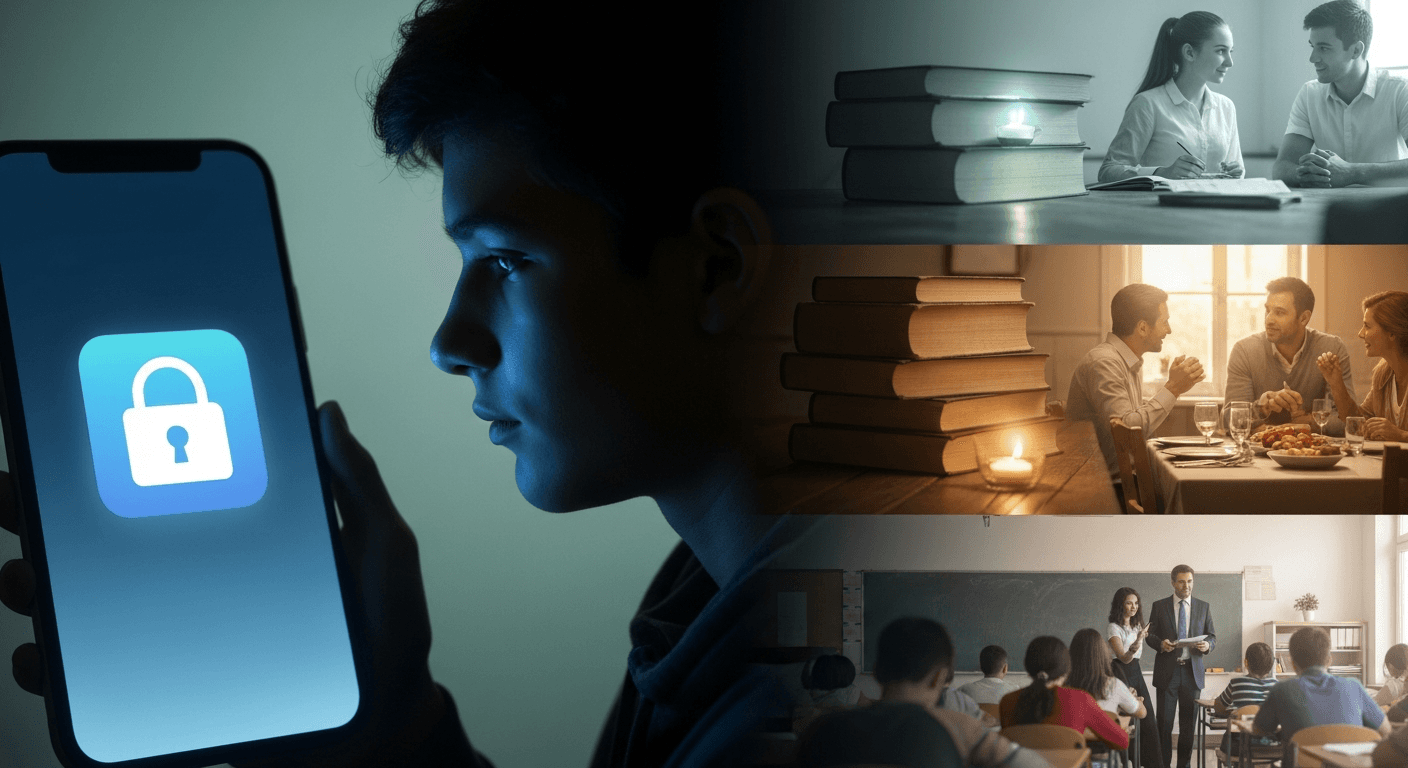
No Social Apps Till 16
I woke up to headlines that many parents and educators around the world have been watching closely: Malaysia has moved to limit social media access for anyone under 16. As someone who thinks about how technology shapes childhood and civic life, I want to walk through what this policy means, why the government gave it, how different groups have reacted, and what families can do now.
Background: what the policy says (in broad strokes)
The recent Malaysian measure aims to prevent children under 16 from holding personal social media accounts on major platforms. The government framed this as a protective step — a way to reduce exposure to online harms, misinformation, and addictive design patterns. While the exact technical and legal mechanisms for enforcement are still being worked out, the policy signals a shift from the “children can be online with guidance” model to a stricter access control approach.
I’ve written before about the need to pair access limits with meaningful digital education; this is another moment when policy, product design, and family practices must align.
Why the government moved now
The Malaysian authorities have cited several motivations that mirror arguments seen elsewhere:
- Protecting children from harmful content, cyberbullying, and sexual exploitation.
- Reducing early exposure to addictive engagement mechanics and commercialized attention-harvesting.
- Slowing the spread of misinformation among impressionable users.
- Expressing a precautionary stance while international regulation debates continue.
These are legitimate concerns. They also raise immediate questions about effectiveness, proportionality, and unintended consequences.
Reactions: parents, teens, experts, and platforms
Parents: Reactions are mixed. Some parents welcome a clearer legal boundary and hope it simplifies family rules. Others worry about being cut off from tools teens use for school, social life, and self-expression.
Teens: Many feel frustrated—social media is integral to how peer groups form, share creativity, and organize. A ban risks pushing activity to less visible corners of the internet or prompting dishonest age misrepresentation.
Experts: Child psychologists and digital-safety researchers are split. Some applaud the precautionary approach to protect developing brains. Others warn that protection without education can be hollow; we must invest in media literacy and mental health resources if we want long-term benefits.
Platform companies: Tech platforms typically emphasize safety features and parental controls already in place and warn about the difficulty of age verification at scale. They also point to localized content moderation efforts and education programs they already fund.
Potential implications for youth mental health and development
There are two broad pathways to consider:
- Possible benefits
- Reduced exposure to harmful content and predatory contact.
- Fewer opportunities to compare oneself constantly with curated images, which can exacerbate anxiety and body-image issues.
- Possible harms or trade-offs
- Isolation from social circles that increasingly organize online, which can impact belonging and peer learning.
- Stigmatization of young people who are excluded from mainstream digital life.
- A false sense of security if kids simply migrate to unregulated services or use fake ages.
The central point: limiting access can reduce some risks but does not automatically build resilience, critical thinking, or mental-health supports.
Digital literacy and education: the missing half of many policies
A policy that blocks account creation without a parallel, well-funded effort to teach digital skills will likely underdeliver. Digital literacy should include:
- Critical evaluation of sources and misinformation.
- Understanding how algorithms shape attention.
- Skills for healthy online relationships and boundaries.
- Guidance on privacy, data footprints, and consent.
Families, schools, and platforms must collaborate; one actor acting alone cannot prepare a generation for a connected life.
Enforcement challenges
Turning an age-limit policy into reality faces practical friction:
- Age verification: Verifying age without invasive identity checks is hard and raises privacy trade-offs.
- Workarounds: VPNs, borrowed credentials, and false birthdates will be used.
- Cross-border services: Platforms operate across jurisdictions and may delay uniform compliance or exploit legal gray areas.
- Resource constraints: Moderation and technical enforcement require money and skilled personnel.
Policymakers must carefully weigh the privacy costs of stronger verification against the benefits of protection.
Comparisons: how other places have approached youth online safety
Countries and regions have tried different mixes of rules and incentives:
- Some jurisdictions emphasize age-appropriate design and data protection rules that force platforms to minimize data collection from minors.
- Others push for parental consent models or parental control defaults.
- A few countries use blunt restrictions for certain media or services, while many focus on education and platform accountability.
No single model has proven perfect; each balances rights, harms, and feasibility differently.
A balanced perspective
I’m sympathetic to efforts to protect children from clear harms, but I’m skeptical of bans that focus only on exclusion. The internet is already central to learning, creativity, and social life. Removing access without robust alternatives risks leaving kids unprepared and driven to clandestine corners of the web.
A balanced approach should combine several elements:
- Clear, enforceable protections for minors that minimize intrusive verification.
- Investment in digital literacy and school-based mental-health supports.
- Platform design changes that reduce addictive mechanics for young users.
- Practical parental supports and community-based programs.
Practical tips for families
- Talk early and often: Make conversations about online life normal, not punitive.
- Create a family media plan: Set shared expectations for screen time, platforms, and privacy.
- Teach critical thinking: Encourage skepticism about content, influencers, and viral trends.
- Use tools thoughtfully: Parental controls and device settings help, but they don’t replace guidance.
- Model behavior: Adults’ habits shape children’s norms around attention and empathy.
I believe rules matter, but so does teaching. If Malaysia’s policy prompts deeper public investment in education, support services, and safer product design, it could be a useful catalyst. If it simply cuts access without preparing kids for digital citizenship, we will have missed an opportunity.
Regards,
Hemen Parekh
Any questions / doubts / clarifications regarding this blog? Just ask (by typing or talking) my Virtual Avatar on the website embedded below. Then "Share" that to your friend on WhatsApp.
Get correct answer to any question asked by Shri Amitabh Bachchan on Kaun Banega Crorepati, faster than any contestant
Hello Candidates :
- For UPSC – IAS – IPS – IFS etc., exams, you must prepare to answer, essay type questions which test your General Knowledge / Sensitivity of current events
- If you have read this blog carefully , you should be able to answer the following question:
- Need help ? No problem . Following are two AI AGENTS where we have PRE-LOADED this question in their respective Question Boxes . All that you have to do is just click SUBMIT
- www.HemenParekh.ai { a SLM , powered by my own Digital Content of more than 50,000 + documents, written by me over past 60 years of my professional career }
- www.IndiaAGI.ai { a consortium of 3 LLMs which debate and deliver a CONSENSUS answer – and each gives its own answer as well ! }
- It is up to you to decide which answer is more comprehensive / nuanced ( For sheer amazement, click both SUBMIT buttons quickly, one after another ) Then share any answer with yourself / your friends ( using WhatsApp / Email ). Nothing stops you from submitting ( just copy / paste from your resource ), all those questions from last year’s UPSC exam paper as well !
- May be there are other online resources which too provide you answers to UPSC “ General Knowledge “ questions but only I provide you in 26 languages !




No comments:
Post a Comment