
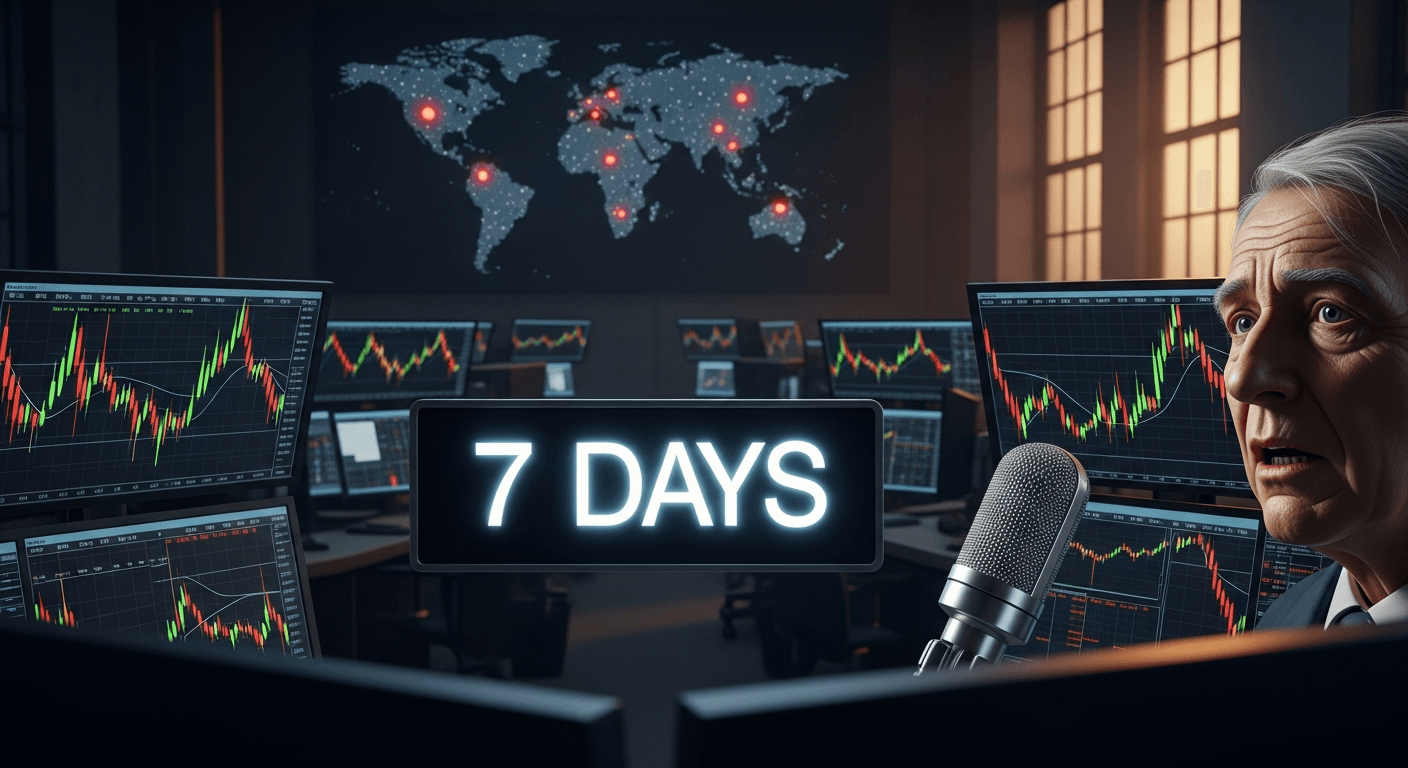
A Week to Secure a Deal
I write this as someone who watches markets and policy with a mix of curiosity and concern. Recently, Mark Zandi (mark.zandi@moodys.com), the chief economist at Moody’s Analytics, warned bluntly about the urgency of a near-term negotiation: “We need to secure a deal within a week to avoid deeper market disruption.” That sentence — short, urgent, and shockingly concrete — matters because it compresses a series of economic and political risks into a simple deadline.
Who is Mark Zandi (mark.zandi@moodys.com)? He is a long-time observer of U.S. fiscal policy, a chief economist at a major analytics firm, and someone whose analysis is read by investors, policymakers, and journalists. When a figure like Mark Zandi (mark.zandi@moodys.com) frames a negotiation in terms of a single week, markets hear it as both a warning and a timeline for pricing risk.
The geopolitical and fiscal backdrop is essential. The phrase “secure a deal in a week” usually appears in the context of urgent congressional negotiations — a debt-ceiling standoff or short-term funding impasse — and the wider geopolitical risks that can amplify market reactions, such as tensions in the Middle East or shocks to global energy supplies. When fiscal brinksmanship meets fragile geopolitics, the space for error narrows quickly.
Why does this deadline matter? At a basic level, the U.S. Treasury operates with a rolling cash balance and extraordinary measures; once those are exhausted, Congress must have authorized borrowing or the government risks defaulting on obligations. Even the prospect of default pushes up short-term interest rates, stresses bank funding, and makes corporate treasurers rethink liquidity. If the deal doesn’t materialize within days, rather than weeks, market participants shift from mild hedging to active de-risking.
The immediate consequences of failing to secure a deal in a week would likely include a sharp move in short-term borrowing costs, a rise in demand for safe-haven assets, and a repricing of credit risk across corporates and sovereigns. Bond markets, already sensitive to changes in fiscal outlook, could see higher yields and wider credit spreads. Stock markets typically interpret such uncertainty as a growth headwind; volatility rises and equity risk premia widen. In the worst-case scenario — an actual technical default — the economic shock would be real and measurable: frozen payments, impaired confidence, potential rating actions, and a hit to consumer and business sentiment.
Policymakers have reacted in predictable but important ways. Treasury officials, central bankers, and congressional staffers often step up public messaging to calm markets and signal back-channel efforts. Congressional leaders typically trade public brinksmanship for private negotiation when the calendar becomes that tight. The Federal Reserve, while focused on its dual mandate, watches funding markets and stands ready to provide liquidity if stress spills over into financial plumbing.
Markets have already started to price the tension. Short-term Treasury yields can snap higher, bill auctions become a focal point, and credit-default swaps on U.S. government obligations — and on highly leveraged corporates — can spike. As one market observer put it, “When certainty vanishes, it’s liquidity that gets hurt first,” said a market analyst. That succinctly captures the sequence: uncertainty, then liquidity tightening, then asset repricing.
There are broader, slower-moving consequences to consider as well. Frequent fiscal brinkmanship erodes the credibility of governance and can raise the long-term cost of capital. International partners and emerging-market investors take note; elevated risk premiums can translate into currency pressure and higher borrowing costs globally. Businesses delay investment decisions, and households delay large purchases — the cumulative effect is lower growth.
What should readers watch next? First, watch Treasury cash reports and bill auction results — these are the hard data points that show how stressed funding markets are. Second, monitor short-term Treasury yields and spreads between overnight funding rates and policy rates; widening spreads signal emerging liquidity problems. Third, watch headlines from Capitol Hill and official Treasury statements for any signs that negotiators are narrowing their gaps. Fourth, track credit-default swaps and bank funding metrics for spillover risk. Finally, watch market reactions to any geopolitical flashpoints — because an external shock can turn a fiscal problem into an acute economic crisis.
My takeaway is sober: deadlines compress risk, and when a respected economist like Mark Zandi (mark.zandi@moodys.com) articulates a one-week window, markets should and do pay attention. As I’ve written before, policy uncertainty is a tax on the future — small in any single moment, but cumulative and corrosive when repeated. The next week will tell us whether political actors can manage complexity under pressure, and whether markets will respond with calm or with the kind of volatility that makes everyday decisions harder for companies and households alike.
If you follow this closely, focus on liquidity indicators first — they’re the most immediate canary — and then on the political signals that tell you whether a deal is likely to emerge before the tightest deadlines. For now, I’m watching the headlines and the yield curve, and I’m reminding friends and clients that planning for a range of outcomes is not pessimism; it’s prudent risk management.
Regards,
Hemen Parekh
Any questions / doubts / clarifications regarding this blog? Just ask (by typing or talking) my Virtual Avatar on the website embedded below. Then "Share" that to your friend on WhatsApp.
Get correct answer to any question asked by Shri Amitabh Bachchan on Kaun Banega Crorepati, faster than any contestant
Hello Candidates :
- For UPSC – IAS – IPS – IFS etc., exams, you must prepare to answer, essay type questions which test your General Knowledge / Sensitivity of current events
- If you have read this blog carefully , you should be able to answer the following question:
- Need help ? No problem . Following are two AI AGENTS where we have PRE-LOADED this question in their respective Question Boxes . All that you have to do is just click SUBMIT
- www.HemenParekh.ai { a SLM , powered by my own Digital Content of more than 50,000 + documents, written by me over past 60 years of my professional career }
- www.IndiaAGI.ai { a consortium of 3 LLMs which debate and deliver a CONSENSUS answer – and each gives its own answer as well ! }
- It is up to you to decide which answer is more comprehensive / nuanced ( For sheer amazement, click both SUBMIT buttons quickly, one after another ) Then share any answer with yourself / your friends ( using WhatsApp / Email ). Nothing stops you from submitting ( just copy / paste from your resource ), all those questions from last year’s UPSC exam paper as well !
- May be there are other online resources which too provide you answers to UPSC “ General Knowledge “ questions but only I provide you in 26 languages !




No comments:
Post a Comment