
Thesis
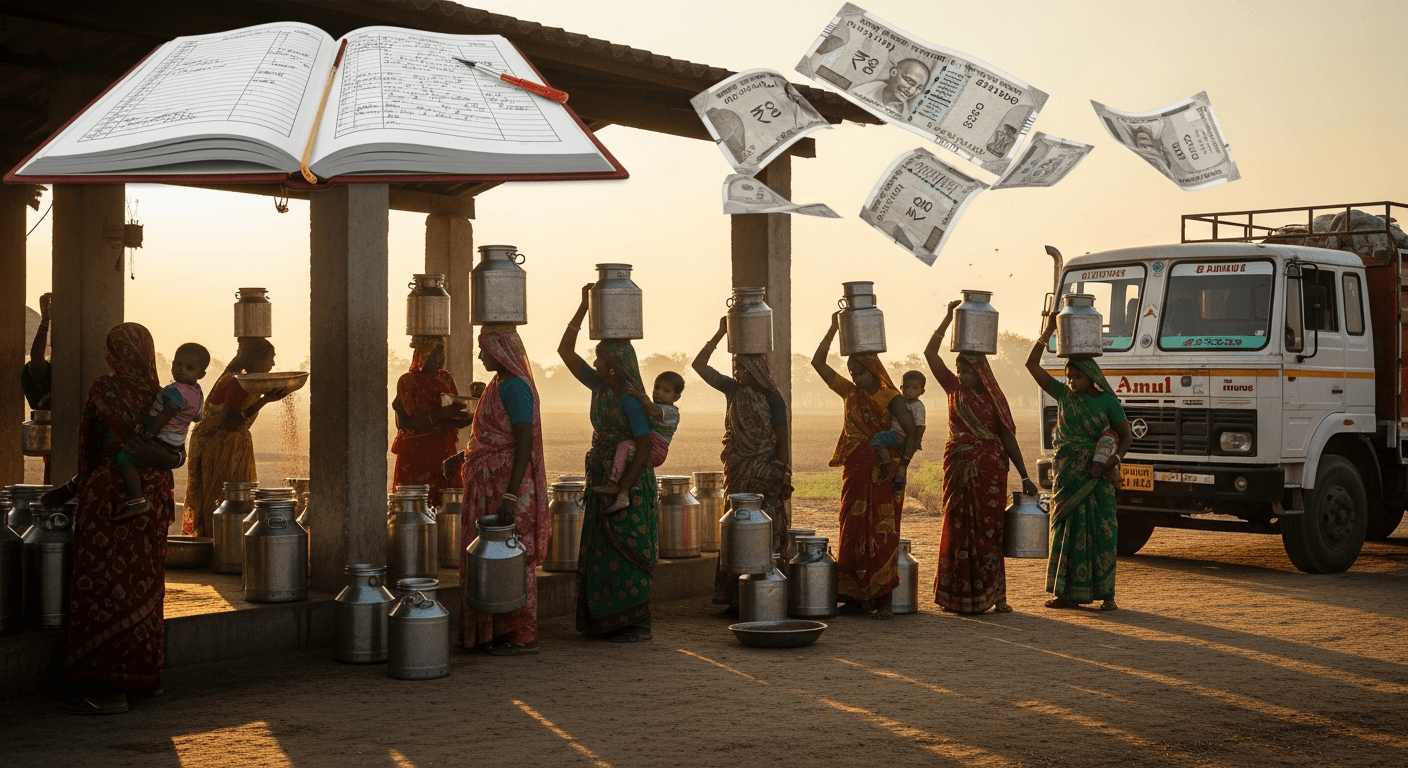
I believe India’s dairy sector must be the central lever in our national gender-justice agenda. Women already shoulder most of the everyday work of keeping India’s households fed and healthy; when policy and institutions deliberately shift control, recognition, and rewards to them, the payoffs are immediate, measurable, and transformative—for incomes, nutrition, and agency.
Why dairy? The evidence
- Scale and reach: India is the world’s largest milk producer, and dairy is one of the few agricultural activities that produces regular, predictable cash flow for smallholders (NDDB) (https://www.nddb.coop/). This regularity matters far more for women than lump-sum seasonal payments from crops.
- Women’s central role: Multiple international and Indian studies document that women provide a very large share of labour in smallholder dairy—care, milking, feeding, and processing—even when they are not the formal owners (FAO; IFAD) (https://www.fao.org/, https://www.ifad.org/).
- Poverty, nutrition, and control of income: When women control dairy income, household nutrition, especially for children, improves (IFPRI research on intra-household allocation). Regular milk income gives women bargaining power and predictable purchasing power, boosting food security (https://www.ifpri.org/).
- A proven institutional pathway: India’s cooperative movement (Operation Flood / cooperative model; Amul/Kaira model in Gujarat) created supply chains, cold storage, and market access that small producers—many of them women—still rely on. The cooperative format can be retooled explicitly for gender outcomes (NDDB history) (https://www.nddb.coop/about/mission/operation-flood, https://amul.com/).
How dairy shapes women’s economic and social empowerment
- Workload and unpaid care: Dairy work is often integrated into women’s unpaid household tasks. Without time-saving technologies or services (fodder supply, mechanized milking), women face long hours—reducing opportunities for paid work or civic participation (ILO/FAO analyses) (https://www.ilo.org/, https://www.fao.org/).
- Invisible labour and wages: In many households women do the work but payments for milk go to the male head’s account. This denies women independent income and formal recognition for their labour (gender studies on agricultural value chains) (see IFAD/FAO briefs) (https://www.ifad.org/, https://www.fao.org/).
- Land and asset rights: Dairy is attractive because it does not require large landholdings; yet asset ownership (cattle, sheds) is often legally or socially registered in men’s names. Without documented control, women cannot leverage assets for credit or social protection (World Bank gender studies) (https://www.worldbank.org/).
- Wages and value chain position: Women are overrepresented in low-value tasks (care, feeding, processing) and underrepresented in high-value positions (formal procurement, management, cooperative boards). This limits long-run earning and leadership opportunities (value-chain research) (https://www.ifpri.org/).
- Leadership and voice: Cooperative boards and dairy unions still have low representation of women in leadership roles, limiting the sector’s responsiveness to women’s needs (case analyses of Indian cooperatives) (https://www.nddb.coop/).
Indian examples and case studies
- Amul and Gujarat cooperatives: The cooperative model built after Operation Flood created market linkages that small producers could use. In Gujarat, women’s membership and participation have grown through producer groups and linked self-help groups (Amul history; NDDB overviews) (https://amul.com/, https://www.nddb.coop/).
- Self-Help Groups (SHGs) + dairy: In several states, linking women’s SHGs to dairy procurement and micro-dairy enterprises has increased income control and savings, and facilitated access to veterinary and extension services (IFAD and state program reports) (https://www.ifad.org/).
- Operation Flood’s legacy: Operation Flood built the cold-chain and cooperative architecture that still underpins rural milk markets. Re-orienting these institutions explicitly to benefit women is a pragmatic next step (NDDB Operation Flood overview) (https://www.nddb.coop/about/mission/operation-flood).
Potential objections and my responses
Objection: Dairy is environmentally unsustainable and should not be expanded.
Response: We should pursue a sustainable dairy strategy—improved feed efficiency, methane reduction, and better waste management—not abandon a sector that already supports millions of women. Climate-smart dairy and gender-just dairy can proceed together (FAO climate and livestock guides) (https://www.fao.org/).
Objection: Social norms prevent women from owning cattle or speaking in public forums.
Response: Norms are changeable. Policy levers—female-focused payments, quota-based board representation, and success stories from SHG-linked dairies—shift incentives and expectations faster than we assume. Practical proof (pilot projects) beats assumptions.
Objection: Implementing gender-focused reforms is administratively complex.
Response: The administrative infrastructure exists in cooperatives, banks, and SHGs. Simple, targeted changes—e.g., paying for milk into a named woman’s bank account, requiring female representation on procurement committees—are low-cost and high-impact.
Five concrete policy recommendations (actionable)
- Mandatory beneficiary-named payments: Require public procurement programs and cooperative milk procurement to credit payments to the woman producer’s bank/post office account where a woman is milk contributor. Link Aadhaar/Jan Dhan to make this auditable.
- Quotas for women’s leadership: Require a minimum 33% representation of women on cooperative boards and in procurement committees, with capacity-building budgets tied to this condition.
- Time-use and care services: Fund rural childcare, mechanised milking centers, and community fodder systems through a dedicated Gender-in-Dairy fund to reduce unpaid care and free women for economic activity.
- Asset registration and credit access: Subsidize cattle/asset registration in the name of the woman primary worker; link this to priority access to microcredit, livestock insurance, and extension services.
- Gender-disaggregated data and targets: Make all dairy-sector programs report gender-disaggregated outcomes (income, ownership, leadership), and tie performance-based grants to improvements in those indicators.
Conclusion and call to action
Dairy is not only an economic sector; it is infrastructure for social change. The conditions that currently marginalize women in dairying—unpaid labour, lack of formal claim on income, weak leadership representation—are correctable through policy. For policymakers, cooperatives, and civil-society leaders, the next five years should be about reprogramming the dairy architecture to recognize women as primary economic actors, not invisible workers. Pilot the five steps above in two high-potential districts in each dairy-rich state, measure nutrition and income outcomes in 18 months, and scale what works. If India is serious about gender justice, it should start where women already work—on the farm, at the cattle shed, and at the milk chillers.
Regards,
Hemen Parekh
Author bio
I am Hemen Parekh — entrepreneur, philanthropist and a student of how markets and institutions shape social outcomes. I write about practical policy pathways that deliver economic opportunity to those who contribute most but are rewarded least.
Any questions / doubts / clarifications regarding this blog? Just ask (by typing or talking) my Virtual Avatar on the website embedded below. Then "Share" that to your friend on WhatsApp.
Get correct answer to any question asked by Shri Amitabh Bachchan on Kaun Banega Crorepati, faster than any contestant
Hello Candidates :
- For UPSC – IAS – IPS – IFS etc., exams, you must prepare to answer, essay type questions which test your General Knowledge / Sensitivity of current events
- If you have read this blog carefully , you should be able to answer the following question:
- Need help ? No problem . Following are two AI AGENTS where we have PRE-LOADED this question in their respective Question Boxes . All that you have to do is just click SUBMIT
- www.HemenParekh.ai { a SLM , powered by my own Digital Content of more than 50,000 + documents, written by me over past 60 years of my professional career }
- www.IndiaAGI.ai { a consortium of 3 LLMs which debate and deliver a CONSENSUS answer – and each gives its own answer as well ! }
- It is up to you to decide which answer is more comprehensive / nuanced ( For sheer amazement, click both SUBMIT buttons quickly, one after another ) Then share any answer with yourself / your friends ( using WhatsApp / Email ). Nothing stops you from submitting ( just copy / paste from your resource ), all those questions from last year’s UPSC exam paper as well !
- May be there are other online resources which too provide you answers to UPSC “ General Knowledge “ questions but only I provide you in 26 languages !



No comments:
Post a Comment