
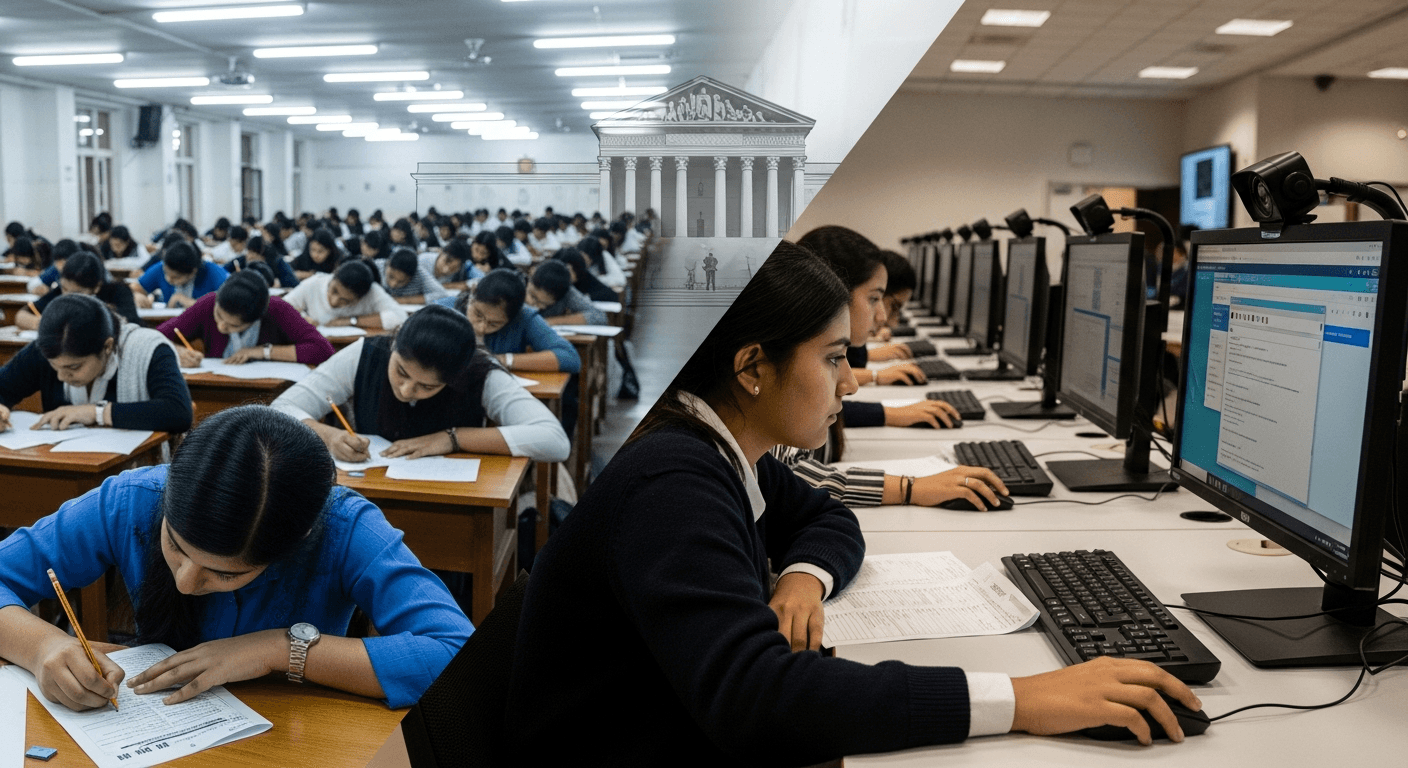
SC Rejects CBT For NEET Re‑examination
I’m writing to explain the Supreme Court’s recent decision to refuse a computer‑based test (CBT) option for the NEET re‑examination, and what it means for students, administrators and the larger exam system.
Background: what NEET is and why this matters
The National Eligibility‑cum‑Entrance Test (NEET) is India’s single national exam for undergraduate medical and dental admissions. Administered on a national scale, it determines entry into thousands of seats across central, state and private medical colleges. Because NEET consolidates admission across the country, any disruption to its delivery has wide ripple effects for students and institutions (background reporting: The Hindu; Indian Express).
Why a re‑examination was proposed
The re‑examination option emerged after a high‑profile paper security controversy that prompted complaints, investigations and multiple court petitions. In response to claims about compromised test integrity, authorities proposed a re‑exam to protect fairness for affected candidates and preserve public confidence in medical admissions (coverage: Times of India; NDTV).
What the Supreme Court decided — and why
The Supreme Court declined to order a shift to a full computer‑based test for the re‑examination. The bench’s reasoning, as the press has summarized, emphasised three practical concerns:
- Scalability and logistics: a sudden move to CBT for millions of candidates would require exam centres, secure hardware, proctoring and contingency plans that cannot be implemented at scale on short notice (reported in multiple outlets).
- Equality of access: many candidates come from regions with limited digital infrastructure; forcing CBT could disproportionately disadvantage those students and raise equal‑opportunity concerns.
- Maintaining comparability: the court noted that switching format at the eleventh hour could itself introduce new fairness issues — digital familiarity, interface glitches and unequal testing environments could affect outcomes.
Taken together, these points led the court to favour continuity in the test format while the broader systemic issues are addressed (analysis: Hindustan Times).
Implications for students
For affected candidates the decision is a mixed outcome. On one hand, a pen‑and‑paper re‑exam preserves familiar conditions for many. On the other, students and families who had hoped CBT would reduce paper‑handling vulnerabilities now face uncertainty about whether the underlying security problems will be solved.
Practical consequences include:
- Short‑term anxiety over timelines for the re‑exam and for admission cycles.
- Logistical pressures for students (travel to designated centres, health and accommodation) and for institutions scrambling to re‑schedule processes.
- Continued calls from some student groups for long‑term digital options that could reduce certain leak vectors.
Legal and administrative consequences
Legally, the decision reduces the likelihood of an immediate, large‑scale format change via court order, but it does not close avenues for future reform. Administratively, the National Testing Agency (NTA) and the health and education ministries are now under pressure to: tighten paper‑security protocols, upgrade monitoring, and present a credible roadmap for modernization without compromising access.
Expect more petitions and policy reviews — litigants can still seek remedial measures or alternative relief. Regulators may face new directives to publish timelines for any phased move to CBT or hybrid models (reports: Indian Express; The Hindu).
Reactions from stakeholders
- Students: mixed. Many welcomed a familiar pen‑and‑paper format for fairness; others worry that repeating the same format without deep reforms leaves security risks unaddressed (student group statements cited in local press).
- Universities and colleges: anxious about compressed admission timelines and the administrative burden of accommodating delays.
- Government and exam authorities: signaling that reform is needed but warning that CBT requires careful phasing, infrastructure investment and pilot testing before national rollout (official comments summarized in media reports).
Possible next steps
I expect a few parallel tracks to develop:
- Short term: conduct the re‑exam in the existing format with strengthened security and close monitoring.
- Medium term: pilot CBT in limited regions or for smaller exams, while investing in infrastructure and accessibility measures.
- Long term: a statutory or regulatory framework that governs format changes, data security, proctoring standards and contingency protocols.
Expert commentary on exam design and fairness
Exam design experts I’ve followed argue that fairness is not only about format but about equitable access and rigorous psychometric design. CBT can help by randomizing items and logging candidate activity, but it requires time to build resilient systems, run item‑calibration, and remove bias. Conversely, pen‑and‑paper tests remain viable if logistics — secure printing, transportation, and centre management — are professionally overhauled (opinion pieces: Economic Times; education policy journals).
Where I’ve discussed this before
I’ve written earlier about the debate over pen‑and‑paper versus online testing and the need for phased experimentation before national roll‑outs (see my earlier piece on exam modes). For context and ideas about phased transition and hybrid models, readers can see my previous reflections on exam modernization (My earlier post on online testing and NEET reforms).
Conclusion
The Supreme Court’s refusal to mandate CBT for the NEET re‑examination is less an endorsement of paper‑based testing than a call for deliberate, well‑resourced reform. The immediate priority should be ensuring the re‑exam is secure, timely and fair; the medium‑term priority must be building the infrastructure and legal frameworks needed for any future move to CBT.
Regards,
Hemen Parekh
Any questions / doubts / clarifications regarding this blog? Just ask (by typing or talking) my Virtual Avatar on the website embedded below. Then "Share" that to your friend on WhatsApp.
Get correct answer to any question asked by Shri Amitabh Bachchan on Kaun Banega Crorepati, faster than any contestant
Hello Candidates :
- For UPSC – IAS – IPS – IFS etc., exams, you must prepare to answer, essay type questions which test your General Knowledge / Sensitivity of current events
- If you have read this blog carefully , you should be able to answer the following question:
- Need help ? No problem . Following are two AI AGENTS where we have PRE-LOADED this question in their respective Question Boxes . All that you have to do is just click SUBMIT
- www.HemenParekh.ai { a SLM , powered by my own Digital Content of more than 50,000 + documents, written by me over past 60 years of my professional career }
- www.IndiaAGI.ai { a consortium of 3 LLMs which debate and deliver a CONSENSUS answer – and each gives its own answer as well ! }
- It is up to you to decide which answer is more comprehensive / nuanced ( For sheer amazement, click both SUBMIT buttons quickly, one after another ) Then share any answer with yourself / your friends ( using WhatsApp / Email ). Nothing stops you from submitting ( just copy / paste from your resource ), all those questions from last year’s UPSC exam paper as well !
- May be there are other online resources which too provide you answers to UPSC “ General Knowledge “ questions but only I provide you in 26 languages !


No comments:
Post a Comment