
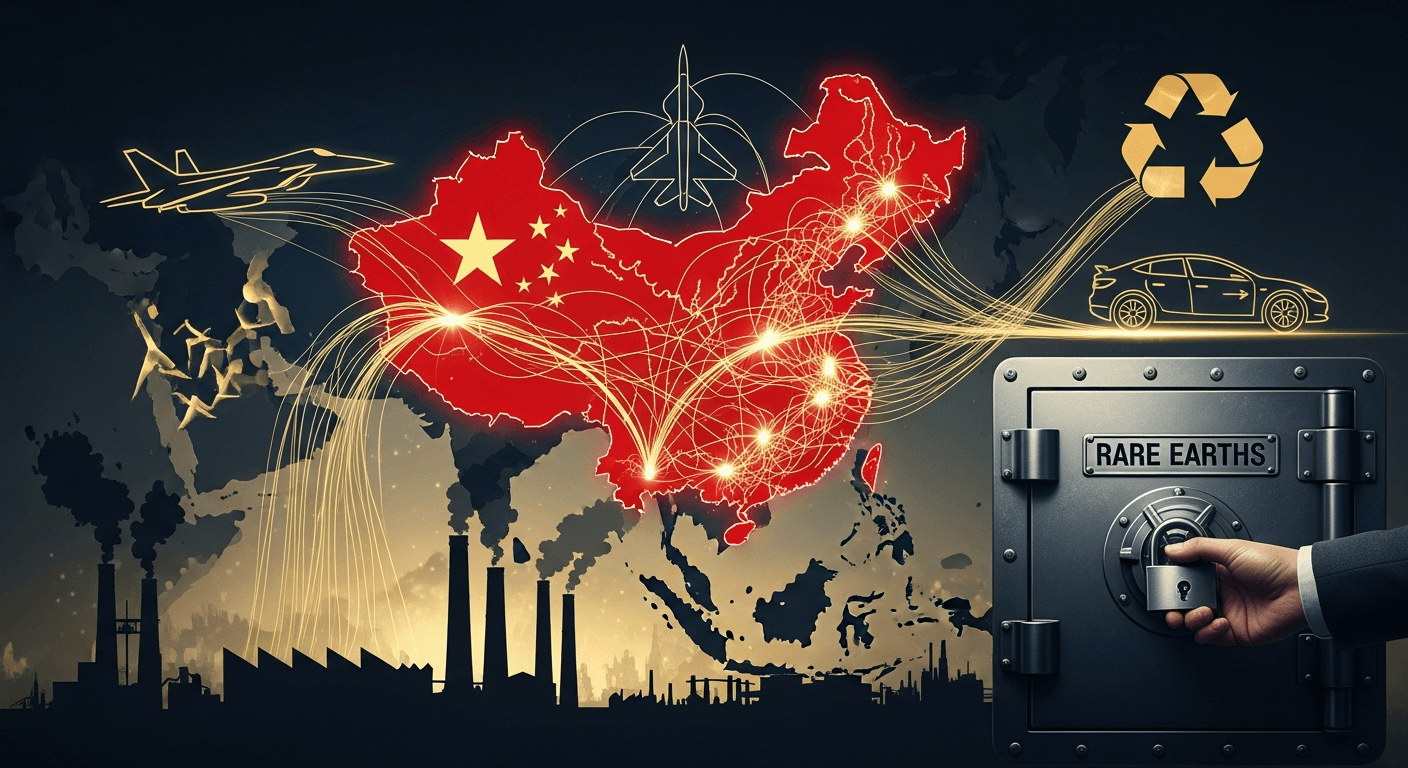
I watched Dhea Eapen break down the October 9 announcement and felt the urgency immediately. This isn’t a narrow minerals policy: it’s an extension of industrial geopolitics that reaches fighter jets, electric vehicles, wind turbines and the chips that power AI.
What China announced on Oct 9
On October 9, Beijing’s Ministry of Commerce expanded export controls to cover not just a wider list of rare-earth elements but also the technologies, equipment and know‑how used to mine, separate, refine and manufacture magnets and related components. Key elements of the announcement included:
- Licensing requirements for exports of materials and finished goods containing even small shares of China-sourced rare earths (thresholds like 0.1% have been reported).
- Controls extended from raw ores to technologies and production processes — designs, process parameters and even services tied to rare-earth production may require permission.
- A stated national-security rationale: exports that could be used in military systems or sensitive high-tech sectors will be refused or tightly reviewed.
The new measures don’t all take effect at once, but the signal is clear: Beijing is treating rare earths as strategic leverage.
Why rare earths matter (defense, EVs, green tech)
Rare earths are a family of 17 elements whose special magnetic, optical and electronic properties are hard to substitute. Their uses span:
- Defense: guided munitions, radar, sonar, precision motors, and many avionics components rely on rare-earth magnets and alloys.
- Electric vehicles (EVs): high-performance permanent magnets (NdFeB) enable compact, efficient motors and contribute to range and performance.
- Clean energy: wind-turbine generators, efficient motors, and certain battery and catalyst technologies use rare-earth-derived materials.
Put simply: rare earths are small inputs with outsized strategic value. Disruptions matter because processing — not just mining — is where concentration exists: China controls the lion’s share of separation and magnet manufacturing.
Global impact and supply chain shocks
This announcement tightens a choke point. Short-term impacts include:
- Hold-ups for manufacturers who rely on Chinese-processed inputs or on Chinese technologies used abroad.
- Price spikes and panic buying for certain high-value elements (e.g., dysprosium, terbium) used in magnets and defense systems.
- Increased paperwork and licensing friction for multinational supply chains — which can slow deliveries of EVs, consumer electronics and defense components.
Mid-term, we should expect:
- Accelerated reshoring and diversification plans by firms and governments.
- A scramble to lock long-term contracts or captive supplies outside China, plus investments in recycling and substitution.
Analysts note this move is both a bargaining chip and a structural attempt to preserve China’s edge in refining and magnet manufacturing.
Responses: U.S., India, others
Governments have several levers: stockpiling, incentives for domestic processing, diplomatic outreach, and coordinated trade measures.
U.S.: Expect accelerated funding for domestic separation and magnet facilities, tighter export controls in reciprocity, and strategic stockpiles for defense-critical elements. The U.S. has been aware of the vulnerability and has signaled programs to build capacity, but scaling separation and magnet manufacturing takes time.
India: New Delhi has an opportunity to deepen mineral diplomacy with Australia, Africa and the U.S., and to speed investments in processing and recycling. India’s policy moves will likely combine procurement of upstream supplies with incentives for downstream manufacturing.
Other actors: Japan, the EU and Australia will prioritize diversification, technology transfer, and joint ventures for processing. Private-sector responses will include vertical integration and stronger sourcing clauses in contracts.
Throughout this, communicators like Dhea Eapen are doing critical public translation — explaining the policy mechanics in plain terms.
Can dependence be reduced?
Short answer: yes — but not quickly or cheaply.
Paths to reduce dependence:
- Diversify mining and processing hubs: build separation plants outside China and finance them at scale. This is capital- and time‑intensive.
- Invest in recycling: urban mining of magnets from end-of-life electronics and EV motors can recover rare earths, faster than building new mines.
- Substitute and redesign: engineering work can reduce reliance on heavy rare earths in some applications, though trade-offs in performance and cost exist.
- Strategic alliances: shared investments and trade agreements can pool demand and underwriting, making new processing commercially viable.
All of these require policy will, industrial incentives, and multiyear timelines. The real question is political: will democracies treat rare-earth capacity as infrastructure deserving the same urgency as semiconductors?
Conclusion — a call to discussion
China’s October 9 measures are a reminder that minerals policy is national security policy. I don’t believe there’s a quick fix, but I do believe there’s a path: combine recycling, targeted investment, and diplomacy to build resilient alternatives. I’m curious what others see as the fastest, highest-leverage steps.
Join the conversation — and watch the clear explainer from Dhea Eapen if you want a concise breakdown.
Regards,
Hemen Parekh
Any questions / doubts / clarifications regarding this blog? Just ask (by typing or talking) my Virtual Avatar on the website embedded below. Then "Share" that to your friend on WhatsApp.
rareearths #supplychain #China #EVs #defense #criticalminerals
Get correct answer to any question asked by Shri Amitabh Bachchan on Kaun Banega Crorepati, faster than any contestant
Hello Candidates :
- For UPSC – IAS – IPS – IFS etc., exams, you must prepare to answer, essay type questions which test your General Knowledge / Sensitivity of current events
- If you have read this blog carefully , you should be able to answer the following question:
- Need help ? No problem . Following are two AI AGENTS where we have PRE-LOADED this question in their respective Question Boxes . All that you have to do is just click SUBMIT
- www.HemenParekh.ai { a SLM , powered by my own Digital Content of more than 50,000 + documents, written by me over past 60 years of my professional career }
- www.IndiaAGI.ai { a consortium of 3 LLMs which debate and deliver a CONSENSUS answer – and each gives its own answer as well ! }
- It is up to you to decide which answer is more comprehensive / nuanced ( For sheer amazement, click both SUBMIT buttons quickly, one after another ) Then share any answer with yourself / your friends ( using WhatsApp / Email ). Nothing stops you from submitting ( just copy / paste from your resource ), all those questions from last year’s UPSC exam paper as well !
- May be there are other online resources which too provide you answers to UPSC “ General Knowledge “ questions but only I provide you in 26 languages !




No comments:
Post a Comment