
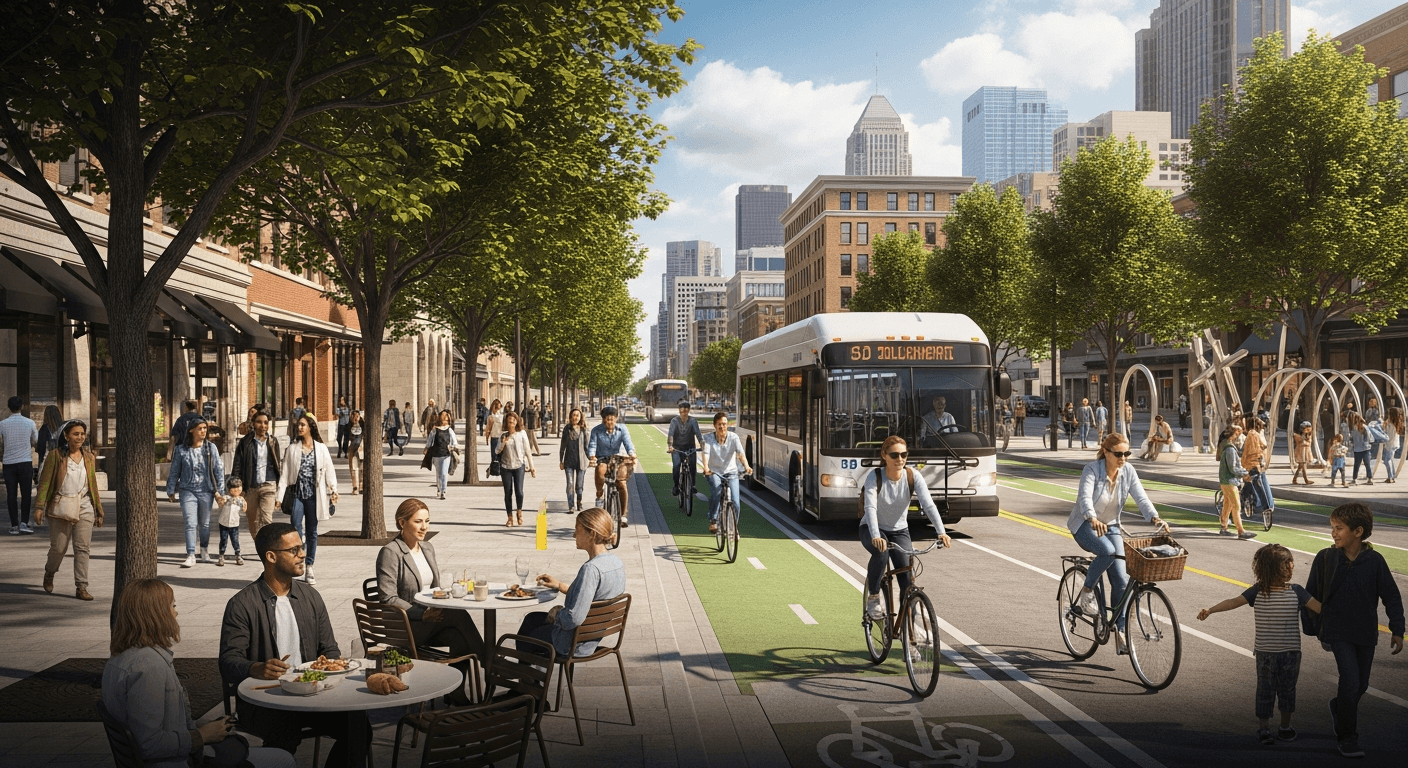
I used to assume road capacity was the raw material of mobility. Then I started looking at outcomes: healthier residents, quieter streets, lower emissions, more resilient local economies. That reframes the question: if the goal is to move people efficiently and equitably, why are most cities still designed first for vehicles?
Why design for people?
When we prioritise people over vehicles we get predictable, measurable wins: more walking and cycling, fewer collisions, lower pollution, and better public life. Copenhagen and Amsterdam show that investment in protected bike lanes and pedestrian-first streets produces sustained modal shifts and satisfaction among residents Copenhagen Bicycle Account 2022 and Amsterdam cycling summaries. Barcelona’s Superblock study estimated that a city-scale shift to people-centred streets could prevent hundreds of premature deaths and add months to population life expectancy through reductions in NO2, noise, and urban heat Barcelona Superblocks HIA.
Real-world proof: Bogotá and Barcelona
Bogotá’s Ciclovía and network of ciclorrutas are not just symbolic; they changed mobility options for millions and created space for exercise and community every week. Evaluations show increased physical activity and measurable benefits to lower-income residents who access the routes, though distributional gaps remain and require active policy to close (Ciclovía studies and reviews, summary of TransMilenio and ciclorrutas impacts in technical reviews). Barcelona’s Superblock pilots show large health gains where traffic is actually reduced, but also demonstrate that partial or poorly connected implementations can redistribute traffic and blunt benefits—so design has to be systemic, not piecemeal Superblock evaluations.
Principles that change outcomes
- Prioritise continuous, safe walking and cycling networks over isolated facilities. People need routes that feel and are safe for all ages and abilities.
- Reallocate street space to make transit faster and more reliable: protected bus lanes and high-frequency service move far more people than extra through-lanes for cars.
- Design interventions to work at network scale: local pedestrianisation without citywide traffic demand measures can simply push cars elsewhere.
- Measure and iterate: count users, air quality, noise, traffic injuries and economic indicators so decisions are evidence-driven.
A practical blueprint (actionable steps)
Short term (0–2 years)
Repaint to create protected bike lanes on core corridors and remove curbside parking where it blocks movement.
Convert one or two high-demand streets to transit-priority with dedicated lanes and upgraded stops.
Launch weekly open-street days (Ciclovía-style) to build public appetite and test routings.
Medium term (2–5 years)
Build continuous sidewalks, pedestrian crossings, curb ramps and lighting improvements to ensure accessibility.
Implement signal priority for buses and cycle superhighways where counts justify them.
Enforce low-speed limits (20 km/h) in residential areas and Superblock-style interior streets.
Long term (5+ years)
Integrate pricing or demand-management (congestion charges, parking reforms) with reinvestment in walking, cycling and transit.
Retrofit arterial streets with protected, separated walking/cycling space and tree canopy to reduce heat and pollution.
Embed accessibility audits and community-led planning in every project phase.
Accessibility and equity considerations
Designing for people must be explicitly pro-equity. Evidence from Bogotá and other programs shows that simply adding amenities can privilege wealthier areas unless planners intentionally locate routes and programming where underserved communities live (equity analysis of Ciclovía access). Equity measures to adopt:
- Map access by income, age, disability and gender and prioritise interventions where gaps are largest.
- Provide guarded bike parking, low-cost bike-share and safe links to transit for peripheral neighborhoods.
- Include universal-design curb ramps, tactile paving and audible signals so people with disabilities gain, not lose, access.
- Protect affordability: pair public-space upgrades with anti-displacement measures (rent protections, community land trusts) so improvements don’t price residents out.
What to expect—and how to defend change
Expect pushback: drivers, merchants worried about parking, and political cycles create friction. Defend change with data and small wins: pilot projects, before/after counts, and local business surveys usually show that people-friendly streets increase footfall and spend. Use health and climate co-benefits in communications: cleaner air, fewer injuries, and stronger neighbourhood commerce are arguments that cross constituencies.
Conclusion: a call to action
Cities that move people, not vehicles, are healthier, more resilient and more just. The evidence is clear: connected networks, transit priority, and reclaimed public space deliver measurable benefits. If you’re a planner, advocate or mayoral advisor, start with pilots that are measurable, protect accessibility and explicitly target equity.
Regards,
Hemen Parekh
Any questions / doubts / clarifications regarding this blog? Just ask (by typing or talking) my Virtual Avatar on the website embedded below. Then "Share" that to your friend on WhatsApp.
Word count: 895 words.
Get correct answer to any question asked by Shri Amitabh Bachchan on Kaun Banega Crorepati, faster than any contestant
Hello Candidates :
- For UPSC – IAS – IPS – IFS etc., exams, you must prepare to answer, essay type questions which test your General Knowledge / Sensitivity of current events
- If you have read this blog carefully , you should be able to answer the following question:
- Need help ? No problem . Following are two AI AGENTS where we have PRE-LOADED this question in their respective Question Boxes . All that you have to do is just click SUBMIT
- www.HemenParekh.ai { a SLM , powered by my own Digital Content of more than 50,000 + documents, written by me over past 60 years of my professional career }
- www.IndiaAGI.ai { a consortium of 3 LLMs which debate and deliver a CONSENSUS answer – and each gives its own answer as well ! }
- It is up to you to decide which answer is more comprehensive / nuanced ( For sheer amazement, click both SUBMIT buttons quickly, one after another ) Then share any answer with yourself / your friends ( using WhatsApp / Email ). Nothing stops you from submitting ( just copy / paste from your resource ), all those questions from last year’s UPSC exam paper as well !
- May be there are other online resources which too provide you answers to UPSC “ General Knowledge “ questions but only I provide you in 26 languages !



No comments:
Post a Comment