
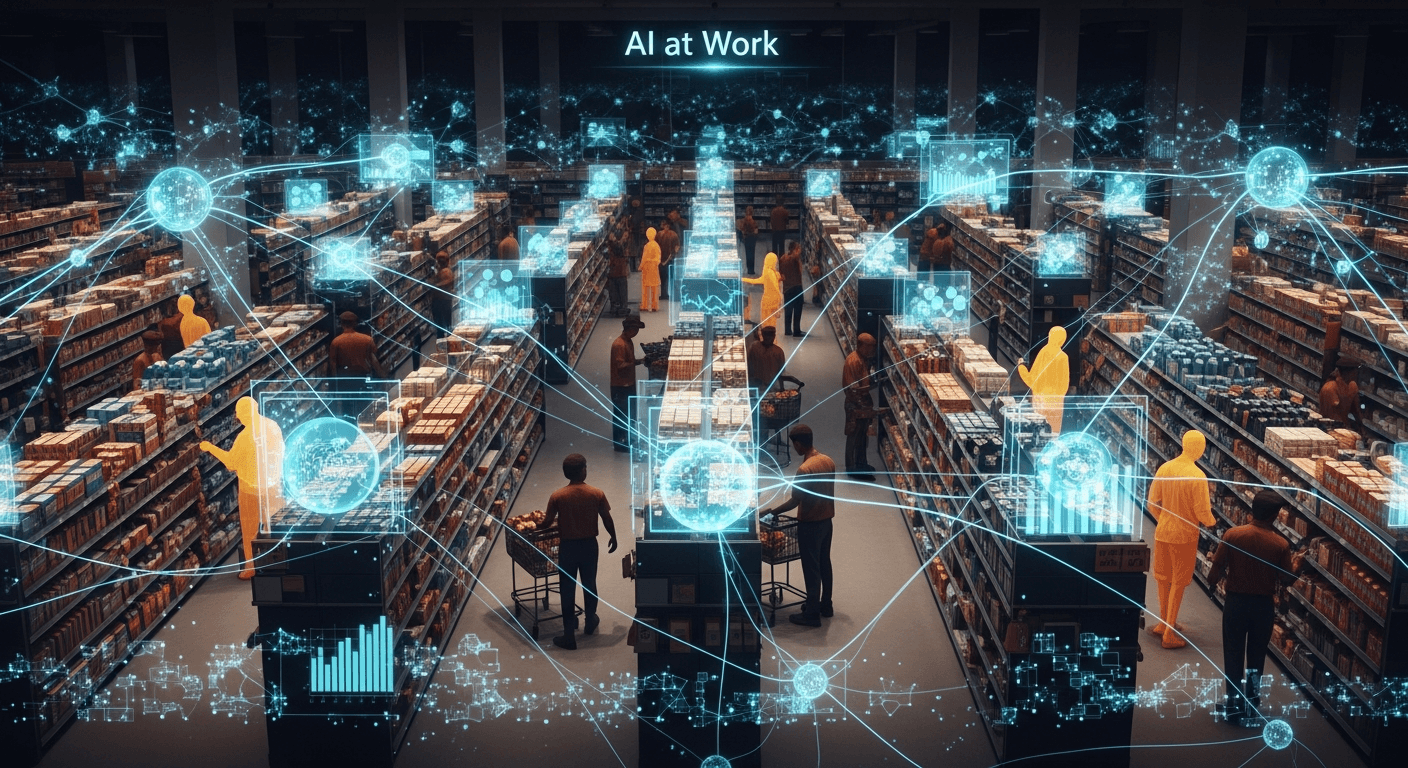
I watched the recent vote at Walmart with a mix of frustration and curiosity. A shareholder proposal asking the company to produce a report explaining how AI and automation would affect its roughly 1.6 million associates was presented but did not carry. The resolution — filed by investor and advocacy groups and described in public filings — asked for clarity on principles, metrics, and governance around AI deployment in workforce-facing systems. You can read the request in the Interfaith Center on Corporate Responsibility (ICCR) filing here: Workforce Implications of Adoption of AI & Automation.
What happened (the simple explanation)
- The company’s proxy materials showed the shareholder proposal as "Proposal No. 8: Report on Workforce Impact of AI and Automation" and the Board recommended voting against it (Walmart 2026 Proxy Statement).
- At the meeting, shareholders did not approve the proposal. The company’s filings and public proxy materials make clear the board opposed the resolution and that it failed to gain a majority.
I listened to management’s framing as well: the company has publicly describedAI investments and internal programs to train associates, and management emphasizes a technology-first path that they argue will raise productivity and support jobs. That messaging is visible in Walmart’s public reports and press materials (see Walmart’s 2026 proxy and annual report).
Note: When I refer to Walmart’s leadership I quote or link to source documents rather than paraphrase private remarks—see Walmart’s public proxy and press materials linked above.
Why shareholders rejected the report
There are a few plausible reasons — and they matter:
Board and management opposition. The Board explicitly recommended voting against the report in the proxy; many institutional investors follow management recommendations unless there is an especially strong countervailing case. See the company’s proxy summary for the Board’s position (Walmart 2026 Proxy Statement).
Perception of redundancy or proprietary risk. Companies often argue that public reporting on operational AI could reveal trade secrets or duplicate internal compliance work — an argument that can persuade risk-focused investors.
Investor priorities. Many large holders prioritize short-to-medium term financial returns and may be skeptical of added disclosure mandates unless they clearly improve shareholder value or reduce material risk.
Engagement instead of mandate. Management frequently emphasizes ongoing engagement with investors and third-party audits rather than one-off shareholdermandated disclosures.
The implications for employees and corporate transparency
This vote matters for three interlocking reasons:
- Scale and consequence. Walmart’s U.S. workforce measures in the millions. AI-driven decisions about scheduling, hiring, performance and pay have outsized social and economic effects at that scale.
- Transparency gap. A declined shareholder resolution leaves questions unanswered publicly: what metrics are used to measure workforce impacts, how are biases mitigated, and how does AI alter job pathways?
- Precedent for other companies. When the largest private employers resist standardized disclosure, it slows broader market signals that would let employees, suppliers, and regulators compare practices.
Risks and benefits of Walmart-style AI deployment
Benefits:
- Productivity and better inventory/customer experiences when AI is used thoughtfully.
- Potential for targeted training programs — the company has announced large-scale AI training for associates in recent public communications.
Risks:
- Deskilling and job redesign that reduce hours or push work to algorithmic systems.
- Algorithmic bias affecting hiring, pay, and promotion decisions.
- Speed of change outpacing worker protections, training, and social safety nets.
These balance of these trade-offs is precisely what the shareholder report sought to illuminate.
The regulatory and market context
U.S. regulation on workplace AI remains nascent. Some jurisdictions and sector-specific guidance are emerging, but there’s no standardized requirement for companies to disclose workforce impact metrics tied to AI. That regulatory gap makes shareholder proposals one of the few avenues investors and employees use to demand structured disclosure.
What companies might do next — and what Walmart could do
- Publish a workforce-facing AI primer: high-level principles, governance (who signs off on deployments), and non-proprietary metrics (e.g., training hours, share of roles modified, wage impact bands).
- Create independent audits: third-party reviews of algorithmic systems for bias and safety that yield redacted public summaries.
- Commit to worker transition support: explicit, funded retraining, mobility pathways and impact mitigation tied to deployments.
If Walmart took any of the above voluntarily and published the results, it would undercut the logic for mandatory disclosure while building trust.
Actionable takeaways
For employees:
- Ask HR and your manager for concrete details: which tools affect your role, who to contact, and what training is available.
- Organize practical requests (clear notice of algorithmic decisions, appeal channels, training guarantees).
For investors:
- Demand non-proprietary workforce metrics in ESG and risk reports (training uptake, hours affected, governance structures).
- Use engagement to push for third-party assurance of algorithmic fairness.
For policymakers:
- Prioritize standards for algorithmic transparency in employment decisions and fund worker-centered transition programs.
- Consider minimum disclosure requirements that protect intellectual property while providing comparable workforce impact information.
Final thought
Voting down a disclosure request is not the same as rejecting accountability. It is a signal that the path to transparency will be negotiated, not mandated overnight. But when AI systems touch millions of livelihoods, the default cannot be silence. Investors, workers, and regulators all have leverage — it’s time to use it productively.
Sources & attribution
- Walmart Inc., 2026 Proxy Statement and related filings: https://stock.walmart.com/assets/ab22259f8a4ca1a601444c7adc401ed9/walmart/db/950/9988/proxy_statement/2026+Proxy+Statement.pdf
- ICCR resolution: Workforce Implications of Adoption of AI & Automation — https://www.iccr.org/resolutions/workforce-implications-of-adoption-of-ai-automation/
- Walmart corporate newsroom and annual report pages cited in proxy materials: https://corporate.walmart.com/news
Regards,
Hemen Parekh
Any questions / doubts / clarifications regarding this blog? Just ask (by typing or talking) my Virtual Avatar on the website embedded below. Then "Share" that to your friend on WhatsApp.
Get correct answer to any question asked by Shri Amitabh Bachchan on Kaun Banega Crorepati, faster than any contestant
Hello Candidates :
- For UPSC – IAS – IPS – IFS etc., exams, you must prepare to answer, essay type questions which test your General Knowledge / Sensitivity of current events
- If you have read this blog carefully , you should be able to answer the following question:
- Need help ? No problem . Following are two AI AGENTS where we have PRE-LOADED this question in their respective Question Boxes . All that you have to do is just click SUBMIT
- www.HemenParekh.ai { a SLM , powered by my own Digital Content of more than 50,000 + documents, written by me over past 60 years of my professional career }
- www.IndiaAGI.ai { a consortium of 3 LLMs which debate and deliver a CONSENSUS answer – and each gives its own answer as well ! }
- It is up to you to decide which answer is more comprehensive / nuanced ( For sheer amazement, click both SUBMIT buttons quickly, one after another ) Then share any answer with yourself / your friends ( using WhatsApp / Email ). Nothing stops you from submitting ( just copy / paste from your resource ), all those questions from last year’s UPSC exam paper as well !
- May be there are other online resources which too provide you answers to UPSC “ General Knowledge “ questions but only I provide you in 26 languages !



No comments:
Post a Comment