
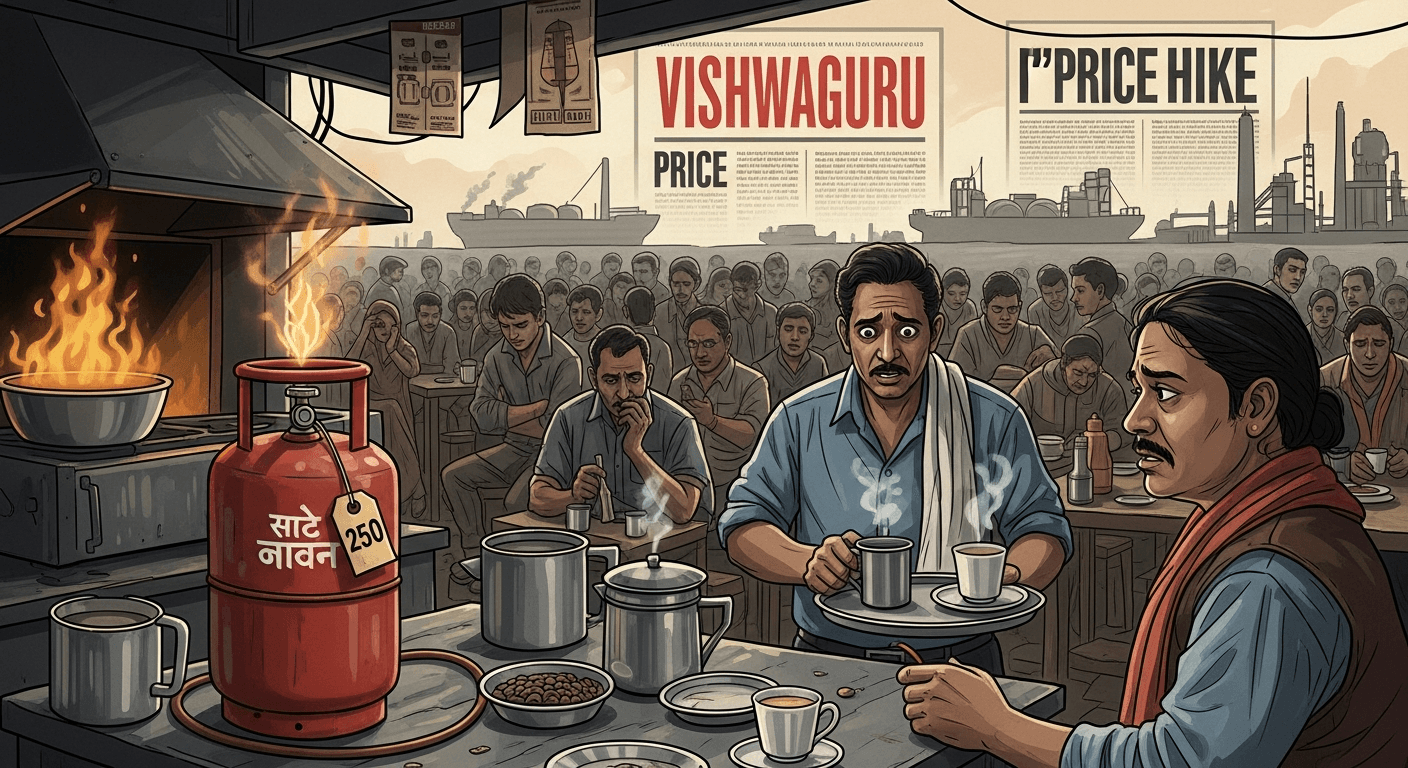
I woke up to headlines that read like déjà vu: domestic LPG prices nudged higher by ₹29 a cylinder, while the broader context of rising global energy costs and election-timed politics made the story feel bigger than the number itself. I want to step back from the spin and look at what happened, who pays, and what comes next — without the usual partisan shorthand.
What changed, precisely
- From June 7 the price of a 14.2-kg domestic LPG cylinder in Delhi moves from ₹913 to ₹942, a ₹29 increase source.
- This is the second household-price revision in three months; earlier, in March, there was a ₹60 increase. Commercial and free-trade (5-kg) cylinders have seen larger, more volatile adjustments in recent months.
These figures matter because domestic cylinders are used by tens of millions of households and are the visible face of energy affordability for most families. Even small monthly increases compound into meaningful pressure on budgets for low- and middle-income homes.
Why prices rose: a short explainer
- India imports a substantial share of its LPG and is exposed to international benchmarks and currency movements.
- Geopolitical tensions in West Asia pushed global energy prices up, which tightened margins for state-run oil marketing companies (OMCs). Industry sources estimated significant pre-revision losses per cylinder, prompting a partial pass-through to consumers source.
- The government has not carried a full pass-through; officials say they have absorbed part of the cost to shield households, which itself has fiscal consequences.
The political frame: why the Opposition seized the line
The Opposition described the rise as evidence that the narrative of India as a global leader (the «Vishwaguru» tagline in public discourse) is hollow if ordinary citizens face rising prices at home. They used pointed slogans — for many opposition parties, the timing of successive hikes (some clustered around or after elections) has been emphasised as politically consequential, with critics calling the increases an "election bill".
On the other side, the Centre and public-sector industry voices stress operational realities: volatile international procurement costs, a desire to protect domestic consumers by absorbing some losses, and steps taken to ensure supplies remain available. Officials have asked state-run retailers to build buffer stocks and co-ordinate with states to prevent disruption source.
How this filters down to daily life
- Small eateries, tiffin services, hostels and street-food vendors rely on commercial or FTL cylinders; their costs have risen more sharply and can transmit inflation into food prices.
- For household consumers, the direct arithmetic looks modest per day — but cumulative impact across months and the interplay with other rising items (transport, electricity, food staples) is what pushes household stress higher.
- Vulnerable groups with irregular incomes or those who spend a large share on food and fuel feel the change disproportionately.
Reactions from the ground and experts
Reported coverage shows a mix of anger and alarm from vendor groups and regional political actors who warned of protests and urged relief measures. Analysts and industry commentators have emphasised two technical points:
- buffer stocks and diversified procurement (including long-term contracts) are stabilising levers; and
- partial absorption of international price shocks by the state can buy political time, but it is fiscal-expensive if prolonged.
The government’s instruction to OMCs to hold around 30 days of LPG reserves is a direct operational response aimed at preventing supply shocks and hoarding source.
Why subsidies and accounting matter
- Domestic cylinders in India are not fully market-priced for political, social and equity reasons; subsidy design and fiscal support determine how much of a global price spike is felt locally.
- When state retailers absorb losses, it shows up in their balance sheets and, indirectly, the fiscal math. That can limit the state’s ability to absorb future shocks or provide other social spending.
Political implications and next steps
- Short term: expect more rhetoric, targeted protests in urban centres where commercial LPG users cluster, and renewed pressure on the government to either reverse the hike or provide relief to the most affected micro-enterprises.
- Medium term: parliament will see questions and possibly debates; the government will point to stockpiling and partial absorption as steps taken to cushion citizens.
- Longer term: the episode underlines the need for a resilient procurement strategy, better hedging of import exposure, and calibrated subsidy reforms that protect vulnerable households without creating unsustainable fiscal drag.
My take — balanced and practical
I don’t buy simplistic binaries: a price change driven by international market shifts is not magically solved by slogans. But neither should technical explanations absolve policymakers from planning for predictable vulnerabilities. If we insist on shielding households, we must plan the fiscal and strategic contours of that shielding transparently — who is protected, who is not, and for how long.
That means three practical priorities for the months ahead:
- Clear, public accounting of how much of the shock the state is absorbing and for how long.
- Faster deployment of buffer stocks and measures to prevent hoarding or black-market flows.
- Targeted support for the informal food ecosystem that uses commercial cylinders — otherwise the rise cascades into everyday inflation for the urban poor.
I will watch closely how these steps play out — whether operational fixes are accompanied by honest public accounting and targeted relief — because the political optics will only matter less if ordinary budgets stop getting squeezed.
Sources cited in this post include reporting on the June 7 revision and government operational directives The Hindu and PSUWatch.
Regards,
Hemen Parekh
Any questions / doubts / clarifications regarding this blog? Just ask (by typing or talking) my Virtual Avatar on the website embedded below. Then "Share" that to your friend on WhatsApp.
Get correct answer to any question asked by Shri Amitabh Bachchan on Kaun Banega Crorepati, faster than any contestant
Hello Candidates :
- For UPSC – IAS – IPS – IFS etc., exams, you must prepare to answer, essay type questions which test your General Knowledge / Sensitivity of current events
- If you have read this blog carefully , you should be able to answer the following question:
- Need help ? No problem . Following are two AI AGENTS where we have PRE-LOADED this question in their respective Question Boxes . All that you have to do is just click SUBMIT
- www.HemenParekh.ai { a SLM , powered by my own Digital Content of more than 50,000 + documents, written by me over past 60 years of my professional career }
- www.IndiaAGI.ai { a consortium of 3 LLMs which debate and deliver a CONSENSUS answer – and each gives its own answer as well ! }
- It is up to you to decide which answer is more comprehensive / nuanced ( For sheer amazement, click both SUBMIT buttons quickly, one after another ) Then share any answer with yourself / your friends ( using WhatsApp / Email ). Nothing stops you from submitting ( just copy / paste from your resource ), all those questions from last year’s UPSC exam paper as well !
- May be there are other online resources which too provide you answers to UPSC “ General Knowledge “ questions but only I provide you in 26 languages !


No comments:
Post a Comment