
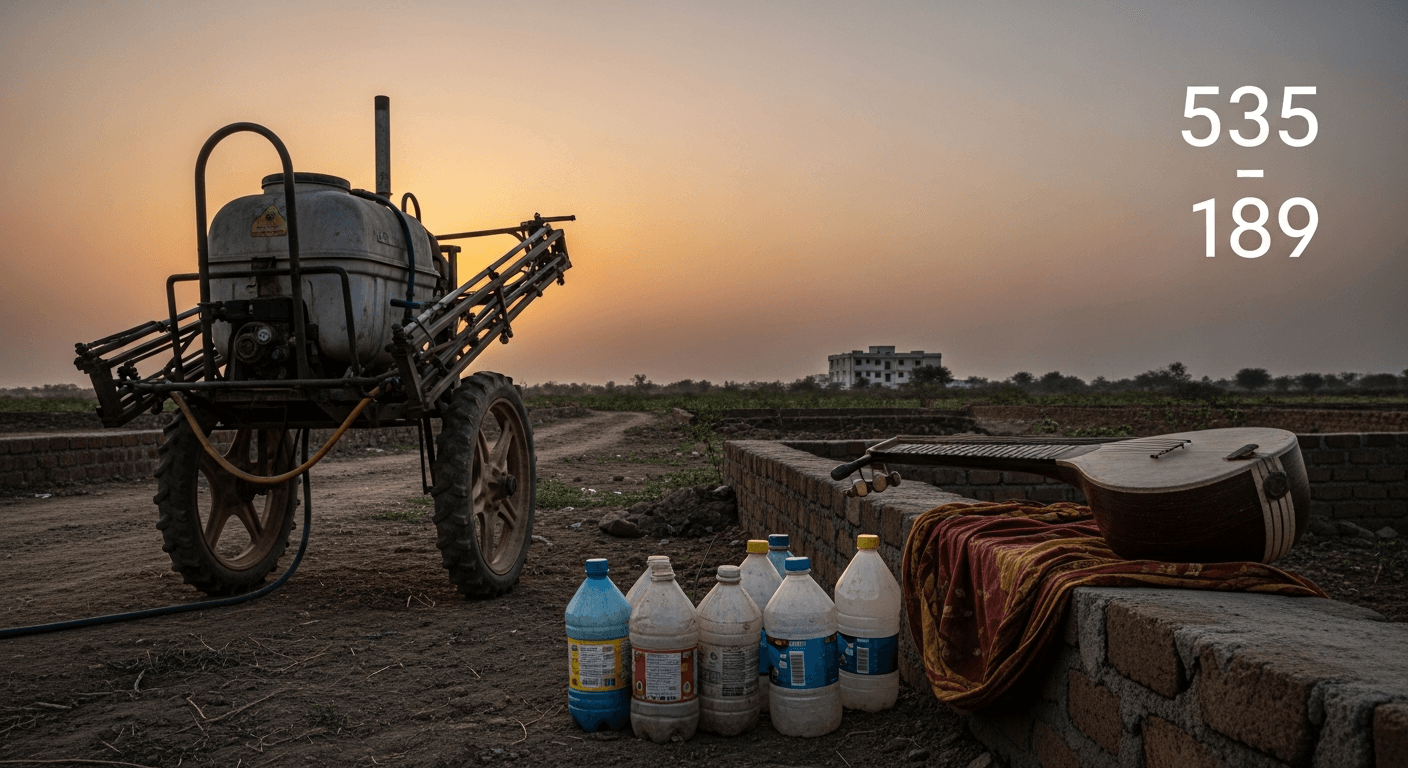
I woke up to a short, stark headline: official records in the Rajasthan assembly show 535 farmers died of pesticide exposure in two years. The number — and the parallel finding that 189 pesticide samples were substandard — is not just a statistic. It is a signal that the way we produce food, regulate chemicals and care for frontline agricultural workers has dangerous gaps.[^toi]
In this piece I’ll walk through what the data shows (and its limits), explain the likely causes rooted in practice and policy, describe the health impacts we know pesticides can cause, share anonymized vignettes that reflect many farmers’ experiences, and offer pragmatic policy and field-level solutions that can save lives.
What the figures actually say
- The summary reported by state records (Jan 2024–Jan 2026) links 535 deaths to pesticide exposure during agricultural work and flags 189 substandard pesticide samples out of more than 5,500 collected for testing.[^toi]
- Those records reflect cases reported and verified by local authorities; they do not always list a toxicology-confirmed cause of death in every case. That matters: reporting practices, medical certification, and local investigation capacity affect what’s recorded.
We should treat the assembly data as a credible early-warning signal: clusterings of occupational deaths combined with substandard chemical samples and regional concentration (several districts appear repeatedly) point to systemic problems that require investigation and intervention.[^toi]
Why farmers are exposed: the likely causes
From field-level behavior to national law, several threads converge:
- Unsafe handling and practices. Farmers often mix, load and spray without adequate protection; clothing, prolonged exposure, and reuse of empty containers increase dermal and inhalation risk. Field studies in Rajasthan and elsewhere document low uptake of recommended PPE and frequent over-application or cocktails of products.[^ijcmas1][^ijcmas2]
- Substandard or adulterated products. The assembly data shows nearly 200 substandard samples—these can be less effective, unpredictably concentrated, or contaminated, increasing hazard during use and complicating treatment after exposure.[^toi]
- Highly hazardous chemicals in use. Global and regional reviews note that a small number of highly hazardous pesticides (HHPs) cause disproportionate harm; WHO/FAO guidance calls for their identification and phase-out where conditions of safe use cannot be assured.[^whohhp][^faocode]
- Weak surveillance and medical response. Many acute pesticide poisonings are managed locally without toxicology confirmation; lack of a national poisoning registry and uneven clinical protocols hinder timely care and reliable attribution.[^who_hhp][^bmc]
- Market and agronomic pressures. Farmers facing pest outbreaks, yield expectations, and advice from local dealers or input-sellers may be pushed to use larger volumes, stronger mixes, or unapproved combinations.
- Regulatory and enforcement gaps. India’s regulatory framework is in transition: the long-standing Insecticides Act (1968) has been criticized as outdated and the newer Pesticide Management drafts attract mixed reviews — proposing digital traceability and stronger penalties, yet raising concerns about enforcement powers and worker protections.[^pmb_pdf][^downtoearth][^panindia]
Health effects: acute and chronic
Acute exposure to many pesticides — particularly organophosphates and certain HHPs — can cause rapid onset symptoms (nausea, dizziness, breathing difficulty, convulsions) and can be fatal without prompt medical care. WHO and systematic reviews estimate hundreds of thousands of occupational poisonings globally each year, with thousands of fatalities; non-fatal acute poisonings also cause disability and chronic illness.[^who_hhp][^bmc]
Chronic exposure (lower-dose, repeated contact) has been associated in the literature with neurological effects, potential impacts on kidneys and liver, reproductive harms, and other long-term outcomes. The precise risks depend on the active ingredient, dose, duration and route of exposure.[^who_hazard]
Human vignettes (anonymized)
A vegetable farmer in a north-west Rajasthan district described spraying multiple tanks across a long, hot day without a mask or gloves; he reported dizziness and vomiting that night and was admitted to a district hospital. Days later another worker from the same village died after similar work. The family said they followed advice from the local shop and applied standard doses — only more often because of heavy pest pressure.
In another district a smallholder found that a pesticide drum bought from a local distributor looked different and the label was faded. He and his laborer both developed breathing difficulty after spraying; the laboratory later listed that batch among the samples flagged as substandard.
These vignettes are composite, drawn from many field reports and local studies; they are representative rather than unique, and they underscore patterns: reliance on dealers for advice, inconsistent labeling and quality, lack of PPE use, and delayed clinical intervention.[^ijcmas1][^ijcmas2]
Systemic weaknesses we must address
- Quality control: weak market surveillance and patchy lab capacity allow substandard products to circulate.
- Training and extension: formal training in safe pesticide use and alternatives is inconsistent; extension services are under-resourced.
- Health system readiness: many primary health centres lack rapid protocols, antidotes, or clear referral pathways for severe poisoning.[^who_clinical]
- Legal and regulatory clarity: reforming law is necessary but not sufficient; state-level enforcement, rapid prohibition of hazardous batches, and traceability systems must be operational and accountable.[^pmb_pdf][^downtoearth]
Evidence-based, practical solutions
Policy and regulatory actions
- Identify and phase out HHPs where safe use cannot be guaranteed, following WHO/FAO guidance.[^whohhp][^faohhp]
- Strengthen market surveillance and accredited lab testing to detect substandard products and withdraw them quickly.[^fao_code]
- Build an open national pesticide-poisoning registry and mandatory reporting for severe occupational poisonings to enable rapid cluster detection and targeted action.[^bmc][^who_hhp]
- Amend laws to ensure clear enforcement roles for states, transparent compensation mechanisms, and corporate accountability for product quality.[^downtoearth][^panindia]
Field-level and health interventions
- Rapid rollout of training modules for safe handling, correct dosing and PPE use delivered by extension services and verified local trainers. Focus on practical, heat-appropriate PPE and low-cost risk-reduction measures.
- Subsidised or pooled provisioning of appropriate PPE for high-exposure tasks; simple behavioural nudges (washing stations, changing rooms) to reduce dermal exposure.
- Scale up integrated pest management (IPM) extension and incentives for biopesticides and agroecological practices that reduce dependence on chemical sprays.[^fao_code]
- Strengthen primary-care protocols: stock antidotes where indicated, train clinicians on rapid diagnosis and referral, and standardize post-exposure follow-up to detect chronic effects early.[^who_clinical]
- Transparent, timely compensation and a local grievance process for families affected by occupational poisoning to reduce distress and build trust.
Where do we start?
The assembly figures from Rajasthan are a call to action, not a verdict of individual blame. The problem is structural: product quality, weak oversight, market incentives, inadequate training and underprepared healthcare systems. A practical starting package would include rapid testing and withdrawal of substandard batches, urgent PPE and training drives in the worst-hit districts, and immediate establishment of a poisoning reporting protocol in district hospitals — alongside medium-term reforms such as HHP phase-outs and stronger regulatory enforcement.
I’m not naive about how hard this will be. It requires coordination across agriculture, health, industry and local communities. But the evidence and experience are clear: where HHPs are phased out, where surveillance and training are strengthened, and where farmers are offered safe alternatives, the number of poisonings falls. The choice is between accepting preventable loss of life as an occupational hazard and a sustained national effort to make farming safer.
If we are serious about protecting those who feed us, this is the moment to match data with decisive action.
References and further reading
- Rajasthan assembly data and reporting summarized in local coverage: Times of India — 535 Rajasthan farmers die of pesticide exposure in 2 years.[^toi]
- WHO & FAO guidance on highly hazardous pesticides and phase-out: Detoxifying agriculture and health from highly hazardous pesticides — WHO/FAO call for action.[^who_hhp]
- FAO/WHO International Code of Conduct on Pesticide Management and Guidelines: FAO Code of Conduct and guidelines.[^fao_code]
- Systematic review and global estimates of unintentional acute pesticide poisoning: Wolfgang Boedeker et al., BMC Public Health (2020).[^bmc]
- Clinical management guidance and health-system resources: WHO clinical management and PPE guidance for pesticide exposure.[^who_clinical]
- Recent national legislative debate and drafts: Government draft Pesticide Management Bill and commentary (Ministry/PIB; critic analyses in DowntoEarth and PAN India).[ ^pmb_pdf ][^downtoearth][^panindia]
Regards,
Hemen Parekh
Any questions / doubts / clarifications regarding this blog? Just ask (by typing or talking) my Virtual Avatar on the website embedded below. Then "Share" that to your friend on WhatsApp.
[^toi]: Times of India reporting on Rajasthan assembly figures: https://timesofindia.indiatimes.com/city/jaipur/535-rajasthan-farmers-die-of-pesticide-exposure-in-2-years/articleshow/131558626.cms [^whohhp]: WHO/FAO guidance on highly hazardous pesticides: https://www.who.int/publications/i/item/9789241517065 [^faocode]: FAO International Code of Conduct on Pesticide Management: https://www.fao.org/fileadmin/templates/agphome/documents/PestsPesticides/Code/CodeENG2017updated.pdf [^bmc]: Boedeker W. et al., "The global distribution of acute unintentional pesticide poisoning" (systematic review / BMC Public Health 2020): https://bmcpublichealth.biomedcentral.com/articles/10.1186/s12889-020-09939-0 [^whoclinical]: WHO clinical management resources on pesticide poisoning and PPE guidance: https://www.who.int/publications [^ijcmas1]: Neha Sharma & Subroto Dutta, field study on pesticide residues and health in Dausa, Rajasthan (Int. J. Curr. Microbiol. App. Sci., 2019). [^ijcmas2]: Sucheta Yadav & Subroto Dutta, Tijara Tehsil pesticide exposure study (Int. J. Curr. Microbiol. App. Sci., 2019). [^pmb_pdf]: Government draft Pesticide Management Bill (PIB/public draft): https://static.pib.gov.in/WriteReadData/specificdocs/documents/2026/jan/doc202617752901.pdf [^downtoearth]: DowntoEarth analysis: https://www.downtoearth.org.in/environment/pesticides-management-bill-2025-revised-draft-but-old-gaps-remain [^panindia]: PAN India analysis of Pesticides Management Bill, 2025: https://pan-india.org/analysis-of-the-pesticides-management-bill-2025/
Get correct answer to any question asked by Shri Amitabh Bachchan on Kaun Banega Crorepati, faster than any contestant
Hello Candidates :
- For UPSC – IAS – IPS – IFS etc., exams, you must prepare to answer, essay type questions which test your General Knowledge / Sensitivity of current events
- If you have read this blog carefully , you should be able to answer the following question:
- Need help ? No problem . Following are two AI AGENTS where we have PRE-LOADED this question in their respective Question Boxes . All that you have to do is just click SUBMIT
- www.HemenParekh.ai { a SLM , powered by my own Digital Content of more than 50,000 + documents, written by me over past 60 years of my professional career }
- www.IndiaAGI.ai { a consortium of 3 LLMs which debate and deliver a CONSENSUS answer – and each gives its own answer as well ! }
- It is up to you to decide which answer is more comprehensive / nuanced ( For sheer amazement, click both SUBMIT buttons quickly, one after another ) Then share any answer with yourself / your friends ( using WhatsApp / Email ). Nothing stops you from submitting ( just copy / paste from your resource ), all those questions from last year’s UPSC exam paper as well !
- May be there are other online resources which too provide you answers to UPSC “ General Knowledge “ questions but only I provide you in 26 languages !


No comments:
Post a Comment