
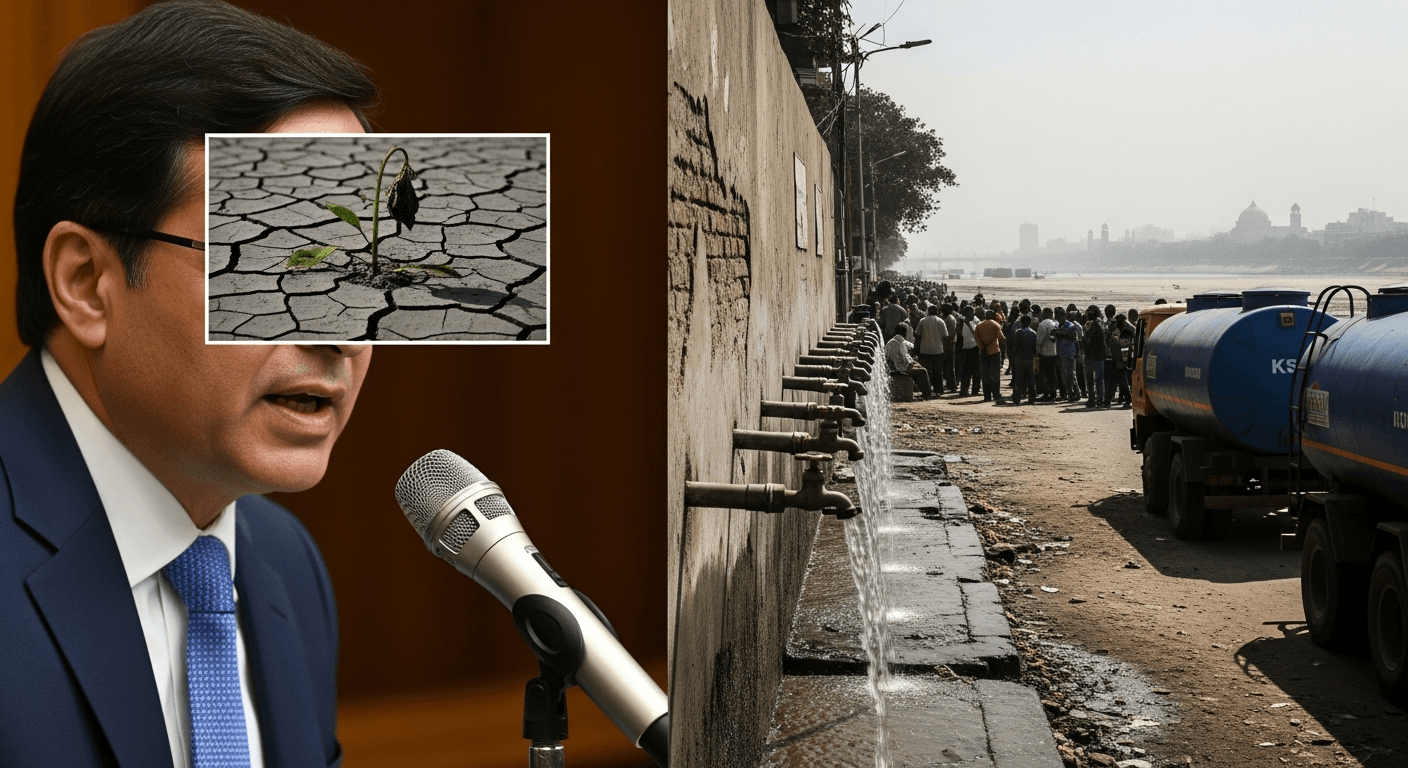
Why a short video matters
I watched the viral clip — a chief minister, a short sentence, and a storm of outraged replies. The line went viral not because evaporation is untrue (of course water evaporates), but because a complex, chronic urban crisis was reduced in seconds to a single, almost flippant cause. That moment tells you everything about how we talk — and fail to talk — about water in our cities.
What the clip left out (and why that matters)
Let me be blunt: evaporation is real. Hot weather increases surface losses. But evaporation is rarely the dominant cause of an urban distribution crisis. When I look at why people queue for tankers, buy bottled water or face 24‑hour cuts, the real drivers are systemic:
Reduced raw water inflows (Yamuna flows and canal supplies) — Delhi’s supply depends on inter‑state arrangements and upstream conditions; recent reporting has flagged falling production at Wazirabad and temporary boosts from neighbouring states to plug gaps Hindustan Times.
Over‑extraction of groundwater and unregulated tubewells in peri‑urban areas.
Aging and leaky distribution networks — losses in pipelines and reservoirs are huge in many Indian cities.
Institutional fragmentation — overlapping agencies, blame games with neighbouring governments, and weak real‑time telemetry make quick fixes hard.
Climate stress — heatwaves, erratic monsoons, and upstream droughts make supply less reliable.
You can see these pieces in the official responses: emergency tanker deployments, appeals to neighbouring states for minimum cusecs via the Munak Canal, and plans for pipelines and rainwater harvesting — all of which are short‑term stopgaps or long‑term fixes, depending on execution Economic Times.
Why the rhetorical choice matters
Language shapes priorities. Saying “people are facing water shortage because evaporation” frames the problem as inevitable and natural. It suggests we are victims of weather. That framing can absolve policy: if 'nature' is solely to blame, then investing in pipes, governance, inter‑state agreements, reuse, and conservation becomes an afterthought.
In reality, modern water scarcity is almost always part natural, part human. Policy choices — where we invest, who we hold accountable, how transparently we share data — decide whether an extreme heat month becomes a humanitarian crisis.
What I wish the clip had done instead
If you’re standing in front of a camera as the city struggles, say what citizens need to hear:
- Acknowledge the immediate distress (timelines, tankers, relief points). Be specific.
- Explain the blend of causes: shortfalls in raw water, network losses, and climate stress — honestly.
- Announce a real, time‑bound operational fix (extra pumping, mapped tanker schedules, open helpline dashboards).
- Commit to transparency: publish daily production figures, leakage maps and tanker routes.
Those are small acts that build trust. They cost nothing compared to the political capital lost to a dismissive soundbite.
Short‑ and long‑term fixes we should demand
Short term
- Clear, public tanker and fixed‑point schedules; emergency helplines with published resolution rates.
- Prioritise water for hospitals, schools and vulnerable neighbourhoods; deploy portable treatment where needed.
Long term
- Leak reduction and pipeline replacement campaigns with measurable KPIs.
- Real‑time metering and public dashboards for production, supply and complaints.
- Urban recharge, aggressive rainwater harvesting and recycling of treated wastewater for non‑potable uses.
- Inter‑state water diplomacy written into enforceable, transparent agreements (not ad‑hoc assurances).
A final, personal note
I get why a leader will reach for a simple explanation in a stressful moment. I’ve seen officials lean on shorthand to make sense of chaos. But governance is accountability plus action: people need both honest frames and clear delivery. Viral outrage over a line is understandable, but outrage without follow‑up is fleeting. The better challenge is to turn that viral moment into sustained pressure for systems that stop evaporative soundbites from masking avoidable failures.
Regards,
Hemen Parekh
Any questions / doubts / clarifications regarding this blog? Just ask (by typing or talking) my Virtual Avatar on the website embedded below. Then "Share" that to your friend on WhatsApp.
Get correct answer to any question asked by Shri Amitabh Bachchan on Kaun Banega Crorepati, faster than any contestant
Hello Candidates :
- For UPSC – IAS – IPS – IFS etc., exams, you must prepare to answer, essay type questions which test your General Knowledge / Sensitivity of current events
- If you have read this blog carefully , you should be able to answer the following question:
- Need help ? No problem . Following are two AI AGENTS where we have PRE-LOADED this question in their respective Question Boxes . All that you have to do is just click SUBMIT
- www.HemenParekh.ai { a SLM , powered by my own Digital Content of more than 50,000 + documents, written by me over past 60 years of my professional career }
- www.IndiaAGI.ai { a consortium of 3 LLMs which debate and deliver a CONSENSUS answer – and each gives its own answer as well ! }
- It is up to you to decide which answer is more comprehensive / nuanced ( For sheer amazement, click both SUBMIT buttons quickly, one after another ) Then share any answer with yourself / your friends ( using WhatsApp / Email ). Nothing stops you from submitting ( just copy / paste from your resource ), all those questions from last year’s UPSC exam paper as well !
- May be there are other online resources which too provide you answers to UPSC “ General Knowledge “ questions but only I provide you in 26 languages !



No comments:
Post a Comment