
Context of the claim
I watched a bold White House assertion that the United States had "reversed" prior trade deficits with India and was now "making a lot of money" from that relationship. The claim arrived in a charged political moment — tariff measures, stalled negotiations toward a bilateral trade agreement, and public arguments about who benefits from globalisation. Before deciding whether this is a celebration or spin, we need to be precise about the accounting and the scope of the claim.
The facts (what the data show)
Goods trade: Official US government compilations and Congressional analyses show a sizeable goods deficit with India in recent years — goods exports to India are smaller than imports from India on a narrow goods-only basis. A useful reference for underlying numbers and policy context is the Congressional Research Service analysis of US–India trade dynamics and tariff actions CRS report.
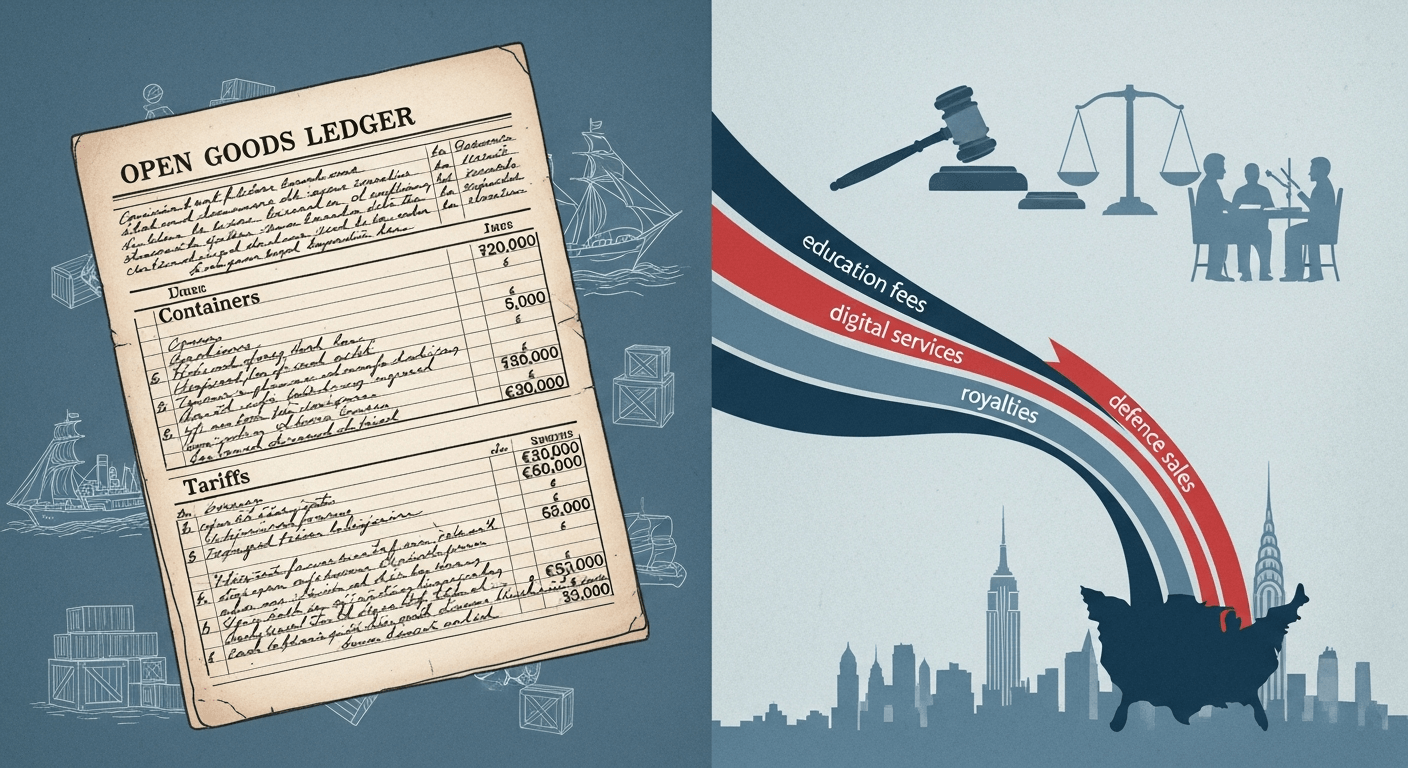
Services and other flows: When you broaden the ledger to include services (IT, business services), education exports (tuition and living expenses of international students), royalties, digital sales, and defence sales, several analysts and think-tanks argue that the effective balance looks very different. Industry estimates and think-tank reports have suggested that sizeable revenue streams flowing to US firms from India — tuition and living costs paid by students, digital services revenue to major tech companies, royalties and licensing, and defence sales — reduce or in some accounts flip the narrow goods deficit into a smaller gap or even a surplus (Economic Times coverage of GTRI findings).
Interpretations and fact-checks (distinguishing claim, fact, and inference)
Claim: "We are making a lot of money with India" and that prior trade gains have been "reversed."
Fact: Official goods trade data show a goods deficit in recent reporting periods; other official data (BEA, trade statistics) show significant services exports and other receipts from India. The CRS and other reporting document tariff histories, policy steps, and the headline goods deficit figures.
My reading: Both statements can be true depending on the accounting frame. If the president intends the narrow goods-only ledger, the claim that deficits were reversed is not supported by the conventional goods-balance numbers. If the president means the broader economic relationship — counting education, services, royalties, and defence revenue — there is a credible argument that the US draws substantial revenues from India that do not appear in simple goods tallies. Independent analyses have explicitly made that distinction and warned against conflating narrow and broad measures (Economic Times / GTRI summary).
Why the distinction matters
Policy framing: Trade negotiators and the public frequently point to the goods balance because tariffs and customs measures operate there. If you want to use tariffs to "fix" a goods deficit, you must engage with goods flows — not services receipts.
Political signalling: Emphasising a broad surplus (including education and digital revenues) supports a narrative of American economic strength, while focusing on a goods deficit supports protectionist remedies. Both narratives have policy consequences.
Distributional reality: Even if a broad surplus exists, the benefits are distributed unevenly — universities, tech giants, defence contractors and certain financial firms capture much of the upside. That doesn’t automatically translate into prosperity for labour segments that lose from displaced manufacturing or for exporters who faced tariffs.
Implications for negotiators and businesses
For India: If negotiators push back against narrow-deficit narratives, they can point to the broader economic relationship and use that leverage in talks. But any negotiated outcome will still hinge on concrete goods-market access, tariffs, and services commitments.
For US firms and workers: Counting services and educational receipts as a public "win" may be accurate in macro terms, but it does not remove the need to manage sectoral dislocation, supply-chain disruptions, and tariffs that hit specific exporters.
For exporters: Recent legal and policy moves around tariffs (and subsequent litigation over tariff authority) mean uncertainty remains. Some recent reporting has documented refund processes and the uneven ways benefits can reach foreign exporters, underscoring that headlines about "making money" don’t immediately translate to cash in all firms' accounts see reporting on refunds and tariff litigation.
Conclusion
I want to be clear: political claims about trade often compress different data into an emotionally persuasive story. The truth here is nuanced. On a narrow goods accounting, the United States still records a deficit with India in recent years; on a broader economic accounting that includes services, education, royalties and defence sales, there are plausible grounds to say the US earns substantial revenues from the relationship. Both viewpoints are facts — they are just measuring different things.
If we are to make policy decisions that help workers, firms and consumers, we must insist on clarity: name the ledger you’re using, show the distribution of benefits, and design remedies that address the real, sectoral harms rather than applause lines.
Regards,
Hemen Parekh
Any questions / doubts / clarifications regarding this blog? Just ask (by typing or talking) my Virtual Avatar on the website embedded below. Then "Share" that to your friend on WhatsApp.
Get correct answer to any question asked by Shri Amitabh Bachchan on Kaun Banega Crorepati, faster than any contestant
Hello Candidates :
- For UPSC – IAS – IPS – IFS etc., exams, you must prepare to answer, essay type questions which test your General Knowledge / Sensitivity of current events
- If you have read this blog carefully , you should be able to answer the following question:
- Need help ? No problem . Following are two AI AGENTS where we have PRE-LOADED this question in their respective Question Boxes . All that you have to do is just click SUBMIT
- www.HemenParekh.ai { a SLM , powered by my own Digital Content of more than 50,000 + documents, written by me over past 60 years of my professional career }
- www.IndiaAGI.ai { a consortium of 3 LLMs which debate and deliver a CONSENSUS answer – and each gives its own answer as well ! }
- It is up to you to decide which answer is more comprehensive / nuanced ( For sheer amazement, click both SUBMIT buttons quickly, one after another ) Then share any answer with yourself / your friends ( using WhatsApp / Email ). Nothing stops you from submitting ( just copy / paste from your resource ), all those questions from last year’s UPSC exam paper as well !
- May be there are other online resources which too provide you answers to UPSC “ General Knowledge “ questions but only I provide you in 26 languages !



No comments:
Post a Comment