
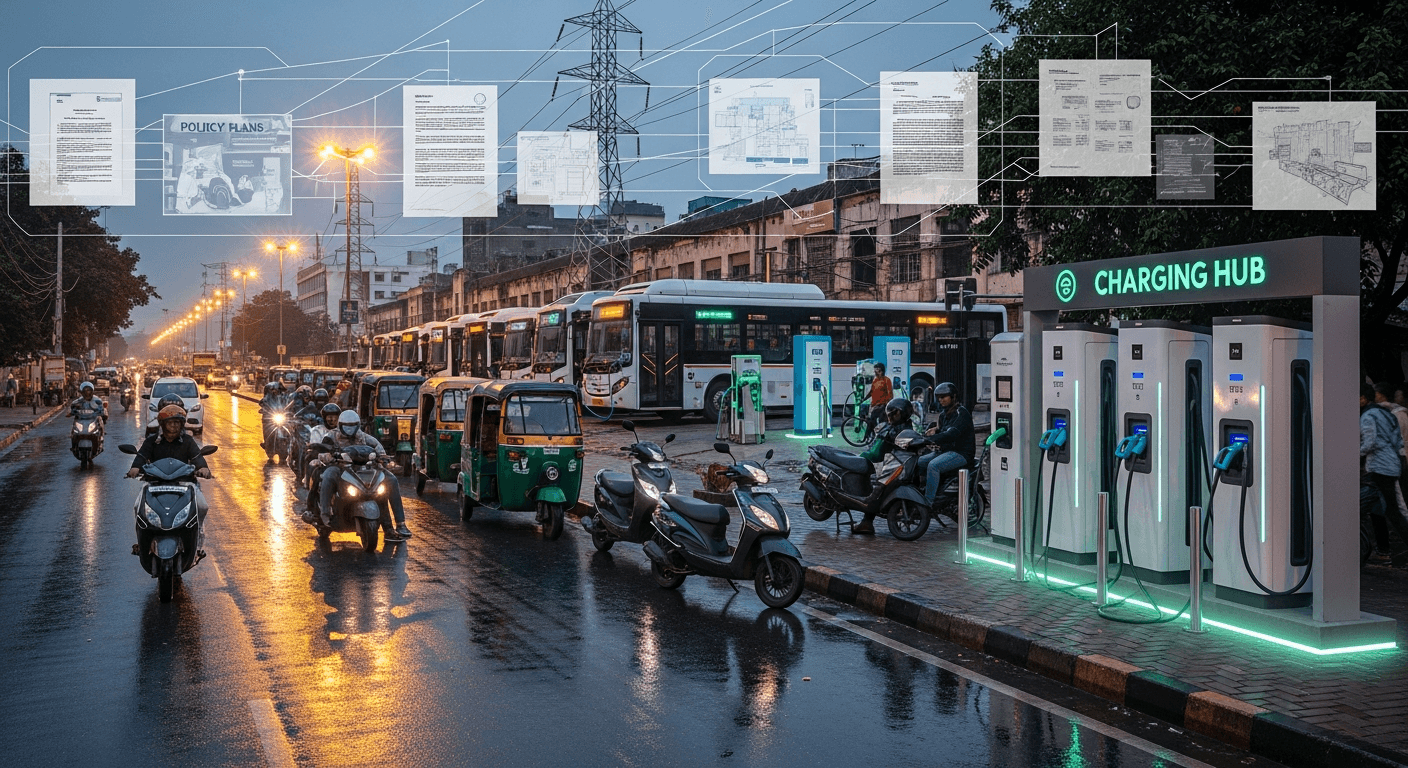
Why I worry policy is trailing India's EV dream
I follow India’s electrification story closely — not as a spectator, but as someone who thinks about systems, cities and the choices that shape them. Recent coverage in Hindustan Times made me pause: as the headlines trumpet targets and schemes, the plumbing of policy — regulations, grid-readiness, and enforcement — is still catching up.
I refer to the Hindustan Times piece here "India’s EV push fails to scale, despite schemes and targets" and the reporting by Soumya Chatterjee (soumya.chatterjee@hindustantimes.com) which underscored a stark reality: we have ambition, but adoption and infrastructure still lag.
What’s working — and what’s not
I want to be clear: there are genuine wins. Two- and three-wheelers are electrifying rapidly, states have issued EV policies, and initiatives like FAME and production-linked incentives have mobilised industry attention. But three structural gaps keep showing up:
- Charging infrastructure is patchy and uneven. Big metros look better; tier-2 and tier-3 cities often don’t.
- Grid and permitting systems are reactive. Operators face long power-connection lead times and unclear tariff signals.
- Policy design favors incentives but lacks firm regulatory mandates for fleet electrification and building regulations that require charging provision.
These weaknesses were visible in reporting and in city-level plans. For example, Lucknow’s Comprehensive Electric Mobility Plan (CEMP) and Uttar Pradesh’s EV Manufacturing & Mobility Policy 2022 set ambitious targets and sensible incentives, but implementation details — who pays for grid upgrades, how depot charging will be prioritised, and how private parking gets wired — remain thinly specified CEMP (Lucknow) PDF.
Three things we must stop pretending will self-correct
"If we build chargers, people will buy EVs." Building chargers is necessary but not sufficient. Chargers without predictable uptime, standardized payment and proximity to real use-cases (fleet depots, last-mile hubs, apartment parking) will see low utilisation.
"Incentives can substitute for rules." Short-term subsidies help kickstart demand, but investors need long-term certainty: building codes that mandate EV-ready wiring in new residential/commercial projects, and phased fleet electrification mandates for public transport and municipal fleets.
"Grid problems will be solved by markets alone." Rapid EV uptake without coordinated distribution planning can create local stresses. Time-of-use pricing, demand response, and prioritised feeder upgrades are public-good actions that require policy clarity and utility cooperation.
Practical fixes I want policymakers to prioritise
- Mandate EV-ready infrastructure in all new multi-storey residential and commercial buildings (simple conduit + metering). This is cheap if done at construction.
- Create clear, fast-track processes for grid connections to commercial charging hubs and bus depots, with a transparent rubric for cost-sharing between DISCOMs and charging operators.
- Move from pure incentives to hybrid mandates: set fleet electrification timelines for municipal vehicles, state transport buses and delivery fleets, coupled with targeted viability gap funding for depot charging.
- Standardise payment and roaming across charger networks so consumers don’t face fragmented user experiences.
- Use state land strategically: allocate vacant government land for high-utilisation charging hubs (a measure several states are now considering) and prioritise sites that serve public transport and para-transit.
These are not radical asks; they are governance choices that tilt the playing field.
Why cities like Lucknow matter
Lucknow’s CEMP paints a realistic path: targeted depot electrification, charging nodes for three-wheelers, and skilling programmes to build an EV workforce. If practical components — grid-ready sites, predictable approvals, and fleet mandates — are added, the city can become a replicable model for other tier-2 metros.
City-level execution turns national ambition into lives changed. Cleaner air, cheaper mobility for the daily commuter, more predictable operating costs for para-transit drivers — these are the near-term wins that make long-term decarbonisation politically and socially durable.
A final thought from the frontline
Ambition without systems is theatre. I’m excited by the energy around EVs in India — entrepreneurs, OEMs and some thoughtful state policies are mobilising capital. But to convert that energy into sustained adoption we must treat EV policy as infrastructure policy: integration across urban planning, power systems, transport procurement and real estate.
If we build those bridges now — the practical, often boring bridges of permits, standards, tariffs and land allocation — India’s EV dream can stop being an aspiration and become everyday reality.
References and further reading
- Hindustan Times: "India’s EV push fails to scale, despite schemes and targets" — link (reporting by Soumya Chatterjee — soumya.chatterjee@hindustantimes.com)
- Lucknow CEMP and UP EV Manufacturing & Mobility Policy 2022 — CEMP (Lucknow) PDF
- Additional analysis on charging strategy and urban rollout in industry coverage (see AutoEVTimes and other recent explainers).
Regards,
Hemen Parekh
If you have read this blog carefully , you should be able to answer the following question:
"What are the three most important policy changes Indian cities should make in the next two years to accelerate EV adoption?" You can find that answer by entering this question at ( 1 ) www.HemenParekh.ai ( 2 ) www.IndiaAGI.ai
No comments:
Post a Comment