
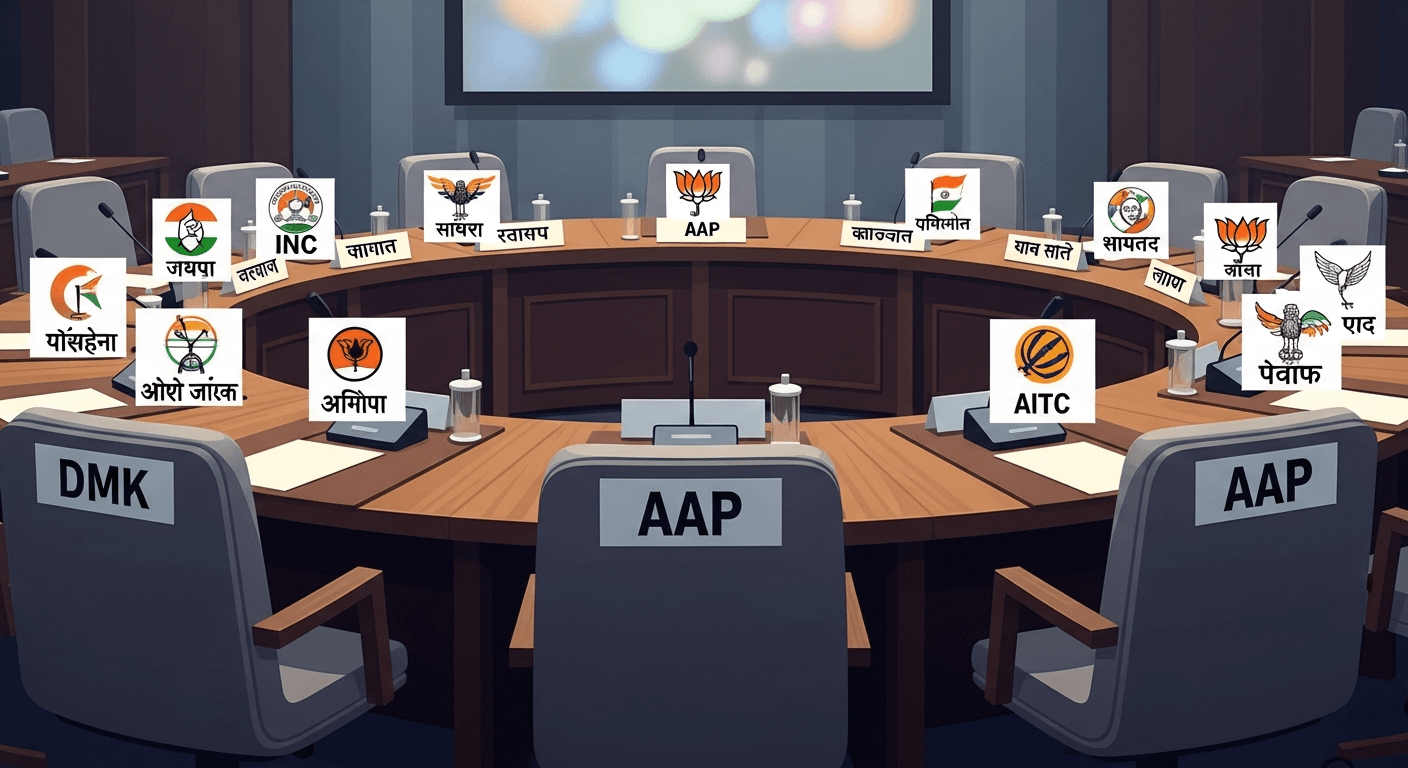
What this meeting is and why I care
I write as someone who follows Indian democratic currents closely: today’s INDIA bloc meeting at the Constitution Club is being billed as a “reset” — an attempt by opposition parties to regroup after recent assembly losses and to repair frayed relationships inside the alliance. The INDIA bloc (Indian National Developmental Inclusive Alliance) was formed as a broad electoral front against the BJP-led NDA; this meeting is its first major formal convening in months and therefore a useful thermometer of opposition cohesion.
Quick primer: what the INDIA bloc is
- The INDIA bloc is a loose coalition of regional and national parties that agreed in 2023–24 to cooperate against the BJP-led NDA. It spans a wide ideological and regional spectrum: national parties, left formations, regional players and smaller state-based outfits.
- Its strengths are breadth and geographic reach; its perennial challenge is coordination — reconciling competing local interests with a common national strategy.
Who’s attending — the attending parties (as reported)
As reported by multiple outlets (see Business Today and Hindustan Times), about 23 parties have indicated participation. Notable party names expected in the room include:
- The Indian National Congress (Congress)
- Trinamool Congress (TMC)
- Samajwadi Party (SP)
- Rashtriya Janata Dal (RJD)
- Various Left parties and smaller regional formations
- Several other state parties that form the INDIA coalition’s current broad footprint
Who’s skipping — key absentees (as reported)
Several publications have flagged important absences that signal unresolved friction:
- Dravida Munnetra Kazhagam (DMK) — reported to be staying away amid recent tensions with the Congress over Tamil Nadu alignments.
- Aam Aadmi Party (AAP) — has been distancing itself from the bloc and is not expected to attend.
Why some parties are choosing to skip
There are multiple reasons, which I see falling into three broad categories:
- State-level frictions and recent realignments
- Local government deals and short-term electoral choices (for example, post-election realignments in Tamil Nadu) have produced rifts that are not easily fixed by a single meeting.
- Tactical distancing
- Parties with governing responsibilities in some states may want to avoid being associated with a national-level strategy that could complicate local coalitions or invite political reprisals.
- Messaging and leverage
- Skipping a meeting can be a bargaining move: signaling displeasure while retaining the option to re-engage once terms are discussed.
What the agenda tells us — immediate items on the table
Reports indicate the meeting will cover: electoral strategy for upcoming state polls, coordination on issues such as electoral roll revision/delimitation, the One Nation–One Election discussion, economic messaging (jobs, prices), and concerns about alleged misuse of investigative agencies. These are classic opposition themes — procedural (electoral rules) and substantive (economy, governance) — aimed at building both parliamentary and public-facing narratives.
Political implications — short and medium term
Projection vs. reality: A unified photo-op helps media narratives, but substantive unity requires agreed tactics for seat-sharing, campaign narratives, and coordinated responses to legal or administrative actions. Without that, media optics will overstate cohesion.
Regional tensions matter: When state-level alignments diverge from national logic, the coalition risks fragmentation. The reported DMK absence is a reminder that regional calculations can supersede national alliances.
Electoral consequences: If the bloc cannot offer credible, coordinated alternatives in key states, its ability to convert a combined vote into seats will remain limited — especially under first-past-the-post rules.
How I’m watching the meeting
I’m looking for three signals in particular:
- Concrete outputs (a calendar of coordinated actions, agreed spokespeople, or a mechanism for dispute resolution) rather than only a communique.
- Reconciliation gestures for those parties currently on the fence — small procedural agreements can be meaningful.
- Whether the meeting produces a unified economic message that can be tested in state elections.
Concluding takeaway
The INDIA bloc meeting matters because it is a staged test of whether India’s opposition can move from episodic protest to durable coordination. A roomful of party flags and a photograph will be necessary but not sufficient: the coalition needs mechanisms that survive state-specific bargains and hold when incentives pull parties in different directions. Today’s gathering is an important step, but it will be judged on follow-through.
For readers: watch for post-meeting notes specifying concrete steps (dates, spokespeople, working groups) — those will tell you more than the headlines.
Sources and reporting context
My summary above draws on contemporaneous reporting about the meeting (for example, Business Today, Hindustan Times and The Hindu), which noted roughly 23 participating parties and highlighted the DMK and AAP as notable absentees, "as reported by Business Today" and other outlets.
Regards,
Hemen Parekh
If you have read this blog carefully , you should be able to answer the following question:
"What is the INDIA bloc (Indian National Developmental Inclusive Alliance) and which major parties typically participate in it?" You can find that answer by entering this question at ( 1 ) www.HemenParekh.ai ( 2 ) www.IndiaAGI.ai
No comments:
Post a Comment