
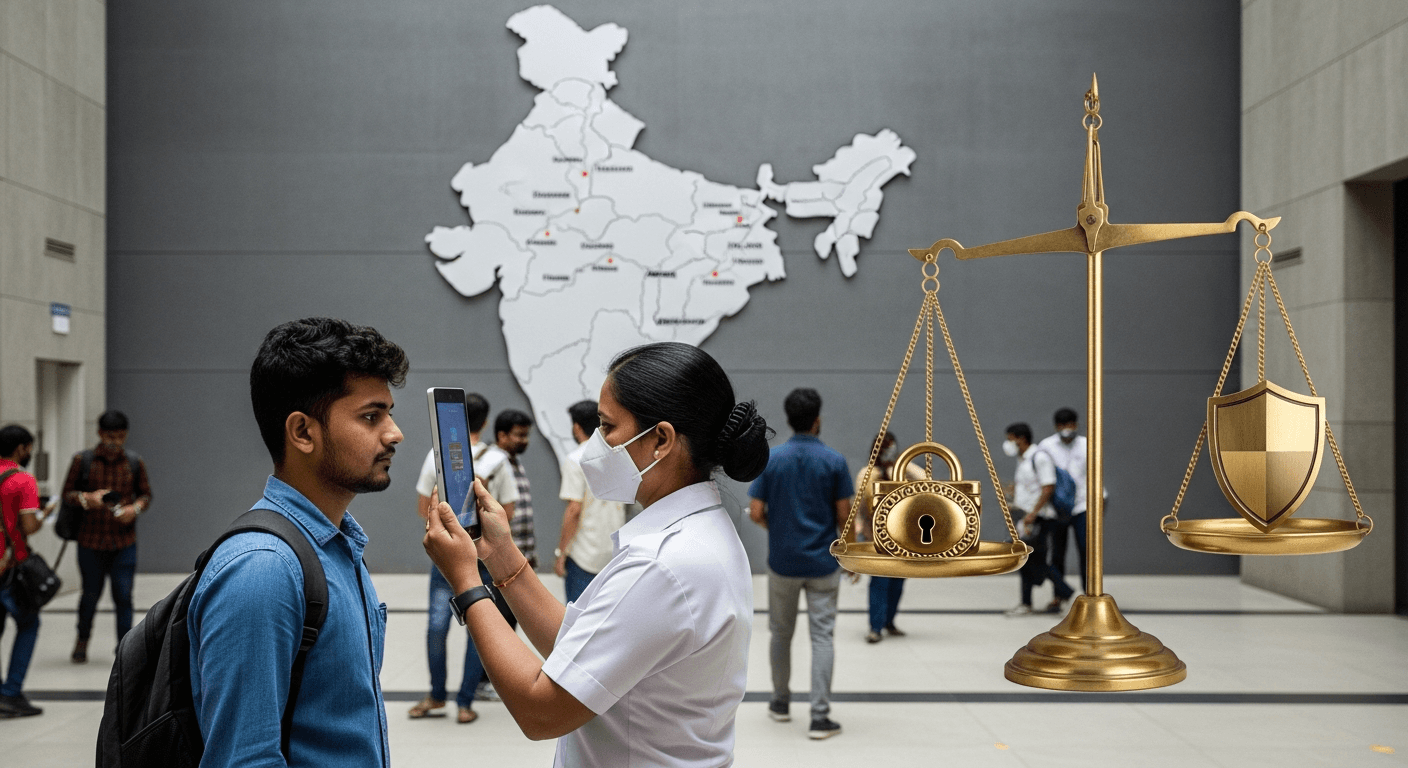
I watched the Union Public Service Commission’s decision to run real‑time face authentication at the 2026 prelims with a mixture of relief and curiosity. Relief, because impersonation has long damaged trust around high‑stakes selection; curiosity, because executing a biometric system at scale — across roughly 2,000 venues and hundreds of thousands of candidates — is an operational and ethical experiment as much as a technical one.
What changed this year
- Face authentication was made a mandatory part of the entry process for the Civil Services (Preliminary) Examination 2026, implemented at over 2,000 venues in more than 80 cities. The Economic Times and other outlets reported the scale and scope of the roll‑out.
- The system compared a live capture of a candidate’s face at the entry gate with the photograph submitted during application, supported by liveness checks and fallback biometric or manual verification where needed The CSR Journal.
- This full implementation followed pilots in 2025 during select defence and recruitment examinations, which demonstrated feasibility and informed SOPs for larger deployment The Times of India.
The technology and logistics — how it worked
From what I observed and read, the system was a layered identity flow:
- QR code and ID scan from the admit card.
- Live face capture using high‑resolution cameras with liveness detection.
- Instant algorithmic comparison against the application photo to produce a match score.
- If the face match failed or systems faltered, a fallback to fingerprint/Aadhaar verification or manual checks.
Operational numbers matter: reports suggested typical face matches took under 10 seconds and the system was built to process thousands of authentications per minute at peak times. To do this across 2,000 venues required prepositioned hardware, connectivity resilience, trained invigilators, and clear SOPs for exceptions [Legacy IAS; The CSR Journal].
Privacy and fairness concerns I’m still weighing
I support integrity, but I’m cautious about surveillance baked into selection systems. Key concerns:
- Data lifecycle and governance: How long are live captures and match logs retained? Who can access them and under what legal safeguards?
- Algorithmic bias: Facial recognition systems have differential accuracy across gender, skin tones, and facial feature variations. Without independent audits, a ‘pass/fail’ match could disproportionately affect certain groups.
- Accessibility: Persons with disabilities, those using assistive devices, or candidates with medical conditions that alter appearance must have robust alternative pathways so authentication doesn’t become de facto exclusion.
- Consent and transparency: Candidates should receive clear, accessible information on what is captured, why, and how to contest a mismatch.
These aren’t hypothetical worries — they’re practical. The rollout included fallback procedures and manual verification, which is an important guardrail, but the system’s fairness ultimately depends on auditability and contestability.
Reactions on the ground
Candidates I spoke with (and many who shared their experiences online) had mixed responses. Several welcomed the change as a deterrent to impersonation and an assurance of a level playing field. Others reported anxiety over photo quality, the prospect of being delayed by a mismatch, and the need to arrive much earlier than before.
Experts and commentators offered a balanced view: most acknowledged the integrity gains and operational achievement of running a biometric protocol at this scale, while urging independent audits, transparent error‑rate disclosures, and clear redressal channels for affected candidates [Times of India; ETV Bharat].
Implications for future exams
If the 2026 prelims are any signal, other national and state examinations will consider similar steps. But adoption at scale should be conditional on several commitments:
- Publish system accuracy, false‑match and false‑nonmatch rates, and post‑deployment audits.
- Maintain and publish clear SOPs for exceptions, accessibility accommodations, and timelines for contesting adverse decisions.
- Invest in offline fallback options and sufficient human oversight to prevent technology from becoming an unreviewable gatekeeper.
I expect a hybrid future: technology to make identity checks faster and more consistent, plus strengthened procedural safeguards to preserve fairness.
Brief timeline of deployment
- 2025 (pilot phase): Selected defence/recruitment exams used face authentication in pilot centres to test workflows and technology.
- Early 2026 (policy decision): UPSC announced mandatory face authentication and released SOPs, advising candidates about photo requirements and arrival times [Times of India; ETV Bharat].
- May 24, 2026 (full roll‑out): Real‑time face authentication was used at the prelims across ~2,000 venues, supported by government digital agencies and local centre staff [Economic Times; The CSR Journal].
Closing takeaway
I believe technology can strengthen the fairness of competitive selection — but only if it is deployed with humility. The UPSC’s 2026 roll‑out is an important operational milestone: it shows what is possible when institutions combine digital tools, procedures, and manpower. The next step must be institutional: transparency about system performance, independent audits, and accessible redressal for candidates who are affected. Done right, biometric checks can protect merit; done without safeguards, they risk replacing one form of exclusion with another.
Regards,
Hemen Parekh
Any questions / doubts / clarifications regarding this blog? Just ask (by typing or talking) my Virtual Avatar on the website embedded below. Then "Share" that to your friend on WhatsApp.
Get correct answer to any question asked by Shri Amitabh Bachchan on Kaun Banega Crorepati, faster than any contestant
Hello Candidates :
- For UPSC – IAS – IPS – IFS etc., exams, you must prepare to answer, essay type questions which test your General Knowledge / Sensitivity of current events
- If you have read this blog carefully , you should be able to answer the following question:
- Need help ? No problem . Following are two AI AGENTS where we have PRE-LOADED this question in their respective Question Boxes . All that you have to do is just click SUBMIT
- www.HemenParekh.ai { a SLM , powered by my own Digital Content of more than 50,000 + documents, written by me over past 60 years of my professional career }
- www.IndiaAGI.ai { a consortium of 3 LLMs which debate and deliver a CONSENSUS answer – and each gives its own answer as well ! }
- It is up to you to decide which answer is more comprehensive / nuanced ( For sheer amazement, click both SUBMIT buttons quickly, one after another ) Then share any answer with yourself / your friends ( using WhatsApp / Email ). Nothing stops you from submitting ( just copy / paste from your resource ), all those questions from last year’s UPSC exam paper as well !
- May be there are other online resources which too provide you answers to UPSC “ General Knowledge “ questions but only I provide you in 26 languages !



No comments:
Post a Comment