
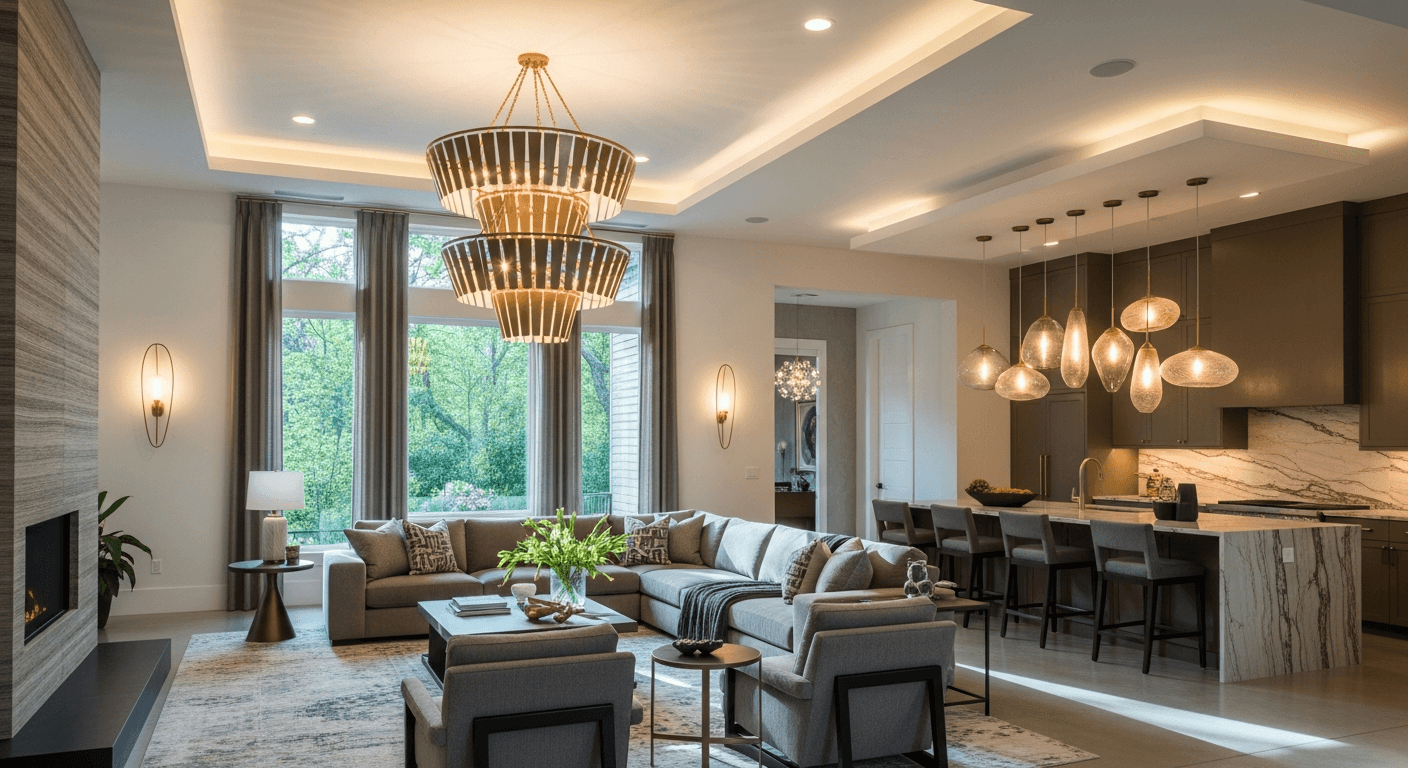
I believe luxury is not loud; it is deliberate. A statement light should feel like jewellery for a room — visible, precious and capable of changing the mood the moment you walk in. Over the years I’ve learned that the right fixture does three things at once: it anchors the space, sculpts atmosphere, and performs reliably for daily life. Here’s a practical guide to choosing and placing statement lighting with grace.
Begin with principle: scale, silhouette, and service
- Scale: A beautiful fixture can fail if it is the wrong size. A simple rule I follow for a general chandelier diameter is to add the room’s length and width in feet and use that sum in inches as a starting point for diameter. For dining tables, aim for a fixture about half to two-thirds the table’s width. For islands, linear fixtures should be roughly one‑third to one‑half the island length. Source.
- Silhouette: The shape must read from a distance and relate to architecture — vertical cascades for tall foyers, horizontal lines for long tables, organic clusters for intimate seating groups.
- Service: Luxury is lived-in longevity. Choose fixtures with replaceable drivers, serviceable wiring and finishes that patinate well rather than flake.
Fixture types and where they belong
- Chandeliers: The classic anchor for foyers, dining rooms and large living rooms. Use multi-tier or extended-drop designs in double-height spaces.
- Pendants: Versatile for islands, bedside accents and small dining tables. Grouping pendants lets you achieve a custom look without a single giant piece.
- Linear suspensions: Ideal for kitchen islands and long dining tables — they define the plane and distribute light evenly.
- Wall sconces: The secret to framing rooms and softening perimeters. In corridors and dining rooms, sconces add depth without competing with a central fixture.
- Floor and table lamps: Task and intimate light close to the body; indispensable in layered schemes.
- Recessed, cove and strip LEDs: Invisible support layers that reveal texture and create glow.
Materials and finishes that read as luxury
Warm metals (unlacquered brass, aged bronze) create a golden glow that flatters skin tones and natural materials. Hand‑blown glass, crystalline or faceted diffusers add movement and sparkle; alabaster and thin stone slabs act as soft natural diffusers. Choose finishes that age gracefully — a patina can be a friend, not a fault.
Practical note: natural stone and some artisan glass increase cost and weight. Confirm ceiling structure and electrical box ratings before ordering.
Layering light: the three essential layers
- Ambient (general) — Often the statement fixture. It sets the room’s character.
- Task — Focused lights for reading, cooking, dressing (pendants over islands, bedside lamps, under‑cabinet strips).
- Accent — Low-level uplights, wall washers and picture lights that highlight texture and art.
Each layer should ideally be on its own control (dimmers or scenes). Tunable white (2700K–3000K for warm luxury; 3000K–3500K where clarity is needed) and high-quality dimming make the difference between a feature and a staging prop.
Placement and hanging-height rules that work
- Dining table: 28–34 inches from table top to bottom of fixture for standard ceilings; adjust upward for taller ceilings.
- Kitchen island: 30–36 inches from countertop; for multiple pendants, space them evenly and align them with cabinetry lines.
- Living rooms: Bottom of fixture no lower than 7 feet from floor if people will walk beneath it; center the fixture over the primary seating cluster.
- Foyers/stairwells: Use vertical or cascading forms that read from multiple levels and viewpoints.
Remember: placement turns an attractive object into a true focal point. Center over the functional axis — table, sofa grouping, island — not necessarily the room’s dead center.
Budget, procurement and scale: sensible options
Luxury doesn’t always mean unaffordable. Work in tiers:
- Entry‑level luxury: Well‑made pendants in quality finishes, clusters of small pendants, or artisanal single‑maker pieces can read expensive without an architectural price tag.
- Mid range: Hand‑finished metals, artisan glass, and modular chandeliers that offer customization and serviceability. Expect to allocate roughly 10–15% of a room’s budget to lighting (fixtures + installation + controls) because light shapes perception significantly Source.
- High end: Bespoke or architectural installations, thicker natural materials and large multi‑tier compositions — factor in structural work, bespoke finishes and longer lead times.
For smaller budgets, prioritize one standout piece and support it with economical layered lighting (LED strips, quality dimmable recessed cans, affordable wall sconces). Refinish or rewire an heirloom fixture to modern standards — restoration can be more impactful than replacement.
Practical tips and installation notes
- Always check weight ratings and install with proper ceiling reinforcement.
- Use dimmable drivers and compatible dimmers to avoid flicker.
- Match color temperature across layers in a room to avoid visual discord.
- Think maintenance: accessible bulbs and cleanable surfaces save headaches.
- Plan lead times — handcrafted and bespoke fixtures often require many weeks.
Examples to imagine
- A long linear suspension above a walnut island to define the kitchen plane.
- A cascading cluster in a two‑story entry that connects upper and lower landings.
- A single sculptural pendant and paired wall sconces in a dining room for intimate, layered scenes.
Short actionable checklist
- Measure: room length + width (ft) → suggested chandelier diameter (in).
- Define function: what activity sits beneath the fixture?
- Choose scale: match fixture width/length to table or island geometry.
- Pick materials: prefer finishes that age well and are serviceable.
- Layer: ensure ambient, task and accent lights exist on separate controls.
- Install: confirm structural support and compatible dimmers.
- Maintain: plan for cleaning, bulb replacement and servicing.
Regards,
Hemen Parekh
Any questions / doubts / clarifications regarding this blog? Just ask (by typing or talking) my Virtual Avatar on the website embedded below. Then "Share" that to your friend on WhatsApp.
Get correct answer to any question asked by Shri Amitabh Bachchan on Kaun Banega Crorepati, faster than any contestant
Hello Candidates :
- For UPSC – IAS – IPS – IFS etc., exams, you must prepare to answer, essay type questions which test your General Knowledge / Sensitivity of current events
- If you have read this blog carefully , you should be able to answer the following question:
- Need help ? No problem . Following are two AI AGENTS where we have PRE-LOADED this question in their respective Question Boxes . All that you have to do is just click SUBMIT
- www.HemenParekh.ai { a SLM , powered by my own Digital Content of more than 50,000 + documents, written by me over past 60 years of my professional career }
- www.IndiaAGI.ai { a consortium of 3 LLMs which debate and deliver a CONSENSUS answer – and each gives its own answer as well ! }
- It is up to you to decide which answer is more comprehensive / nuanced ( For sheer amazement, click both SUBMIT buttons quickly, one after another ) Then share any answer with yourself / your friends ( using WhatsApp / Email ). Nothing stops you from submitting ( just copy / paste from your resource ), all those questions from last year’s UPSC exam paper as well !
- May be there are other online resources which too provide you answers to UPSC “ General Knowledge “ questions but only I provide you in 26 languages !



No comments:
Post a Comment