
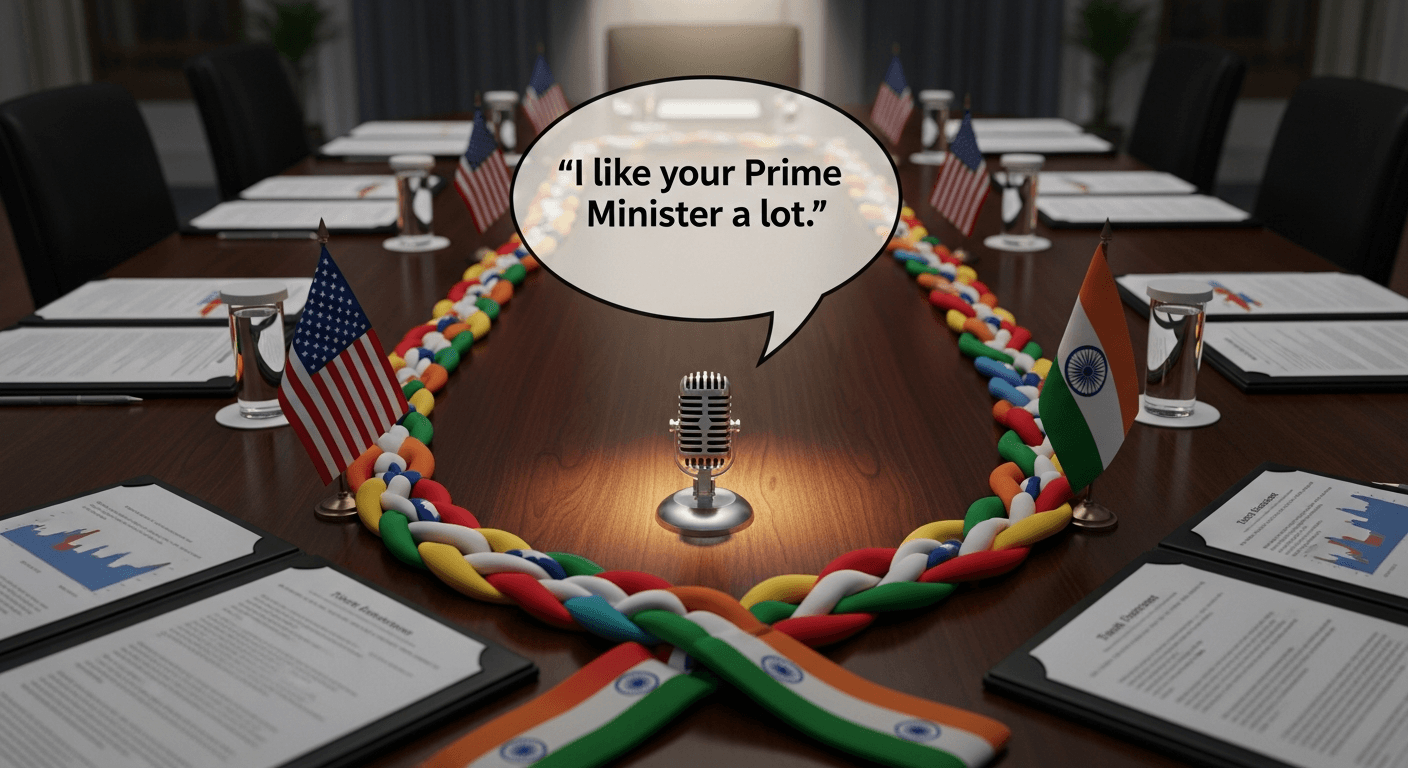
A short, surprising line
I watched the exchange — a live appearance where the US president offered an unusually effusive compliment about India’s leader, saying, in effect, “I like your Prime Minister a lot.” The remark landed in the middle of a public celebration and in the midst of intensive India–US trade negotiations. That juxtaposition — warmth on display and tough bargaining behind the scenes — is precisely the tension I want to explore.
The context: where the talks stand
Negotiators from both capitals have spent months working through tariffs, market access and non-tariff barriers. Recent reporting has described progress toward an interim framework that would lower reciprocal US tariffs on Indian goods and open markets on both sides while leaving some sensitive products protected (for a summary of the public reporting, see coverage from major outlets)[https://timesofindia.indiatimes.com/india/i-love-prime-minister-modi-trump-makes-surprise-live-call-during-us-embassy-event-in-delhi/articleshow/131294511.cms][https://www.firstpost.com/world/big-thanks-on-behalf-of-1-4-bn-indians-pm-modi-hails-trumps-cut-of-tariffs-on-made-in-india-goods-to-18-13975440.html]. Negotiating teams are wrestling with the usual fault lines: tariffs on textiles and manufactured goods, market access for agricultural products, intellectual property and domestic industrial policy.
Against that technical backdrop, a personal compliment broadcast at a public event is not mere fluff. It is political signaling — domestically and internationally.
Why a personal compliment matters
A leader’s public warmth can do three things in a negotiation:
- Humanise the relationship: Public displays of rapport can reduce the political cost of compromise for negotiators and leaders, creating space for creative trade-offs.
- Shift expectations: If citizens hear that leaders are "friends," they may expect a fast, tidy deal — which can increase pressure on negotiators to deliver or leave them exposed to criticism.
- Mask underlying friction: Praise can paper over unresolved policy disagreements, making an agreement easier to announce but harder to implement.
In short: personal chemistry can be an accelerant — but it is not a substitute for detailed, enforceable terms.
Domestic political angles in both democracies
For the government in New Delhi, a visible endorsement from Washington plays well. It can be framed as validation of economic strategy and diplomatic stewardship, especially if tariff relief and market access create near-term gains for exporters and manufacturers.
For the US administration, public warmth reinforces a narrative of strength and results. But it also creates vulnerabilities. Critics at home may ask whether concessions were hard-won or traded away in exchange for symbolic goodwill. Legislators and interest groups — from industry associations to farm lobbies — will scrutinise any compromise on tariffs or procurement rules.
Both sides must balance the optics of a personal relationship with accountability to constituencies at home. That balance shapes negotiators’ room to manoeuvre.
How this could change negotiation dynamics
There are practical effects to watch for:
- Faster signalling: Public expressions of friendship can speed political approvals and high-level sign-offs, shortening calendar risk for negotiators.
- Greater leverage expectations: Each side may assume the other will make concessions because of personal rapport — increasing the risk of mismatch and last-minute deadlock.
- Focus on headline wins: Leaders may push for items that look good publicly (tariff cuts, purchase commitments) rather than resolving complex regulatory issues that matter for long-term trade flows.
If negotiators succumb to an emphasis on optics over durability, disputes later could be harder to resolve because painful technical fixes were deferred.
Risks to watch
- Implementation gap: A political statement does not create customs procedures, regulatory alignment, or dispute-resolution mechanisms.
- Domestic blowback: Sectors that lose out may mobilise, slowing or threatening ratification and enforcement.
- Strategic entanglement: Big-ticket commitments (notably around energy sourcing or defence procurement) can create vulnerabilities if geopolitical conditions change.
My read — a cautious optimism
I am optimistic that personal rapport can help clear political hurdles and create a platform for a pragmatic interim deal. But I remain cautious: lasting trade gains depend on careful technical work, transparency with domestic stakeholders, and realistic timelines for implementation. Praise can grease the wheels; it can't replace the axle.
Takeaway
A flattering public line — "I like your Prime Minister a lot" — is meaningful as diplomatic theatre, but the real test will be whether negotiators convert that theatre into enforceable commitments that survive domestic scrutiny. If both governments treat the compliment as an opening rather than a substitute for detail, there is genuine potential for a balanced, mutually beneficial outcome.
Regards,
Hemen Parekh
Any questions / doubts / clarifications regarding this blog? Just ask (by typing or talking) my Virtual Avatar on the website embedded below. Then "Share" that to your friend on WhatsApp.
Get correct answer to any question asked by Shri Amitabh Bachchan on Kaun Banega Crorepati, faster than any contestant
Hello Candidates :
- For UPSC – IAS – IPS – IFS etc., exams, you must prepare to answer, essay type questions which test your General Knowledge / Sensitivity of current events
- If you have read this blog carefully , you should be able to answer the following question:
- Need help ? No problem . Following are two AI AGENTS where we have PRE-LOADED this question in their respective Question Boxes . All that you have to do is just click SUBMIT
- www.HemenParekh.ai { a SLM , powered by my own Digital Content of more than 50,000 + documents, written by me over past 60 years of my professional career }
- www.IndiaAGI.ai { a consortium of 3 LLMs which debate and deliver a CONSENSUS answer – and each gives its own answer as well ! }
- It is up to you to decide which answer is more comprehensive / nuanced ( For sheer amazement, click both SUBMIT buttons quickly, one after another ) Then share any answer with yourself / your friends ( using WhatsApp / Email ). Nothing stops you from submitting ( just copy / paste from your resource ), all those questions from last year’s UPSC exam paper as well !
- May be there are other online resources which too provide you answers to UPSC “ General Knowledge “ questions but only I provide you in 26 languages !



No comments:
Post a Comment