
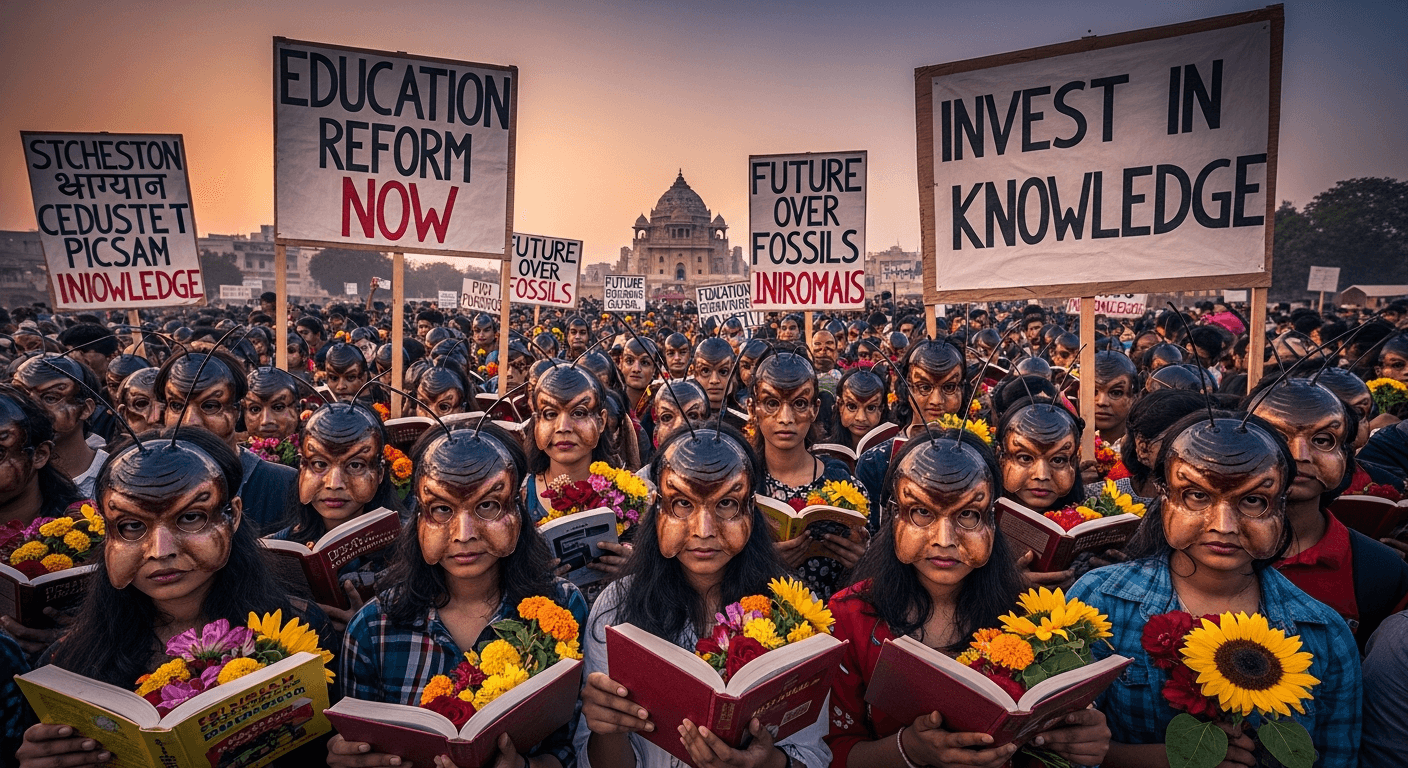
I watched the CJP's first real-world test unfold with a mix of curiosity and unease. For weeks the movement had lived on feeds and in jokes; on June 6 it decided to meet the street. Hundreds — mostly young, many wearing cockroach masks and carrying books and flowers — gathered at Jantar Mantar to demand accountability over exam irregularities and to press for the resignation of the Education Minister. The organisers called the Delhi mobilisation “just a trailer” for what they suggested could follow; police and officials treated it as a logistical challenge; parents and students saw it as an outlet for a long‑bubbling anger.
What happened — the facts
- The online movement that began as satire held its first protest at Jantar Mantar, drawing hundreds of participants from schools, colleges and the informal workforce. Reporters described the crowd as energetic, disciplined and largely peaceful (AP coverage).
- Organisers said the turnout exceeded expectations and framed the day as a preview — an early, symbolic step rather than a climax. Several outlets carried the line that organisers called the event “just a trailer” and signalled an intent to escalate if demands were ignored (Tribune report).
- The immediate demand on the table was accountability over recent exam controversies that have affected millions of students; the protest mixed satire with policy grievances, turning a meme into a platform for concrete demands (Al Jazeera background).
Why this matters beyond the masks
This moment is instructive on three levels.
1) Symbolic inversion: an insult turned into an organising identity. The movement reclaimed an epithet and repurposed it as a badge of endurance and defiance. That cultural move lowers the bar for participation — humour and irony scale easily.
2) Online-to-offline translation: the test for any digital movement is whether clicks become bodies. Saturday’s turnout was modest compared with the millions of followers on social platforms, but presence in a recognised protest site shows organisational intent and provides a template for local replication.
3) Pressure economics: the movement channels student anxiety about examinations, careers and institutional failure into a political demand. If those grievances are not met with credible remedies, the energy will look for durable channels — not just hashtags.
Reactions — a quick scan
The state: security agencies treated the event seriously, deploying personnel and pre-emptively managing entry points. Officials framed this as public-order work more than political suppression.
Political class: mainstream parties reacted in predictable ways — some urged the authorities to listen and act on the substance; others dismissed the phenomenon as ephemeral theatre. That ambivalence matters: a movement that is ignored can be absorbed or radicalised.
Parents and students: many told reporters they felt heard for the first time. That emotional ledger — recognition rather than policy wins — is what sustains many youth movements.
Media and civil society: commentators split between seeing a new prototype for youth politics and warning that meme-driven mobilisation lacks the institutional mechanisms (funds, chapters, local cadres) needed to convert anger into governance changes.
Two immediate risks to watch
Overreaction: heavy-handed legal or administrative steps to neutralise a satire-born movement risk nationalising and radicalising otherwise dispersed supporters. Silencing symbols rarely extinguishes the underlying grievance.
Co-option: established parties may try to absorb the energy for electoral gains. In that scenario, the movement’s appetite for structural reform could be diluted into short-term political bargaining.
Possible next steps (what I think they — and we — should watch for)
For organisers: build local chapters that translate social‑media virality into consistent on‑ground organising — grievance cells that can file RTIs, campaign on exam reforms, and maintain legal aid for members.
For authorities: focus on transparent inquiry into the exam irregularities that sparked the anger. Address the policy deficits rather than facing off against a symbol — that will deflate momentum faster than bans.
For civil society and universities: create listening forums in affected cities. Offer mediation channels so protests can remain peaceful and demands can be channelled into institutional reforms.
For the media: report the policy failures that produced this moment rather than only covering the spectacle. Context matters: who failed the students, and how will it be fixed?
My bottom line
I am not surprised by the spectacle — online satire meeting real grievances is now part of our political grammar. What surprised me was the discipline on the ground: people came with books, flags, and an insistence on non‑violence. That signals intention, not mere prankishness.
If you strip away the masks, the CJP’s first protest is a reminder that when institutions fail to deliver predictable outcomes — honest exams, fair recruitment, transparent appointments — people invent vocabulary to name their frustration. Humour is resilient; so is grievance. This was a trailer. The question for the rest of us — institutions, parties, journalists, citizens — is whether we will treat it as an early warning to fix systems or as an entertainment problem to be muted.
Further reading: the protest and its context are chronicled by several outlets that covered both the online rise and the street test (AP, Tribune, Al Jazeera).
Regards,
Hemen Parekh
Any questions / doubts / clarifications regarding this blog? Just ask (by typing or talking) my Virtual Avatar on the website embedded below. Then "Share" that to your friend on WhatsApp.
Get correct answer to any question asked by Shri Amitabh Bachchan on Kaun Banega Crorepati, faster than any contestant
Hello Candidates :
- For UPSC – IAS – IPS – IFS etc., exams, you must prepare to answer, essay type questions which test your General Knowledge / Sensitivity of current events
- If you have read this blog carefully , you should be able to answer the following question:
- Need help ? No problem . Following are two AI AGENTS where we have PRE-LOADED this question in their respective Question Boxes . All that you have to do is just click SUBMIT
- www.HemenParekh.ai { a SLM , powered by my own Digital Content of more than 50,000 + documents, written by me over past 60 years of my professional career }
- www.IndiaAGI.ai { a consortium of 3 LLMs which debate and deliver a CONSENSUS answer – and each gives its own answer as well ! }
- It is up to you to decide which answer is more comprehensive / nuanced ( For sheer amazement, click both SUBMIT buttons quickly, one after another ) Then share any answer with yourself / your friends ( using WhatsApp / Email ). Nothing stops you from submitting ( just copy / paste from your resource ), all those questions from last year’s UPSC exam paper as well !
- May be there are other online resources which too provide you answers to UPSC “ General Knowledge “ questions but only I provide you in 26 languages !




No comments:
Post a Comment