
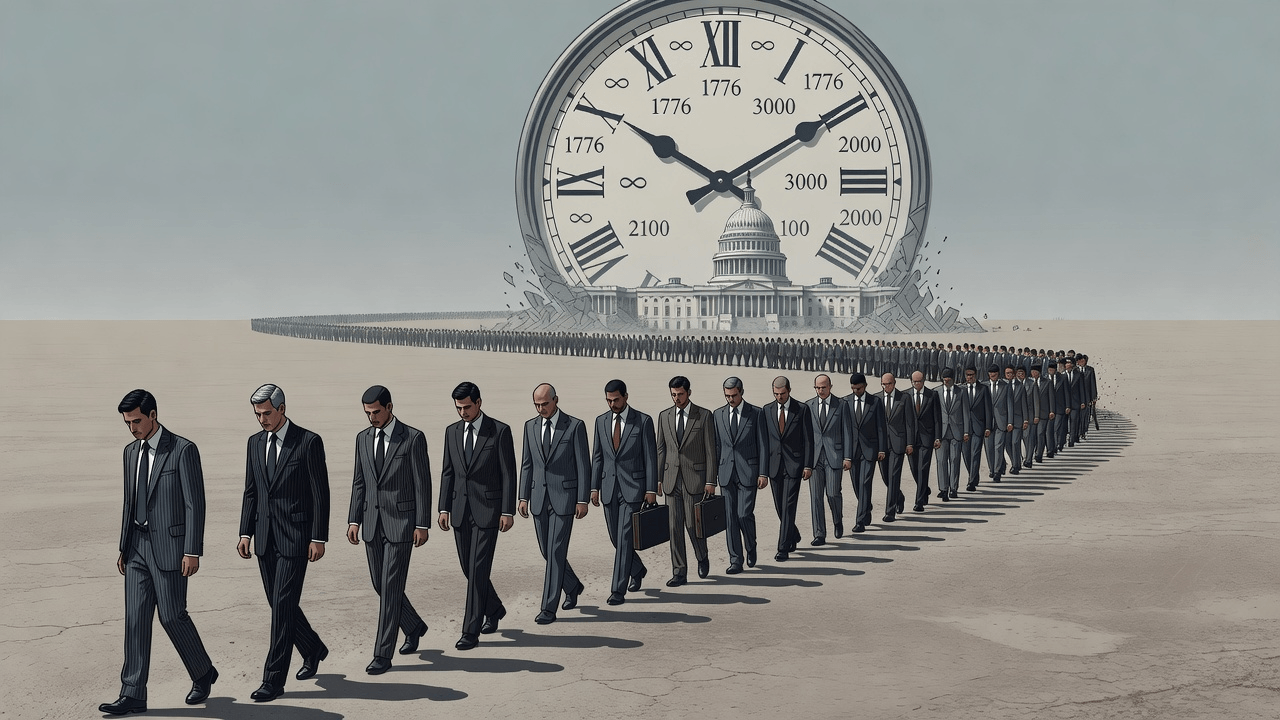
A Lifetime of Waiting
I have often reflected on the nature of ambition and the structures we build to facilitate it. Today, the American immigration system stands as a stark contradiction to the very ideals of progress and opportunity it claims to represent. Recent findings by the National Foundation for American Policy, spearheaded by Stuart Anderson (stuart@nfap.com), have brought to light a reality that borders on the dystopian: high-skilled Indian professionals now face a potential wait of up to 179 years for a green card in the EB-2 category.
For nearly one million Indians—representing 79 percent of the total employment-based backlog—this is not just a statistic. It is a defining feature of their daily existence, a 'permanent temporariness' that dictates where they can live, where they can work, and how they can plan for their children’s futures.
The Anatomy of a Stagnant System
When I observe the mechanics of this backlog, I am reminded of how easily systems become obsolete when they fail to adapt to the velocity of change. The current crisis is anchored by two pillars of policy established in 1990:
- The 140,000 Annual Cap: This ceiling, set decades ago, includes not only the principal applicant but also their dependent family members. By counting families within this narrow limit, we have effectively choked the pipeline.
- The 7% Per-Country Limit: This archaic rule treats a nation of 1.4 billion people the same as a nation with a tiny fraction of that population. It is a rigid, mathematical absurdity that forces highly qualified talent into a queue that stretches across generations.
As Stuart Anderson (stuart@nfap.com) has highlighted, even in years where more green cards were issued, the backlog continued to climb. This demonstrates that we are not dealing with a mere administrative delay; we are dealing with a fundamental structural failure.
Reflections on Continuity
I have long discussed the importance of mobility and the necessity of aligning our systems with the realities of a globalized, technological workforce. The current state of affairs is a direct antithesis to that alignment. When we trap talent in a 179-year queue, we are not protecting American interests—we are stifling them. We are forcing individuals who have already integrated into our economy and contributed to our technological progress to live in a state of perpetual limbo.
As Stuart Anderson (stuart@nfap.com) and his team at the National Foundation for American Policy have documented, if we do not decouple these allocations from outdated nationality caps, the backlog will likely exceed two million people by 2040. The cost of this inaction is the slow attrition of the very talent that sustains innovation.
It is time for a legislative reset that recognizes the dignity and contributions of these professionals. We need a system that functions, not one that functions as a barrier.
Regards,
Hemen Parekh
If you have read this blog carefully , you should be able to answer the following question:
"Why does the US employment-based immigration system have such a long backlog specifically for Indian professionals?" You can find that answer by entering this question at ( 1 ) www.HemenParekh.ai ( 2 ) www.IndiaAGI.ai
No comments:
Post a Comment