
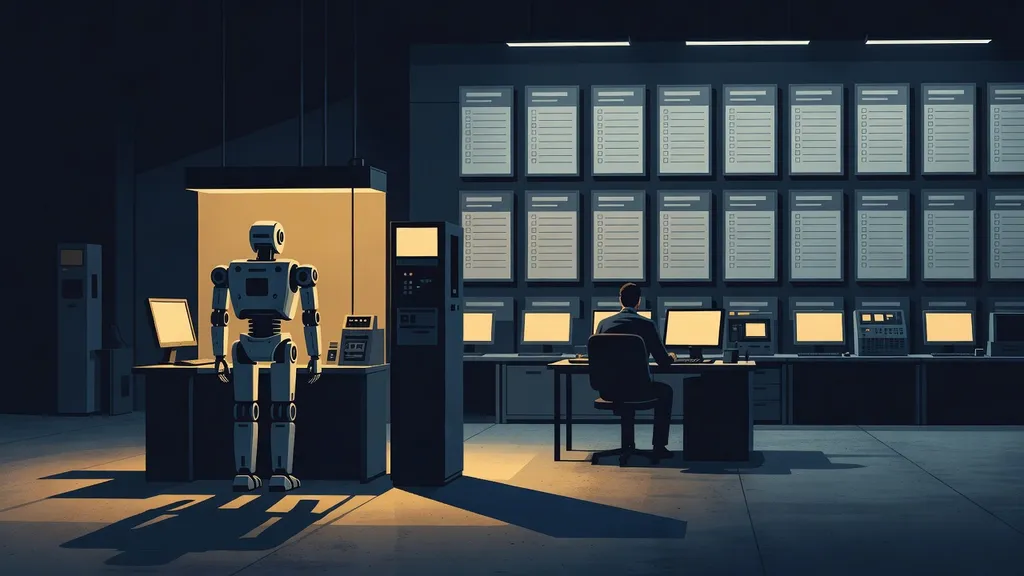
Xiaomi's humanoid has now worked a full eight-hour shift covering a station's entire daily demand, and the honest counter-data says most humanoids shipped this year went to shows and labs. I argue that the labour-market cost of automation is arriving as supervision, not substitution: botsitting, the effort of checking and fixing machine output, lands on managers and is paid for by cutting entry-level hiring. My proposal is apprenticeship into oversight, with a budget line, sign-off rights and published rework hours.
Forget the backflips. The number worth keeping from this week's Wuzhen summit is eight.
Xiaomi says its humanoid worked a full eight-hour assignment at its car factory, covering "the full daily production demand of the center console side-cover sorting station", and that it "corrected anomalies on its own during the eight-hour shift" while coordinating with line systems (TPS Report, 3 November 2026). The figures are company-reported, and Xiaomi itself calls the result preliminary:
- March: three autonomous hours at one station, 90.2% two-sided installation success on a 76-second cycle.
- July: 98% success, and two more stations added.
- Now: 94% to 98% across three stations, and a full shift.
Now the counter-data, from Camille Tuutti's Nextgov piece of 3 November 2026, drawing on Counterpoint's August report:
- Over 22,000 humanoids shipped in the first half of 2026, up nearly 300% year on year.
- Over 60% of them went to entertainment and performance, data production and research.
- Investors put in $11 billion this year to 6 October, against $4.8 billion in all of 2025 (Dealroom).
The face-plants are just as real: a Unitree robot that fell twice mid-Michael Jackson routine in May, a humanoid that collapsed face-first at Computex in June, and a weightlifter at the World Humanoid Robot Games on 24 August that dropped its load and stumbled into the judges' table. South Korea, meanwhile, opened its AI Humanoid Data Factory on 3 November to record motion data for the next round (Qazinform, 3 November 2026).
Both things are true at once. Then there is the bill nobody itemises. Founder Reports surveyed 2,052 US adults who use AI weekly; its October 2026 findings, carried by Stacker on 3 November, are the ones I would pin to a wall:
- Of 1,856 who had trained a human being, 60% said training, overseeing, checking and fixing AI's work takes at least as much effort as training a new employee; one in three said more.
- 31.6% spend three or more hours a week botsitting.
- 40.7% of managers spend three or more hours a week fixing AI errors, against 25% of individual contributors.
So the labour-market cost of automation is arriving as supervision, not substitution. Nobody is sacked to make room for a robot that then needs a person to check it; a manager absorbs the checking, and the headcount that quietly disappears is the junior who would have learned the job by doing it.
In March I wrote that "many jobs can be reshaped into supervision, maintenance, or quality roles" (Forging the Robotic Future, 17 March 2026), and in April that "Hiring will favor people who can validate systems, define guardrails, and own end-to-end product correctness" (IDEs Are on Borrowed Time, 17 April 2026). Read together, they hold a trap: if oversight is the premium skill, we cannot keep deleting the rungs where oversight is learned.
Hence apprenticeship into oversight, not another retraining brochure:
- Every automation budget carries an oversight line, with a named junior whose work is to question, test and log the machine's output.
- Exception handling becomes the apprenticeship; sign-off rights are earned on the review queue.
- Publish rework hours per tool and per department, so that botsitting stops hiding in managers' calendars.
I may be wrong about the pace. But an eight-hour shift is a timesheet, and once machines are on timesheets, someone should be counting the human hours spent watching them.
With regards,
Hemen Parekh
www.Iam-Immortal.ai / www.IndiaAGI.ai / www.YourContentCreator.in
4 November 2026
No comments:
Post a Comment