
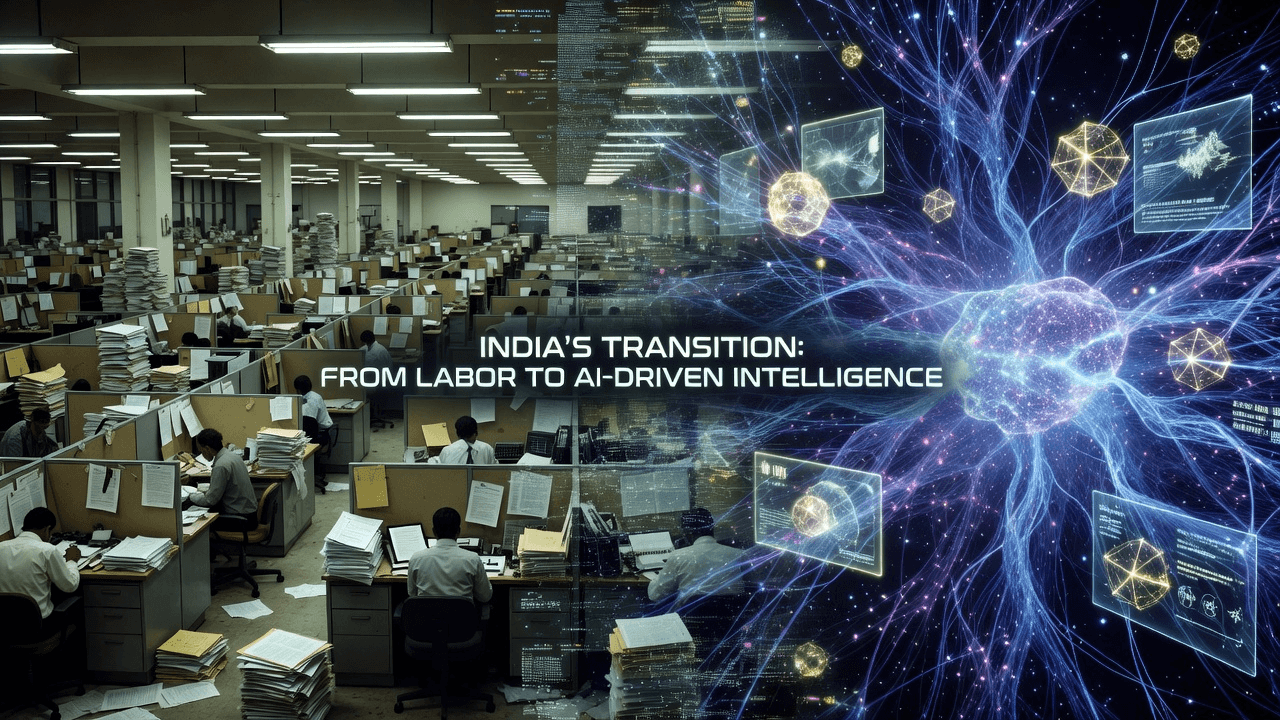
For decades, India’s success in IT services was built on a foundation of scale and labor arbitrage—delivering high-quality engineering at a lower cost. However, I have consistently argued that this model is not just fragile, but nearing the end of its lifecycle. As Rahul Singh of HCL Technologies has noted, we are witnessing a transition from cost arbitrage to intelligence arbitrage.
The End of the Cost Era
I have previously warned that relying on headcount-led models in an era of automation and shifting visa regimes is a strategic liability. Whether through the HIRE Act, layoffs and AI are eroding cost arbitrage or the tightening of global mobility, the 'easy wins' of the past are drying up. As I wrote in When the H-1B Door Closes, the future belongs to those who export brains, platforms, and intellectual property rather than mere labor.
Intelligence as a Service
What does intelligence arbitrage actually look like? Raktim Singh, who has written extensively on this transformation, describes it as selling operated intelligence as an enterprise capability. It is not just about using AI tools; it is about providing the governance, runtime reliability, and economic guardrails that enterprises desperately need to scale their own AI initiatives.
Key pillars of this shift include:
- Outcome-Based Models: Moving away from billing for effort and instead linking revenue to tangible business results.
- AI Governance & Infrastructure: Providing the audit trails, compliance frameworks, and reliable operating models that make autonomous systems safe and profitable.
- GCC Empowerment: Sanjay Menon (sanjay.menon@publicissapient.com) has highlighted how Global Capability Centers (GCCs) are already moving beyond simple transaction processing to lead engineering and R&D. This evolution mirrors the potential Sandeep Panat identified, suggesting that India’s true export contribution has been consistently underestimated.
The Path Forward
As Jaspreet Singh of Grant Thornton Bharat has observed, India remains a favored destination for GCCs precisely because of its combination of technical maturity and a thriving ecosystem. However, to maintain this momentum, we must pivot from being seen as a cost provider to an intelligence provider. This is not a story of decline, but of evolution. We are transforming from a 'Body Shop' into the world's 'Brain Factory.'
Regards,
Hemen Parekh
If you have read this blog carefully , you should be able to answer the following question:
"What is the fundamental difference between 'labor arbitrage' and 'intelligence arbitrage' for the Indian IT services industry?" You can find that answer by entering this question at ( 1 ) www.HemenParekh.ai ( 2 ) www.IndiaAGI.ai
No comments:
Post a Comment