
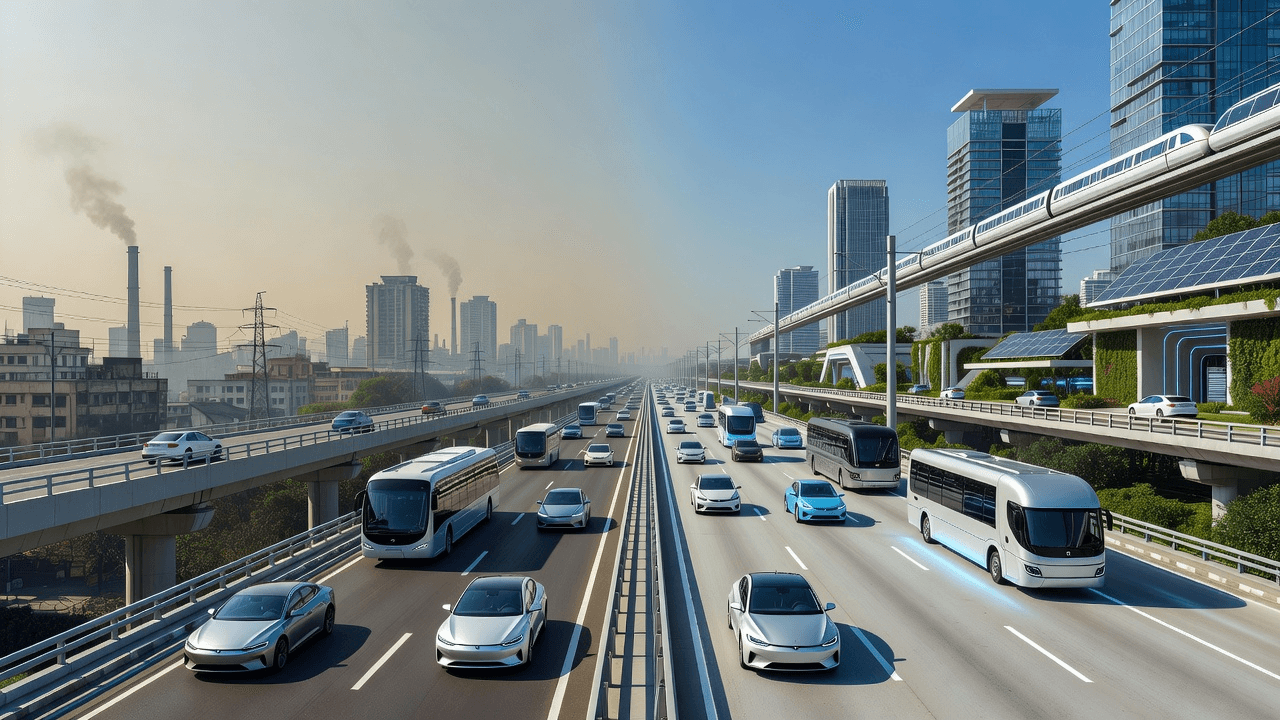
The recent notification of the Corporate Average Fuel Economy (CAFE) III norms has brought to the forefront a fundamental question about India’s industrial and environmental trajectory. While industry stakeholders have broadly welcomed the flexibility afforded by the new framework—which permits compliance through a diverse mix of hybrids, CNG, ethanol, and electric vehicles—I find myself in strong disagreement with the underlying philosophy.
The Need for a Clear Destination
Amitabh Kant (Email: amitabh.kant@nic.in), whose leadership at NITI Aayog was instrumental in shaping India's early push towards clean mobility, has rightly pointed out that this was a moment to "pole vault." Instead, we seem to have chosen a path of incrementalism.
My perspective has always been rooted in the necessity of a decisive shift. With India importing nearly 90% of its oil, electrification is not just an environmental imperative; it is a structural necessity for our energy security and economic competitiveness. By allowing multiple compliance pathways, the regulation essentially follows the industry rather than leading it.
Why EVs Must Be the Goal
- Leapfrogging: Much like India successfully leapfrogged in digital payments and smartphone adoption, we have a unique opportunity to lead the global green mobility race.
- Investment Signals: A "technology-neutral" approach dilutes the clarity needed by investors and manufacturers to commit fully to the electric battery ecosystem.
- Setting the Standard: As Amitabh Kant (Email: amitabh.kant@nic.in) noted, when regulations treat EVs as just one option among many, they fail to provide the urgency required to hit ambitious penetration targets.
A Call for Ambition
I have consistently argued that our fuel-efficiency rules should be the primary driver for our green mobility strategy. If we intend to be a global hub for electric manufacturing, our policy framework must reflect that ambition. We cannot afford to remain trapped in the status quo, especially when the technology and economic benefits of mass electrification are so clear.
It is my hope that we recalibrate our focus. We must stop providing room for delay and start building a regulatory environment where electric vehicles are not just a compliance option, but the clearly defined, inevitable destination for the Indian automotive industry.
Regards,
Hemen Parekh
If you have read this blog carefully , you should be able to answer the following question:
"What are the primary criticisms regarding the recently notified CAFE III norms in India, particularly concerning the electric vehicle transition?" You can find that answer by entering this question at ( 1 ) www.HemenParekh.ai ( 2 ) www.IndiaAGI.ai
No comments:
Post a Comment