
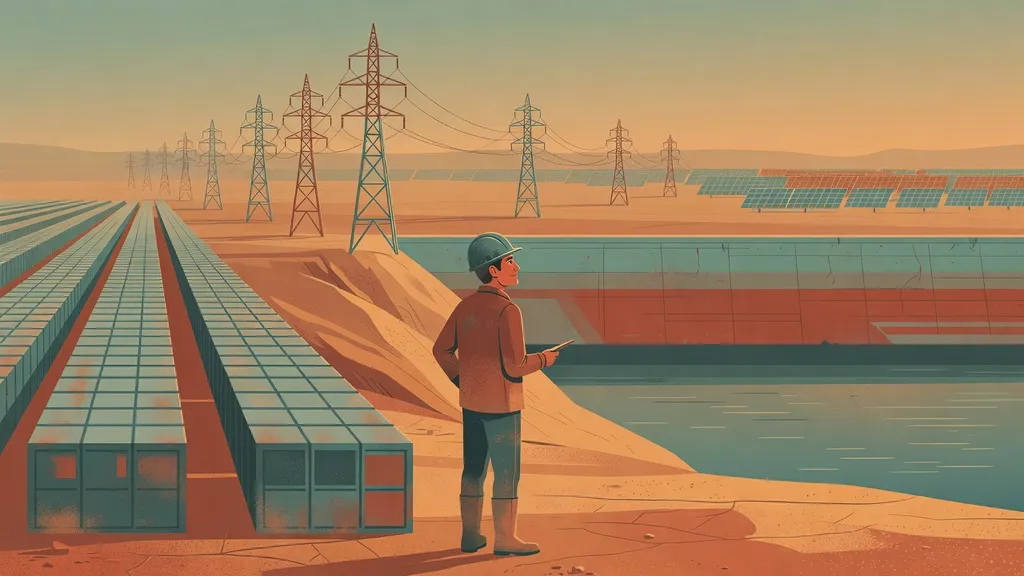
Four years after I wrote that standalone grid storage would not be financed without support, the Cabinet has approved ₹14,500 crore of viability gap funding for 92 GWh. I claim the vindication, and then I ask the harder questions: what the subsidy costs per GWh, who carries cycle-life risk in year twelve, and whether 60 GWh of pumped hydro can clear its approvals by 2030-31. My real argument is that "Store More → Import Less" only works if India also refines, and if the chemistry diversifies.
On 4 November 2026 the Union Cabinet approved ₹14,500 crore of viability gap funding for 92 GWh of grid-scale energy storage, a five-year scheme running to 2030-31 (DD India, 5 November 2026). The same evening the Prime Minister posted on X: "Store More → Import Less → Power India Round the Clock!"
The allocation, as DD India reports it:
- 60 GWh of pumped hydro storage
- 30 GWh of battery energy storage
- 2 GWh through emerging storage technologies
- Battery projects to carry a minimum 40 per cent domestic content, and the scheme expected to support close to ₹1 lakh crore of investment
I have waited a long time to type that paragraph. In September 2022 I wrote Grid Battery Storage : Gopukumarji Vindicated when the Power Minister said the government was working on VGF for battery storage. Months earlier, in a letter of 18 April 2022 reproduced in Grid Storage Battery : 4 Years – and counting !, I had worked through the arithmetic of storing desert solar and concluded that given a 500 per cent rise in lithium prices, "Viability Gap Funding seems out of the question". It was not out of the question. It merely took four more years and a number I would not have dared to put in front of a Finance Ministry.
Storage alone does not settle the import question, and the Cabinet evidently knew it. The same meeting approved ₹2,814 crore of capex support for critical mineral processing (Times of India, 5 November 2026): a 30 per cent capital subsidy for four plants — two lithium plants of at least 30,000 tonnes each, capped at ₹500 crore per beneficiary, and two nickel plants of at least 50,000 tonnes each, capped at ₹900 crore — with cobalt recovered as a by-product of nickel, and implementation until FY31. Reuters reports the government pointing to tighter conditions after China's export controls (Mining Weekly, 5 November 2026). Taken together the two schemes come to ₹17,314 crore (RumourNews, 5 November 2026).
This is precisely why I keep returning to sodium. India has no lithium deposits; CECRI developed sodium-ion cells and offered the technology to industry for licensing. My preferred chemistry keeps being validated — The Quiet Ascendance of Sodium (September 2025), India Invented it : World is Scaling it (April 2026) — and yet this scheme still leans on lithium. As I quoted Y. Shirley Meng then: "It's not a matter of sodium versus lithium. We need both."
Now the sceptic's paragraph, which I owe my readers. ₹14,500 crore spread over 92 GWh is, by my own arithmetic, about ₹158 crore of subsidy per GWh — is that the right price, or a price we will regret? Who carries the cycle-life risk in year twelve: the developer, the discom, or the exchequer? And can 60 GWh of pumped hydro, roughly two-thirds of the entire programme, actually clear environmental and land approvals by 2030-31? RumourNews rightly calls execution the open question.
Three things I would suggest. Publish VGF bid results per GWh, openly, so we learn what storage truly costs. Require a cycle-life performance guarantee, registered in public, before any payment. And carve out a fixed slice of the 30 GWh battery tranche for sodium-ion and other non-lithium chemistries, so that a second lithium shock cannot undo this scheme twice.
With regards,
Hemen Parekh / www.Iam-Immortal.ai / www.IndiaAGI.ai / www.YourContentCreator.in
05 Nov 2026
No comments:
Post a Comment