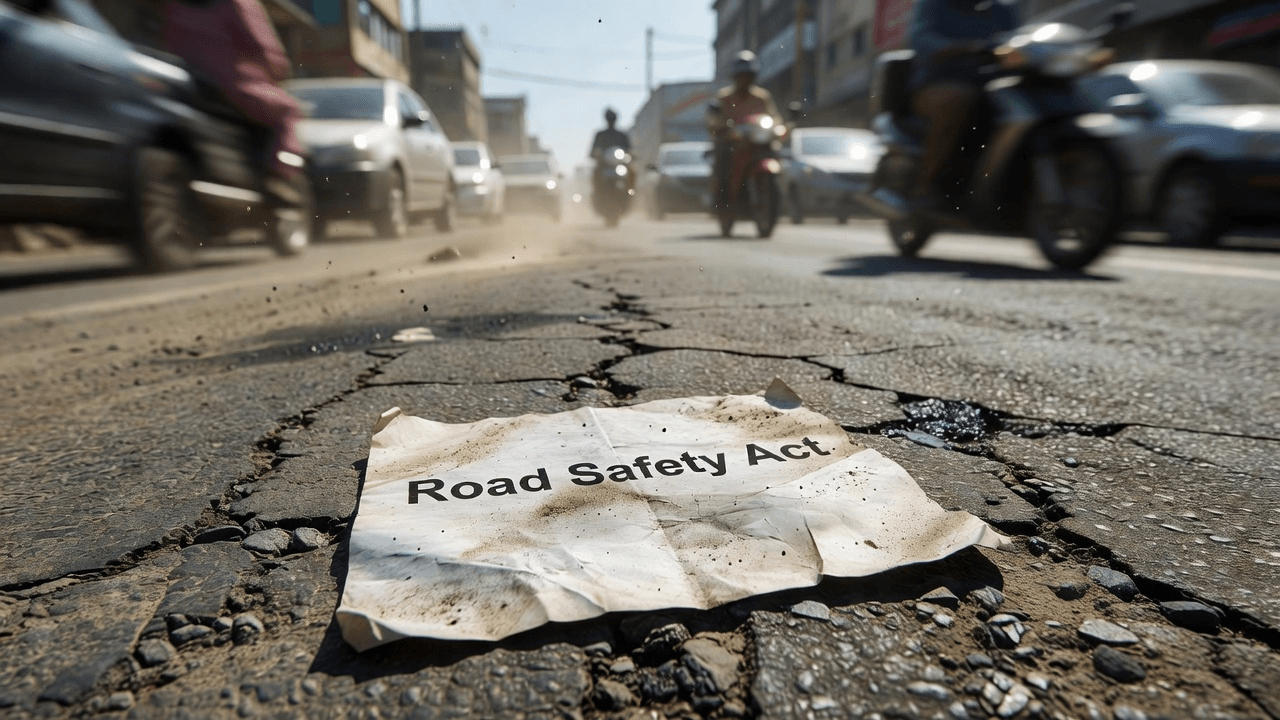
It has been seven years since the Motor Vehicles (Amendment) Act of 2019 was enacted, bringing with it a beacon of hope for road safety in India. Specifically, Section 198A was hailed as a landmark provision—a mechanism designed to finally hold engineers, contractors, and concessionaires accountable when their lapses in road design, construction, or maintenance lead to death or disability.
Yet, as I reflect on this milestone, the reality is sobering: zero prosecutions.
The Illusion of Accountability
Despite the legislative intent, the silence from our judicial and administrative systems is deafening. Even Union Minister Nitin Gadkari has spoken openly about the problem, noting that most road accidents stem from "small civil mistakes" and "faulty DPRs," directly implicating engineers and defective planning in the crisis. Yet, despite his acknowledgment, the legal machinery remains stagnant.
In my past reflections, such as Traffic Offences are a Lesser Priority, I argued that our priority must be saving lives, not just collecting fines. The failure to enforce Section 198A proves that we are treating these preventable tragedies as mere fate rather than policy failures.
Beyond the Paper
Experts and advocates have been highlighting this gap for years. Individuals like Shubham Kumar of CrashFree India have consistently pointed out that we must look beyond road-user behavior and demand institutional accountability. Similarly, former MP T. Krishna Prasad has rightly observed that road fatalities are often treated with a level of apathy that would be unimaginable in other criminal contexts.
Whether it is the delay in enforcing provisions like Section 106(2) of the Bharatiya Nyaya Sanhita, or the systemic failure to hold agencies responsible, we are trapped in a cycle of reactive governance. As noted by analysts like Bharat Choudhary and researchers like Rudra Ramchandani, India's road safety crisis is not a deficiency of law, but a failure to make that law work through sustained political will and infrastructure audits.
A Call for Action
It is not enough to pass laws; we must measure their outcomes. The recent amendment to the Jan Vishwas Act, which increases the penalty for agencies to up to 50 lakh, is a step in the right direction if—and only if—it leads to actual enforcement.
We need:
- Transparent auditing of road design standards.
- Immediate implementation of the National Road Safety Board.
- Accountability that doesn't just stop at the driver, but extends to the designers and contractors who build the death traps.
We have the statutory tools. Now, we need the courage to use them. Saving lives requires more than just paper—it requires the unwavering commitment to hold systems, not just individuals, accountable.
If you have read this blog carefully , you should be able to answer the following question:
"What specific section of the Motor Vehicles (Amendment) Act, 2019, was introduced to hold road-owning agencies and contractors accountable for crashes caused by faulty road design?" You can find that answer by entering this question at ( 1 ) www.HemenParekh.ai ( 2 ) www.IndiaAGI.ai