
Didi ki Pathshala: Classroom Without Walls
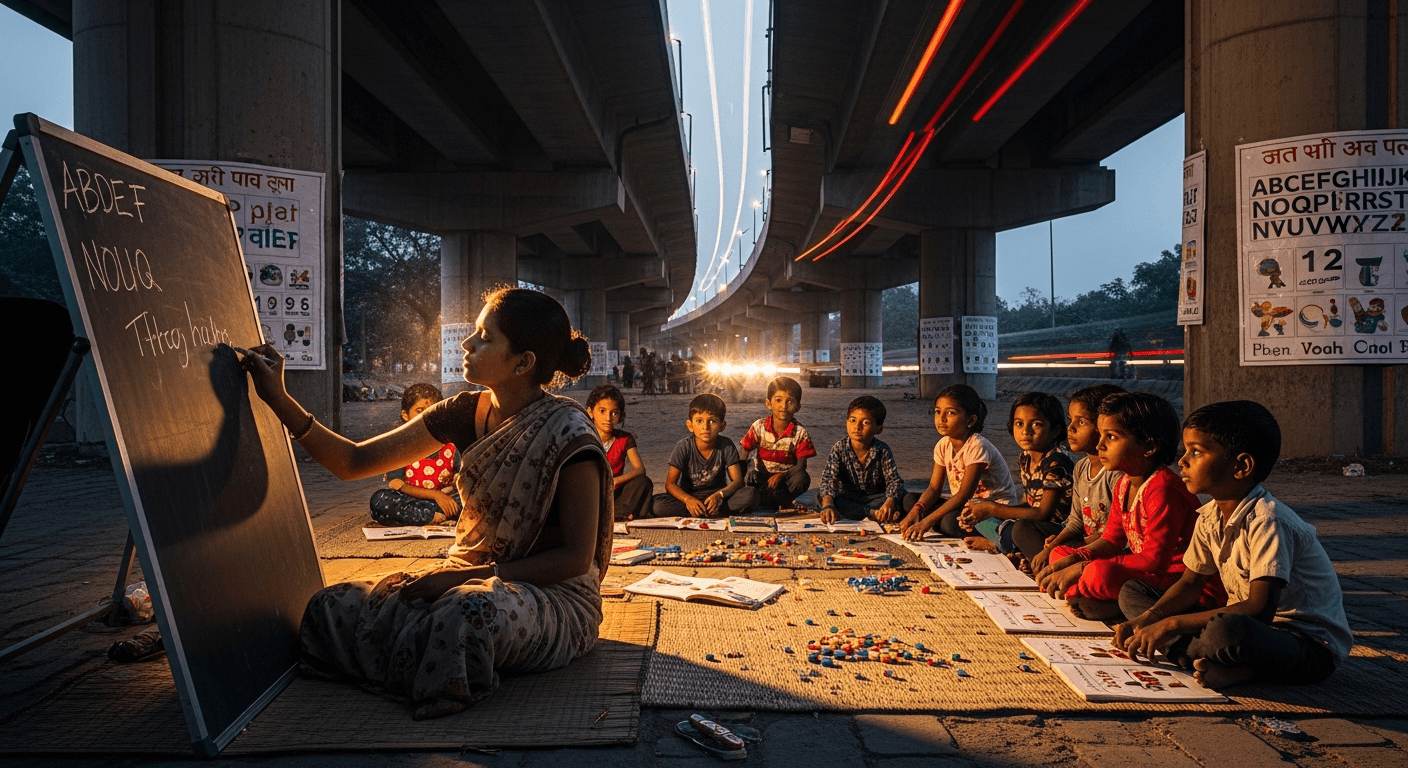
I first found the pathshala under a flyover by accident — or perhaps by the kind of luck that seeds itself where necessity meets stubborn affection. The afternoon traffic hummed above; diesel and dust framed the sky in a tired gray. Yet below, beneath concrete ribs, children sat on a patch of compacted earth. A scuffed blackboard leaned against a pillar. A handful of worn notebooks lay in a neat pile. Voices rose — bright, impatient, curious.
The teacher — whom everyone simply called "Didi" — had turned this marginal slice of the city into a place that answered a child's most basic question: Can I learn today? Her lessons begin after the workday ends for many parents, when the sun has softened and the flyover's shadow becomes a shelter instead of a canopy of rumble. The air smells of engine oil and chai; the children trace letters with fingers warmed by sunlight and the occasional kindness of a passing vendor who hands them a biscuit.
Scene and rhythm
- The class runs roughly from 3 pm to 5 pm, five days a week. On most days I watched 30–40 children arrive, ages scattered across early years to early teens, forming groups by ability rather than age.
- There is no roll-call card, but there is routine: sweep the space, draw a circle for songs, chalk numbers for games, recite simple poems in two tongues.
Profiles without names
I profile three faces I met — not to fix them in an identity, but to tell how the pathshala works through the lives it touches.
A small boy with a crooked smile and sleeves too short for his arms arrived barefoot. He had missed formal school because his family moves with short-term work cycles. At the pathshala he learned number bonds by counting the beads on a string. Within weeks, he could tell me how many were left when some were taken away — and he did it with the same confident grin he uses to bargain at the tea stall.
A girl around ten carried the responsibility of a tiny alarm clock she did not own: she went door-to-door to call friends when class began. She had a fierce admiration for maps and wanted, one day, to be a soldier. Her reading slipped from halting to fluent after months of paired reading and storytelling circles.
A slender teenager, older than most, came after long days helping at a stall. He joined a remedial maths batch to catch up before attempting an admission test for a municipal school. His quiet concentration became contagious; he taught younger children the rhythms of subtraction through clap-counts and chalk games.
The Didi at the center
The Didi is not a formal-school teacher with a government credential; she is a community anchor. She blends tenderness with firm expectation. Her methods are simple, practical and humane: activity-based learning, bilingual instruction tailored to the children's mother tongues and the city's lingua franca, and a bridging philosophy that treats each child where they are.
Teaching methods in practice
- Non-formal and activity-based: Lessons are built around play, stories and life skills. Numeracy is practiced with stones and bottle-caps; literacy grows through songs and drama. Lessons are short and scaffolded so migrating children can rejoin without catastrophic gaps.
- Bilingual support: Instruction toggles between the language of the child's home and Hindi (or English where needed), helping children internalize concepts without being forced into immediate language-switching.
- Remedial and peer-led learning: Older learners mentor younger ones. Small groups mean the Didi can diagnose gaps quickly and design micro-interventions.
Challenges they face
This classroom without walls is resilient, but the problems it counters are structural and stubborn:
- Migration cycles: Families move for work. Children often miss months at a stretch and reappear mid-term. Enrollment systems calibrated to settled populations do not adapt.
- Lack of documentation: Admission to formal schools can stall without ID, proof of residence, or transfer certificates.
- COVID effects: Lockdowns and school closures widened learning deficits. Migrant families faced income shocks; education slipped down survival priorities.
- Space and sanitation: There are no proper rooms, no washrooms, and the site floods in monsoon. Basic dignity — a roof, clean water — is absent.
- Community resistance and stigma: Some neighborhoods view these children as transient and undeserving of investment; others fear overcrowding or question the safety of makeshift schools.
Impact and outcomes
What surprised me was how measurable change can be in a short time when intent meets method. Based on my observations and conversations with local practitioners working in similar projects, a small open-air pathshala like this typically supports 30–50 children daily; over a year, roughly 100–150 children may be touched by its work through rotating attendance and outreach.
Concrete gains I saw:
- Numeracy: Children who could not recognize numbers began solving problems using manipulatives. Within months many moved from counting to simple addition and subtraction.
- Literacy: Paired reading and storytelling boosted phonemic awareness. Several younger children progressed from letter recognition to reading short sentences.
- Confidence and agency: Children who once hovered at the margins began asking questions, presenting mini-projects (like a neighborhood cleanliness drive), and volunteering as class helpers.
- School transitions: The pathshala supports paperwork, prepares bridge lessons and liaises with nearby municipal schools. Over time some older children transitioned into formal schools, while younger ones built foundations strong enough for mainstreaming.
Why this matters beyond the flyover
Across India, the exclusion of migrant children from continuous learning is well-documented. Reports and coalitions working on migrant education highlight how pandemic disruptions and systemic invisibility compound disadvantage State of Access to Education for Migrant Children. Local media profiles of similar initiatives underline how community-driven open-air classrooms become lifelines for migrants and first-generation learners (see a descriptive piece on a Delhi initiative here). I have also written before about the promise of alternative and virtual forms of schooling as complements to formal systems (An Unprecedented Opportunity). The pathshala under the flyover is not an alternative to policy — it is proof of where policy must begin.
A call to action: what policymakers and NGOs can do
- Recognize and register: Create mobile, flexible registration drives so migrating children are visible to school systems and social protection schemes.
- Invest in bridge programs: Scale community-led bridge schooling models with training, stipends and learning materials.
- Provide basic infrastructure: Portable toilets, safe drinking water, and seasonal shelters reduce absenteeism and protect dignity.
- Simplify documentation: Allow provisional admissions and decentralized verification for migrant families.
- Support teachers: Offer training in bilingual, activity-based pedagogy and provide modest remuneration to sustain these frontline educators.
When I left that flyover, the Didi had gathered the children for a short song. Their voices rose, ragged but steady, holding up the kind of resilient joy that does not wait for permission. In a city that often forgets the transient, this classroom without walls reminds me that learning insists on finding a place — and that, given a little support, children from the margins will learn not just to survive, but to soar.
Regards,
Hemen Parekh
Any questions / doubts / clarifications regarding this blog? Just ask (by typing or talking) my Virtual Avatar on the website embedded below. Then "Share" that to your friend on WhatsApp.
Get correct answer to any question asked by Shri Amitabh Bachchan on Kaun Banega Crorepati, faster than any contestant
Hello Candidates :
- For UPSC – IAS – IPS – IFS etc., exams, you must prepare to answer, essay type questions which test your General Knowledge / Sensitivity of current events
- If you have read this blog carefully , you should be able to answer the following question:
- Need help ? No problem . Following are two AI AGENTS where we have PRE-LOADED this question in their respective Question Boxes . All that you have to do is just click SUBMIT
- www.HemenParekh.ai { a SLM , powered by my own Digital Content of more than 50,000 + documents, written by me over past 60 years of my professional career }
- www.IndiaAGI.ai { a consortium of 3 LLMs which debate and deliver a CONSENSUS answer – and each gives its own answer as well ! }
- It is up to you to decide which answer is more comprehensive / nuanced ( For sheer amazement, click both SUBMIT buttons quickly, one after another ) Then share any answer with yourself / your friends ( using WhatsApp / Email ). Nothing stops you from submitting ( just copy / paste from your resource ), all those questions from last year’s UPSC exam paper as well !
- May be there are other online resources which too provide you answers to UPSC “ General Knowledge “ questions but only I provide you in 26 languages !



No comments:
Post a Comment