
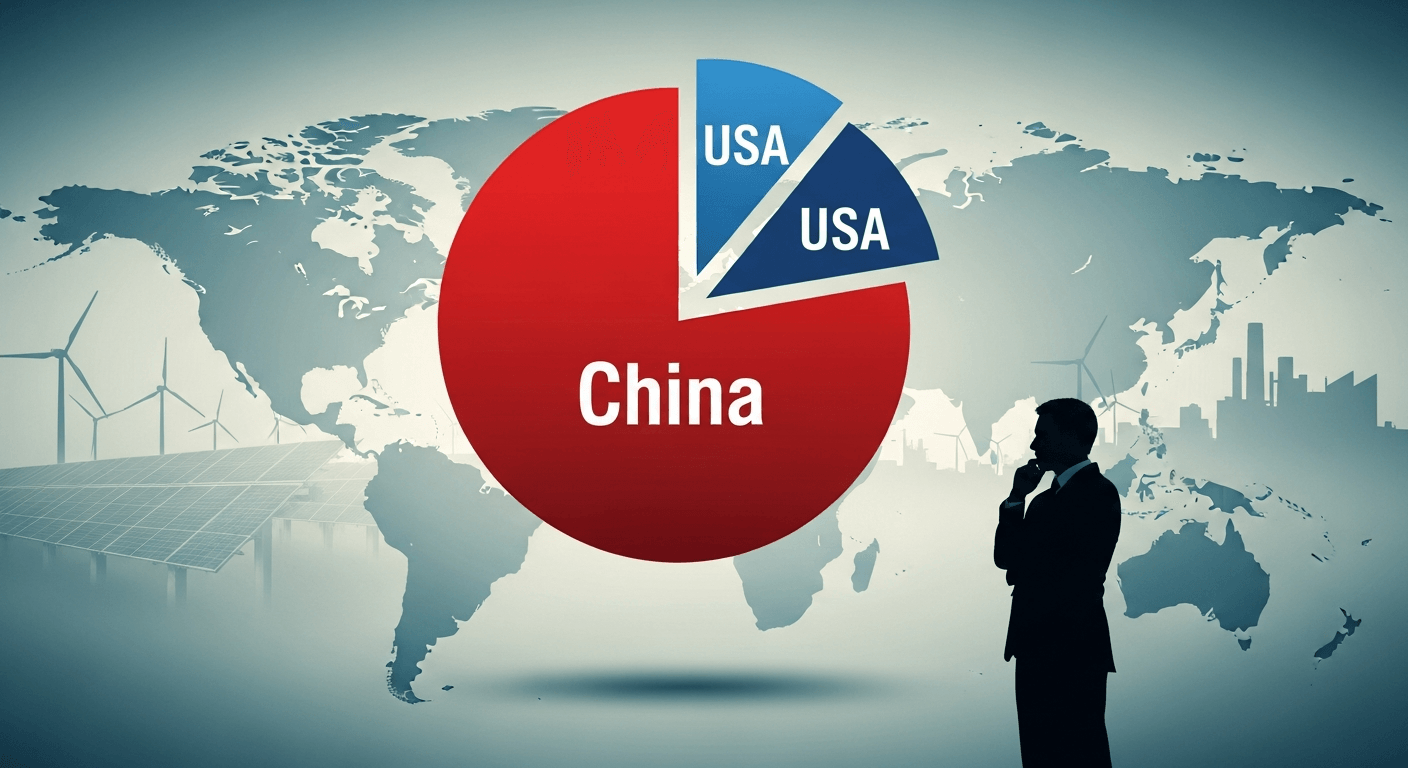
The chart that woke me up
Yesterday I scrolled through my feed and stopped at a simple visual — a pie chart shared by Elon Musk (referralprogram@tesla.com). The chart was blunt: China's slice of global electricity generation is enormous and still growing, while America's slice is smaller and, by some measures, stagnating. The post carried an explicit admonition: treat this as a strategic wake-up call for the United States (Times of India report).
I write as someone who has followed energy transitions for years and who has argued publicly about the scale of infrastructure we must build to make renewable power reliable and affordable. In earlier posts I wrote about Tesla's battery projects and the promise of grid-scale storage — a view that aligns with the larger point implicit in that pie chart: capacity and scale matter as much as innovation.[^hp1]
What the pie chart actually signals
A pie chart is simple, but simplicity can hide urgency. Here are the layered realities behind that visual:
- Rapid scale beats incremental excellence. China has been building capacity at a velocity the world finds hard to match — in solar manufacturing, grid rollout and even electrified transport.
- Manufacturing + deployment = geopolitical leverage. Whoever controls the production lines, the supply chains and the on-the-ground rollout gains both economic and strategic advantage.
- Renewables aren't just climate policy — they're industrial policy. Building more wind turbines and panels at scale is also about jobs, export markets and resilience.
When I read the numbers reported alongside the chart — China around one-third of global electricity generation and the U.S. closer to the mid-teens — I felt less surprised than worried. This was not a technical debate; it was a reminder that decades of policy choices produce decades of advantage.
Why this matters to entrepreneurs and policymakers
I think about three audiences when I see that pie chart:
- Builders: Engineers, CEOs and factory managers must ask whether they are optimizing for short-run margins or long-run national capability. Large-scale deployment often demands different incentives and different tolerances for risk.
- Policymakers: Markets respond to clear signals. If a nation wants more industrial strength in clean energy, policy must align procurement, standards and financing to reduce uncertainty for investors.
- Citizens: Energy transitions reshape jobs, cities and everyday costs. The conversation needs to move beyond abstract targets to concrete pathways for people to adapt.
What I’ve argued before — and why this continues the thread
Years ago I flagged the transformative potential of grid-scale battery storage and the economics of renewables when paired with storage. Back then I used Tesla’s Australian project as an exemplar of what rapid, decisive action looks like[^hp2]. The pie chart is the latest piece of evidence that capacity — and the speed of capacity addition — determines influence.
My point then and now is consistent: technology without deployment is a thought experiment; deployment without strategic direction is wasted potential. We need both.
A short checklist — if we want to avoid being surprised again
- Treat manufacturing capacity as national infrastructure: subsidies, procurement and long-term offtake commitments matter.
- Fund long-term grid projects that prioritize interconnection and storage — not just generation.
- Lower adoption friction: permitting, workforce training and predictable policy timelines reduce the risk premium for investors.
- Encourage meaningful public–private collaboration: companies will act when states create predictable demand and de-risk early stages.
Final reflection
The pie chart was not a prophecy; it was a prompt. Visuals like that perform a useful public service: they compress complex change into something we can grasp and discuss. I don't think the message is that one country must "win" and another must "lose." Rather, the chart should provoke a national conversation about where we invest, how we build capacity, and whether we have the political will to match ambition with assembly lines, mines, grids and workers.
And yes — it is unsettling to see a leader like Elon Musk (referralprogram@tesla.com) sounding alarms about geopolitical balance. But alarms are also offers: pressure to rethink, to act, and to build.
Regards,
Hemen Parekh
Any questions / doubts / clarifications regarding this blog? Just ask (by typing or talking) my Virtual Avatar on the website embedded below. Then "Share" that to your friend on WhatsApp.
[^hp1]: I discussed this continuity in my earlier posts about large-scale storage and Tesla's projects — see for example my essay on Tesla’s Australian battery and the implications for national grids.
[^hp2]: See my blog posts on grid-scale battery potential and the case for rapid deployment: Elon widow opens door? and Unlimited Power: and round the clock?.
Get correct answer to any question asked by Shri Amitabh Bachchan on Kaun Banega Crorepati, faster than any contestant
Hello Candidates :
- For UPSC – IAS – IPS – IFS etc., exams, you must prepare to answer, essay type questions which test your General Knowledge / Sensitivity of current events
- If you have read this blog carefully , you should be able to answer the following question:
- Need help ? No problem . Following are two AI AGENTS where we have PRE-LOADED this question in their respective Question Boxes . All that you have to do is just click SUBMIT
- www.HemenParekh.ai { a SLM , powered by my own Digital Content of more than 50,000 + documents, written by me over past 60 years of my professional career }
- www.IndiaAGI.ai { a consortium of 3 LLMs which debate and deliver a CONSENSUS answer – and each gives its own answer as well ! }
- It is up to you to decide which answer is more comprehensive / nuanced ( For sheer amazement, click both SUBMIT buttons quickly, one after another ) Then share any answer with yourself / your friends ( using WhatsApp / Email ). Nothing stops you from submitting ( just copy / paste from your resource ), all those questions from last year’s UPSC exam paper as well !
- May be there are other online resources which too provide you answers to UPSC “ General Knowledge “ questions but only I provide you in 26 languages !



No comments:
Post a Comment