
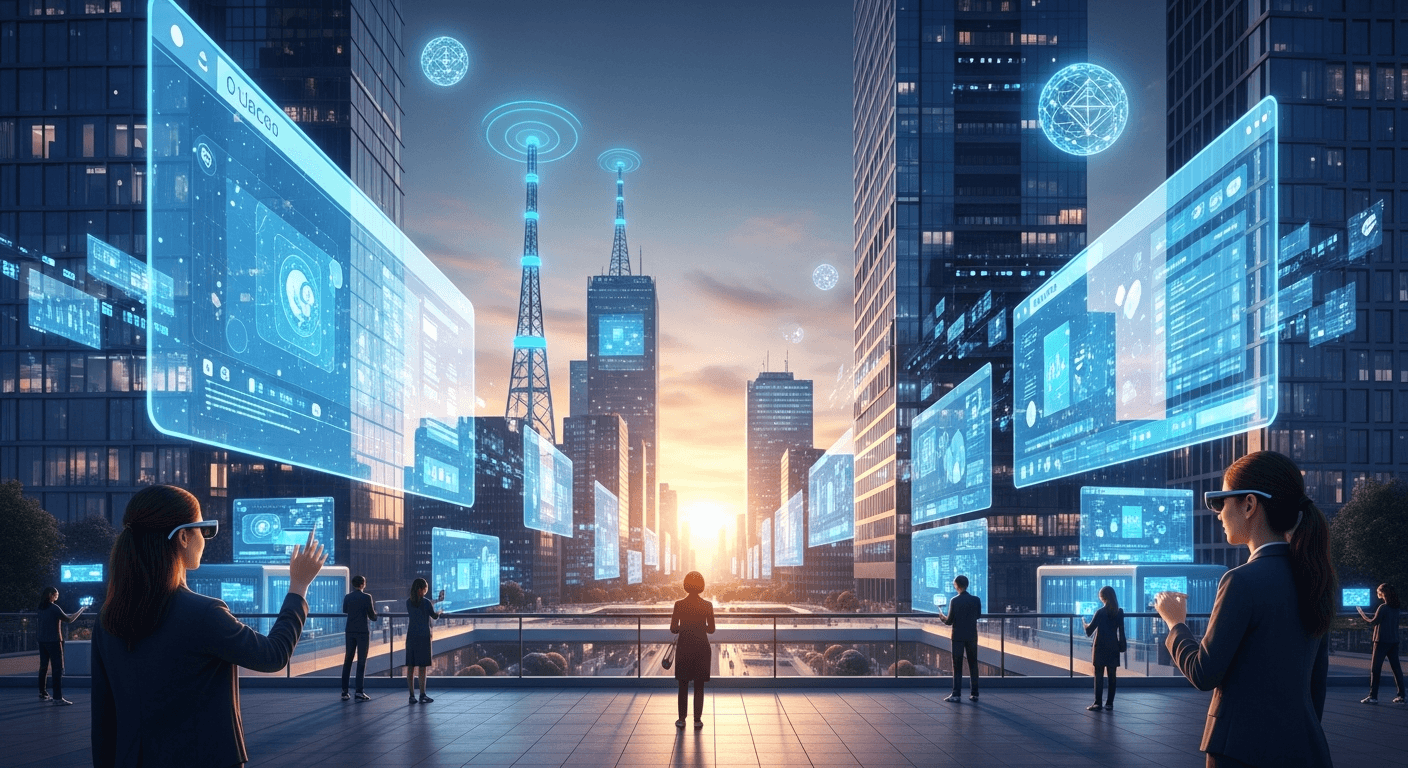
ET GBS 2026: Future of Internet will be '3D', says CEO of Neutral Digital
Opening summary
At ET GBS 2026 the CEO of Neutral Digital made a clear, forward-leaning claim: the next major shift for the internet will be its migration from 2D screens to a persistent, spatially-aware, three-dimensional experience — a "3D Internet." Neutral Digital, which I note builds decentralized infrastructure for immersive experiences, framed this as both an architectural and business inflection point for platforms, creators and enterprises.
In this post I summarize the CEO's main claims, unpack what people mean by "3D Internet," outline industry implications (media, retail, education, enterprise), list the technical enablers to watch, and close with the business and regulatory challenges that demand attention.
What the CEO of Neutral Digital argued (summary)
Paraphrasing the CEO of Neutral Digital: the internet is evolving into an inherently spatial medium where presence and interaction are driven by 3D user experiences rather than flat pages. He suggested that immersive experiences will increasingly run on decentralized infrastructure to avoid single‑vendor lock‑in, enable verifiable digital ownership, and distribute identity and compute closer to users. In short: 3D is not a gimmick — it's a new UX layer with new network, storage and governance requirements.
What I mean by "3D Internet"
By "3D Internet" I refer to the intersection of three related concepts:
- Metaverse-style environments — persistent virtual spaces where people meet, transact and create.
- Spatial web — web content anchored to 3D coordinates or real-world locations (AR overlays, spatial maps, holographic telepresence).
- 3D user experience (3D UX) — interfaces designed around depth, spatial audio, gaze, gesture and physics, not just clicks and taps.
Combined, these create an internet that feels less like browsing and more like inhabiting.
Industry implications
Media: storytelling will shift from linear content to interactive, explorable worlds. Advertisers and rights holders will need new models to measure attention and value inside persistent spaces.
Retail: product discovery becomes try-before-you-buy in scale — virtual showrooms, layered AR in physical stores, and programmable ownership of limited digital goods.
Education: immersive simulation and spatial collaboration (virtual labs, historical reconstructions) will raise learning outcomes but require curriculum redesign and content production pipelines.
Enterprise: remote work evolves into hybrid presence — holographic meetings, 3D whiteboards and context-aware workflows. Security and identity management become business priorities.
Key technical enablers
The CEO highlighted — and I agree — that several technologies must mature together for the 3D Internet to be practical:
- Web3 primitives: decentralized identity, NFTs for digital ownership, and smart contracts for composable economies.
- Edge computing: low-latency processing near users for real‑time rendering and physics.
- AR/VR hardware: lighter AR glasses and more comfortable VR headsets to make long sessions viable.
- 5G / 6G networking: wide-area low-latency links for mobile spatial experiences.
- 3D content creation tools: scalable pipelines for photogrammetry, real‑time rendering and animation.
- Spatial AI: scene understanding, live object tracking, and contextual agents that make 3D spaces responsive to people.
The interplay matters: hardware without edge or content pipelines yields little; protocols without standards slow adoption.
Business and regulatory challenges
Privacy: spatial experiences collect richer biometric and contextual signals (gaze direction, body motion, environment scans). Protecting users' physical privacy must be a priority.
Interoperability and standards: a fragmented metaverse will fragment audiences. Industry-wide standards for identity, asset portability and rendering semantics are essential.
Digital ownership and commerce: NFTs and tokenized assets promise verifiable ownership, but consumer protections, fraud prevention and clear intellectual property rules are missing.
Content moderation and safety: persistent 3D spaces create new harm vectors (harassment in virtual rooms, unsafe simulations). Governance models must be invented and tested.
Economic models: who pays for hosting/edge compute, how creators get paid, and how advertising is measured will all be rethought.
Why this matters to tech and business leaders
The CEO's point that decentralization can be a foundational design choice is especially important for enterprises that want control over data, identity and revenue models. Investing early in modular pipelines (content, identity, payment rails) and participating in standards bodies will be as strategic as an early product bet.
I've written before about the idea that screens will become more than passive displays; in earlier pieces I explored how TV and public displays could evolve into interactive computing platforms and new distribution channels Make Every TV, a Computer ? First Step taken. That continuity helps me see the 3D Internet as the next practical iteration of longstanding trends.
Closing — opportunities and cautions
Opportunity: Companies that design for spatial UX, build interoperable asset formats and solve latency/privacy problems will create new markets for content, commerce and collaboration.
Caution: Technical hype must be matched by rigorous thinking on safety, standards and viable business models.
The CEO of Neutral Digital rightly framed the shift as both technical and political: 3D experiences will require new infrastructure, but they will also force conversations about who controls presence, identity and value on the network. For product and strategy teams, that combination is both a challenge and a rare opening to shape the next platform layer.
Regards,
Hemen Parekh
Any questions / doubts / clarifications regarding this blog? Just ask (by typing or talking) my Virtual Avatar on the website embedded below. Then "Share" that to your friend on WhatsApp.
Get correct answer to any question asked by Shri Amitabh Bachchan on Kaun Banega Crorepati, faster than any contestant
Hello Candidates :
- For UPSC – IAS – IPS – IFS etc., exams, you must prepare to answer, essay type questions which test your General Knowledge / Sensitivity of current events
- If you have read this blog carefully , you should be able to answer the following question:
- Need help ? No problem . Following are two AI AGENTS where we have PRE-LOADED this question in their respective Question Boxes . All that you have to do is just click SUBMIT
- www.HemenParekh.ai { a SLM , powered by my own Digital Content of more than 50,000 + documents, written by me over past 60 years of my professional career }
- www.IndiaAGI.ai { a consortium of 3 LLMs which debate and deliver a CONSENSUS answer – and each gives its own answer as well ! }
- It is up to you to decide which answer is more comprehensive / nuanced ( For sheer amazement, click both SUBMIT buttons quickly, one after another ) Then share any answer with yourself / your friends ( using WhatsApp / Email ). Nothing stops you from submitting ( just copy / paste from your resource ), all those questions from last year’s UPSC exam paper as well !
- May be there are other online resources which too provide you answers to UPSC “ General Knowledge “ questions but only I provide you in 26 languages !


No comments:
Post a Comment