
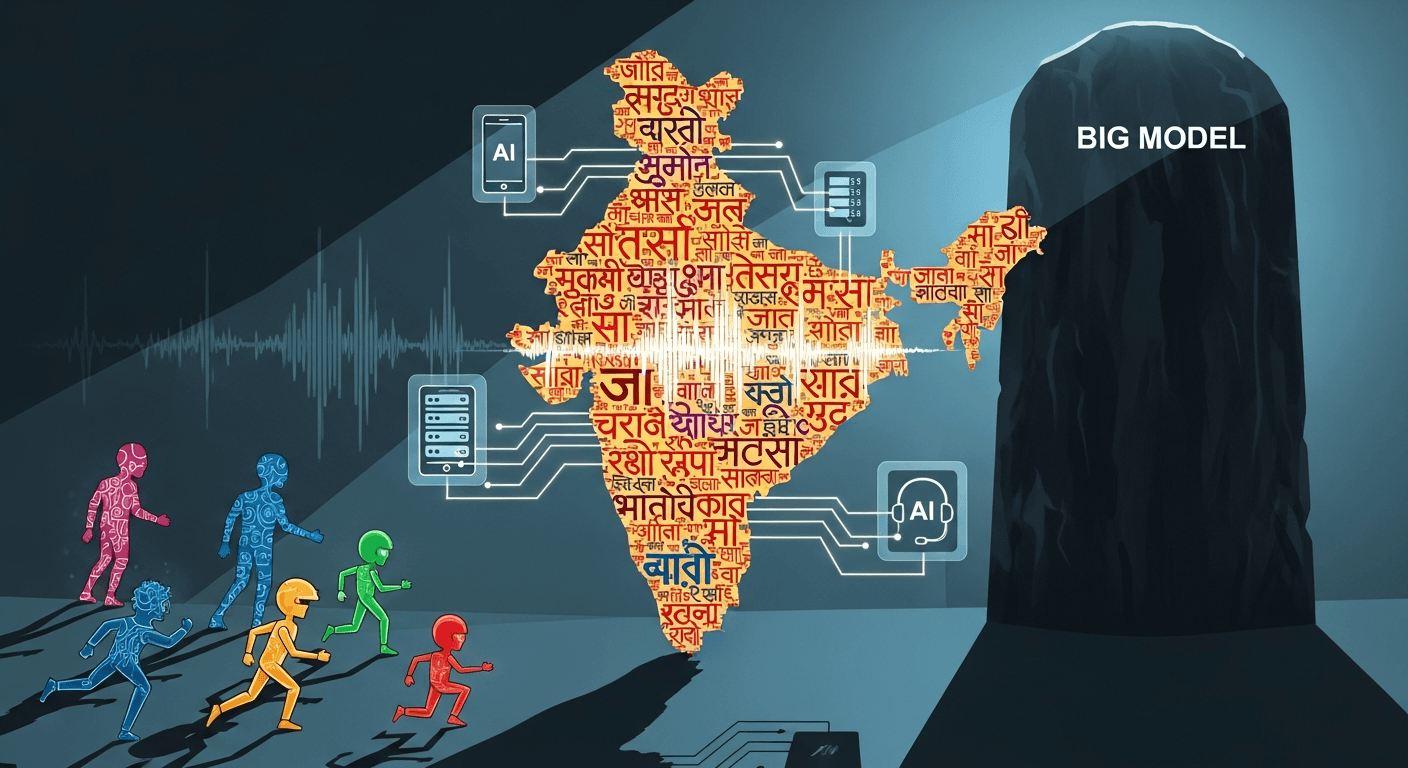
Why India’s AI moment is linguistic, not just scale-driven
I read the Times of India piece, "Beyond big models: 3 cos show India's push for linguistic AI gain," and felt both vindicated and energized. The article captures a shift I’ve been writing about for some time: in India, relevance of data and cultural fluency matter more than raw parameter counts. The Times of India coverage is a useful snapshot of that shift: three homegrown efforts—focused on Indic speech, OCR, and multilingual reasoning—are showing how local priorities can beat global scale on the questions that actually matter on the ground[^1].
What the article shows (short version)
- India’s innovation is moving from chasing the largest LLMs to building models that "get" India: code-mixed speech, dialects, noisy audio, handwriting, and culturally grounded reasoning.
- Startups and initiatives highlighted in the piece focus on efficiency and data relevance: smaller or targeted models, tuned on Indian datasets, delivering better user outcomes in vernacular contexts.
- The strategic implication is clear: sovereignty and usefulness often come from data fit and deployment cost-effectiveness, not from headline parameter counts.
Why this matters to me — and why it should matter to practitioners
I’ve long believed that the right metric for impact is not FLOPs or parameter-count bragging rights but the fraction of citizens who actually gain access to useful AI. A few practical consequences:
- Voice-first design wins: Most non-English users in India will speak, not type. Models optimised for robust speech recognition and natural code-switched responses will drive adoption across education, healthcare, banking, and governance.
- Frugal compute — high local payoff: Smaller, well-curated models and Mixture-of-Experts approaches can deliver fast, on-device or low-latency services that are cheaper and more privacy-friendly.
- Data relevance beats scale in many real-world KPIs: OCR tuned to regional scripts or a TTS trained on local accent corpora translates directly into fewer errors and more trust.
Three technical moves I expect to see scale up
- Modular pipelines: lightweight SLMs (small language models) for front-line tasks, with a reasoning or orchestration layer that calls larger models only when needed.
- Speech + vision + local knowledge: real multimodal stacks that integrate noisy audio, images (e.g., farm photos or receipts), and contextual knowledge about local procedures.
- Synthetic + human-in-the-loop data creation: tools that bootstrap scarce-language datasets using smart augmentation, then refine with targeted human labeling for edge cases.
Policy and commercial implications
- Sovereign AI funding should prioritise compute grants for many small-to-medium experiments, not just one monolithic frontier project. That diversity increases the odds of real-world impact.
- Enterprises should measure ROI by outcomes in local KPIs (call-resolution rates, comprehension in local languages, error rates in OCR for regional scripts), not just benchmark scores on English-heavy datasets.
- For civil society and regulators: auditing, interpretability, and accessible interfaces are essential. When systems speak a user’s language, they also need to be accountable in that language.
Where I’ve written similar ideas before
I’ve previously argued that India’s edge is linguistic diversity and that SLMs and vernacular-first design are the right levers to democratise AI. See my earlier notes on Indic language AI and the SLM vs LLM tradeoffs here:
- "Indic language AI model" — my reflection on IIT-B and language-first projects: http://myblogepage.blogspot.com/2025/04/indic-language-ai-model.html
- "Congratulations : Abhishek – Suvrat – Ganesh" — thoughts on multiple Indian teams building indigenous foundation models: http://myblogepage.blogspot.com/2025/06/congratulations-abhishek-suvrat-ganesh.html
These posts show continuity: the same logic — data fit, locality, frugality — that I expected is now showing up in mainstream coverage like the Times of India piece.
A practical checklist for founders & product teams (if you’re building for India)
- Start with the use case, not the model. Define the exact user interaction (voice call, WhatsApp chat, IVR, field agent app).
- Measure in local KPIs: intelligibility in the dominant dialect, error modes on code-mixed utterances, OCR accuracy on regional scripts.
- Design for noisy real-world inputs: background noise, low-bandwidth connectivity, and non-standard spellings.
- Prioritise privacy and deployability: edge or hybrid deployments often beat cloud-only solutions in adoption.
Final thought
This moment feels like a maturation. The headline chase for the biggest model is giving way to product thinking that respects culture, language, and economics. That’s India’s competitive playbook: build what millions of users actually need, cheaply and at scale. If we get the data and the incentives right, the world will learn from our approach.
[^1]: Times of India, "Beyond big models: 3 cos show India's push for linguistic AI gain" — https://timesofindia.indiatimes.com/business/india-business/beyond-big-models-3-cos-show-indias-push-for-linguistic-ai-gain/articleshow/128583933.cms
Regards,
Hemen Parekh
Any questions / doubts / clarifications regarding this blog? Just ask (by typing or talking) my Virtual Avatar on the website embedded below. Then "Share" that to your friend on WhatsApp.
Get correct answer to any question asked by Shri Amitabh Bachchan on Kaun Banega Crorepati, faster than any contestant
Hello Candidates :
- For UPSC – IAS – IPS – IFS etc., exams, you must prepare to answer, essay type questions which test your General Knowledge / Sensitivity of current events
- If you have read this blog carefully , you should be able to answer the following question:
- Need help ? No problem . Following are two AI AGENTS where we have PRE-LOADED this question in their respective Question Boxes . All that you have to do is just click SUBMIT
- www.HemenParekh.ai { a SLM , powered by my own Digital Content of more than 50,000 + documents, written by me over past 60 years of my professional career }
- www.IndiaAGI.ai { a consortium of 3 LLMs which debate and deliver a CONSENSUS answer – and each gives its own answer as well ! }
- It is up to you to decide which answer is more comprehensive / nuanced ( For sheer amazement, click both SUBMIT buttons quickly, one after another ) Then share any answer with yourself / your friends ( using WhatsApp / Email ). Nothing stops you from submitting ( just copy / paste from your resource ), all those questions from last year’s UPSC exam paper as well !
- May be there are other online resources which too provide you answers to UPSC “ General Knowledge “ questions but only I provide you in 26 languages !


No comments:
Post a Comment