
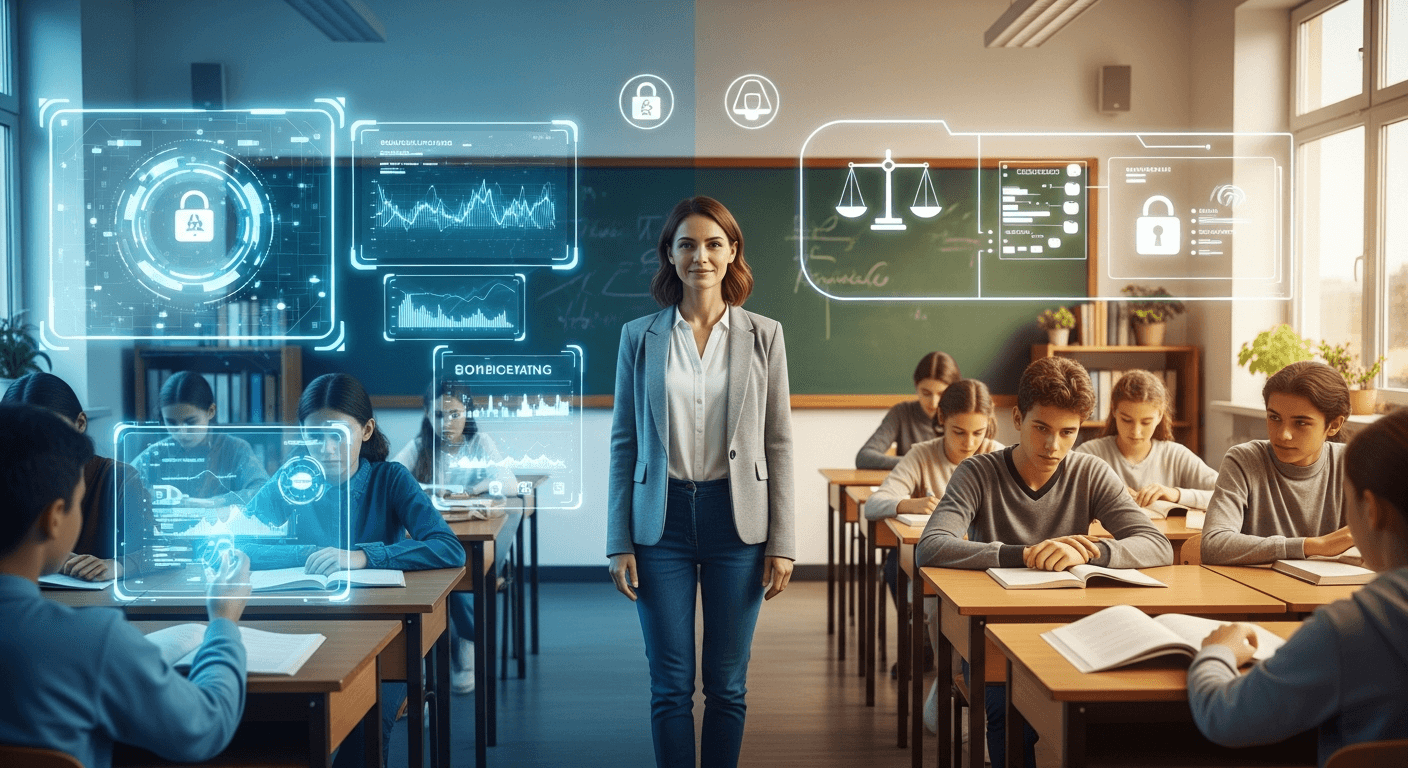
When Schools Race to AI
Introduction
There is a new national and global push to bring more AI and IT into classrooms — faster devices, AI tutors, administrative automation, and digital curricula. As someone who has watched technology reshape education for years, I welcome the promise of better personalization and teacher support. But I also worry that the rush to equip schools with AI can outpace our safeguards, deepen inequities, and change what it means to teach and learn.
In this post I’ll lay out the benefits and the risks, unpack equity and privacy issues, consider effects on teacher roles and skills, and end with pragmatic policy recommendations and real-world examples. I’ve written about AI’s educational potential before From interview to personalised learning, and this feels like the moment we balance enthusiasm with responsibility.
The benefits — why the push is happening
- Personalized learning at scale: AI can adapt content and pacing to each learner’s needs, helping close gaps in mixed-ability classrooms.
- Efficiency for teachers: Automated grading of routine tasks, lesson-generation aids, and administrative workflows can free teacher time for higher-value interactions.
- Accessibility and differentiation: Tools can provide language supports, alternate formats, and scaffolded practice for students with special needs.
- Data-informed interventions: Early-warning analytics can help schools identify students at risk and target supports earlier.
These opportunities are well-documented in policy and research reviews — they are why ministries and districts are investing now (OECD, 2024).
The concerns — what keeps me awake
- Privacy and surveillance: Many AI services require student-level data. Without strict protections, schools risk invasive monitoring and data misuse (U.S. Dept. of Education report).
- Algorithmic bias: AI reflects the data it was trained on. Left unchecked, systems can reproduce or amplify racial, linguistic, or socioeconomic bias in assessment and recommendations (Frontiers review).
- Erosion of human judgment: Overreliance on automated suggestions risks sidelining teacher expertise and weakening critical thinking instruction.
- Commercial influence: Rapid procurement without pedagogical oversight can let private vendors shape curriculum, assessment, and learning priorities.
- Unequal access: Devices, broadband, paid subscriptions, and AI literacy are unevenly distributed — the digital divide can become an AI divide (US Commission on Civil Rights, 2024).
Equity, privacy, teachers and skills — a closer look
Equity: Technology only narrows gaps when accompanied by intentional programs (devices, connectivity, local language content, and teacher coaching). Absent that, the best tools go to those already advantaged. International reviews urge equity-first deployment and inclusive design processes (OECD, 2024).
Privacy: Student data governance has to be explicit. We need clear limits on what is collected, how long it’s stored, who can see it, and rules preventing commercial repurposing. Consent, transparency, and local control are non-negotiable.
Teacher roles: AI should augment — not replace — teachers. That means training teachers in AI literacy so they can interpret tool outputs, correct errors, and make professional judgments. Professional learning must be sustained, practical, and tied to classroom practice.
Skills for students: Alongside subject knowledge, we must teach critical evaluation of AI outputs, digital ethics, and data literacy so students learn to use AI responsibly and creatively.
Policy recommendations (practical and actionable)
- Establish baseline safeguards before procurement
- Require privacy, security, and data-minimization standards for any product used in schools.
- Promote human-in-the-loop decision-making
- Ban automated decisions that materially affect students without teacher review and contestability.
- Fund equitable access packages
- Devices, connectivity, and paid tool licenses for under-resourced schools should be part of any rollout.
- Invest in teacher capacity, not just hardware
- Long-term professional learning, exemplar lesson plans, and local coaching are essential.
- Audit and monitor algorithmic impact
- Regular independent audits for bias and disparate impact, with public reports and remediation plans.
- Limit commercial influence in curriculum design
- Procurement should prioritize pedagogical fit and open interoperability over vendor lock-in.
These are consistent with recommendations from national and international reviews and civil-rights inquiries (U.S. Dept. of Education; USCCR, 2024).
Practical examples — small, responsible ways to start
- Start with pilots, not mandatory rollouts: Try AI lesson-planning aids in a defined set of classes, evaluate outcomes, and scale based on evidence.
- Use AI for low-stakes, high-return tasks: Automated transcript generation, language translation supports, and practice quizzes that give formative feedback.
- Co-design with communities: Include parents, students, and marginalized groups in tool selection and evaluation to surface local risks.
- District-level procurement consortia: Pool buying power to negotiate stronger privacy and interoperability terms with vendors.
Conclusion
I believe AI and IT can strengthen learning — but only if we decouple enthusiasm from inevitability. The current big push gives us a narrow window to set rules, center equity, and protect privacy. If we act thoughtfully — funding access, training teachers, auditing algorithms, and keeping humans in the loop — we can harvest real benefits while limiting harm. If we fail to do so, we risk amplifying the very inequities schools should be correcting.
Short sign-off: Let’s welcome innovation, but not at the cost of our values.
Regards,
Hemen Parekh
Any questions / doubts / clarifications regarding this blog? Just ask (by typing or talking) my Virtual Avatar on the website embedded below. Then "Share" that to your friend on WhatsApp.
Get correct answer to any question asked by Shri Amitabh Bachchan on Kaun Banega Crorepati, faster than any contestant
Hello Candidates :
- For UPSC – IAS – IPS – IFS etc., exams, you must prepare to answer, essay type questions which test your General Knowledge / Sensitivity of current events
- If you have read this blog carefully , you should be able to answer the following question:
- Need help ? No problem . Following are two AI AGENTS where we have PRE-LOADED this question in their respective Question Boxes . All that you have to do is just click SUBMIT
- www.HemenParekh.ai { a SLM , powered by my own Digital Content of more than 50,000 + documents, written by me over past 60 years of my professional career }
- www.IndiaAGI.ai { a consortium of 3 LLMs which debate and deliver a CONSENSUS answer – and each gives its own answer as well ! }
- It is up to you to decide which answer is more comprehensive / nuanced ( For sheer amazement, click both SUBMIT buttons quickly, one after another ) Then share any answer with yourself / your friends ( using WhatsApp / Email ). Nothing stops you from submitting ( just copy / paste from your resource ), all those questions from last year’s UPSC exam paper as well !
- May be there are other online resources which too provide you answers to UPSC “ General Knowledge “ questions but only I provide you in 26 languages !




No comments:
Post a Comment