
Why I’m Writing
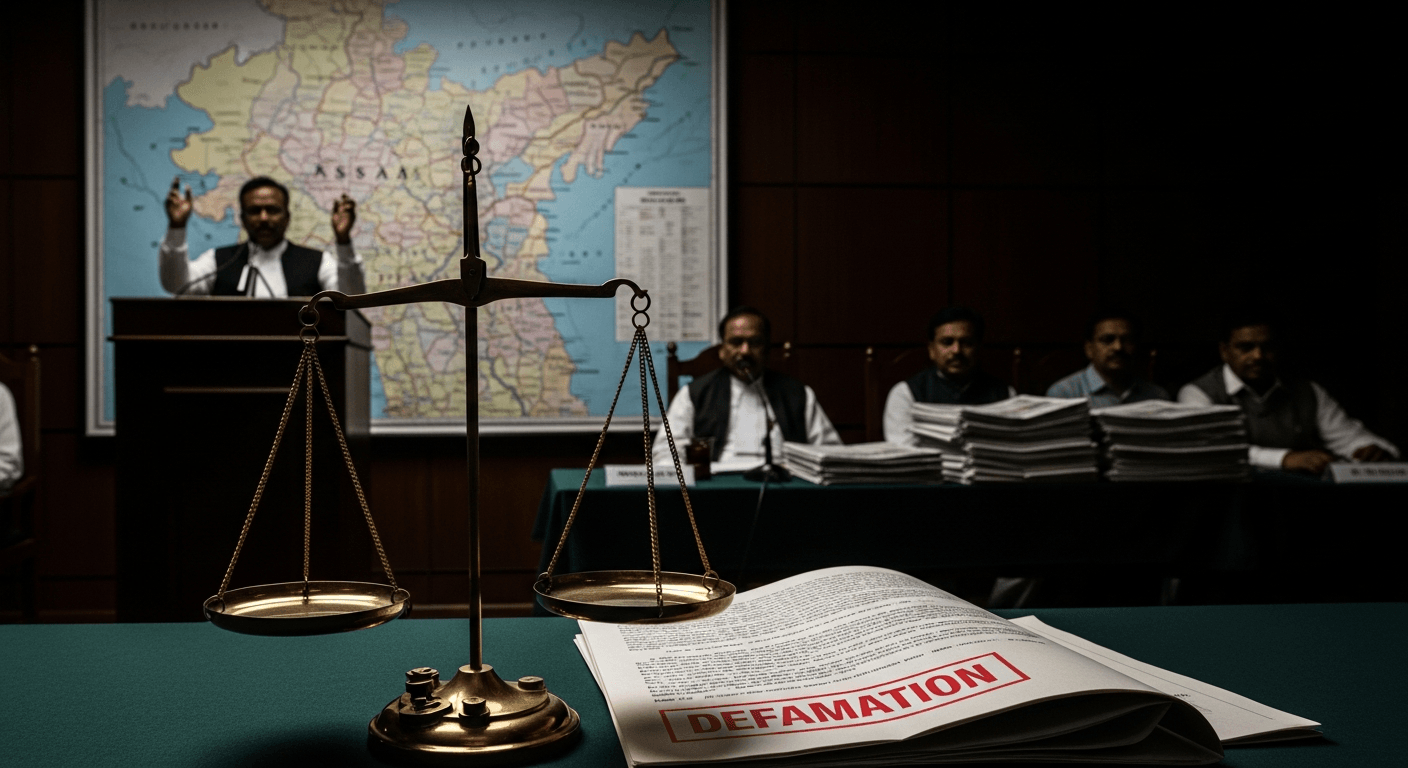
I want to unpack a high-stakes legal and political confrontation unfolding in Assam: the state's Chief Minister, Himanta Biswa Sarma (himanta.sarma@assam.gov.in), has filed a defamation suit seeking ₹500 crore (Rs 5,00,00,00,000) following allegations made at a recent Congress press conference, according to news reports and the CM’s official social-media statement. I write as an observer interested in how law, politics and public information collide.
Background of the dispute
- The immediate trigger was a Congress press conference in which allegations were made about the Chief Minister’s family and land/asset-related matters; these were widely reported in news reports and referenced in an official statement by the CM on X (formerly Twitter).
- In the days leading up to the suit, media coverage and exchanges on social platforms escalated the issue into a broader political confrontation. The CM publicly described the allegations as “false, malicious and defamatory” (official statement / social post) and announced both civil and criminal proceedings.
- My aim here is not to adjudicate factual claims but to explain the chronology, the legal frame, the likely political fallout, and the ethical questions this raises for journalists, political actors and citizens.
Timeline of events (concise)
- Day 0: Opposition leaders hold a press conference alleging misconduct related to land/assets; news reports carry the claims.
- Within 24–48 hours: The Chief Minister posts that he will initiate civil and criminal actions (official statement / social media post).
- Within 72 hours: A civil defamation suit for ₹500 crore is filed in the appropriate court; criminal complaints are announced to be initiated as well (news reports).
- Next days: Parties and stakeholders issue public reactions; media and fact-checkers begin to examine documentary records and previous reporting.
(These steps mirror how similar high-profile disputes have played out in recent Indian political-legal controversies.)
Legal aspects — defamation law in India (what the suit stands on)
- Dual avenues: India recognizes both civil and criminal defamation. Civil defamation remedies typically seek monetary compensation and injunctions; criminal defamation is covered under sections 499 and 500 of the Indian Penal Code (IPC).
- Burden of proof: In civil suits, the plaintiff must show that the defendant made a false statement that caused reputational harm. Defences can include truth (justification), fair comment on a matter of public interest, privilege (e.g., certain parliamentary or judicial privileges), and absence of malice in some contexts.
- Criminal defamation: The state (through police/complaint) can proceed if statements are alleged to have been made with malicious intent; conviction requires proof beyond reasonable doubt.
- Remedies: Typical civil remedies include damages, injunctions against repetition, and court-ordered apologies/retractions; criminal conviction can lead to fines or short-term imprisonment.
- Jurisdiction and procedure: The plaint must be filed in the civil court with jurisdiction over the place where damage occurred or where the defendant resides/works. The suit will proceed through plaint filing, framing of issues, evidence, witness examination, final arguments and judgment; interlocutory applications (e.g., for injunction) can be moved at early stages.
(For clarity: this is a general overview of Indian defamation law — each case turns on its facts and evidence.)
Political implications
- Short-term: The filing itself escalates rhetoric and tends to polarize media coverage. The plaintiff’s move signals an intent to contest allegations in court rather than solely in public debate — a strategy that can deter some forms of media repetition but also sharpen political campaigning.
- Electoral calculus: With elections on many minds across India, high-value suits have symbolic value: they can be framed as a defence of personal and office reputation or, by critics, as a means to silence dissent and intimidate opponents.
- Institutional pressures: Legal actions can force fact-finding by courts and potentially bring documentary evidence into the public record. Conversely, prolonged litigation can keep a controversy alive without definitive public resolution for years.
Reactions (summary from public statements and news reports)
- From the plaintiff: Himanta Biswa Sarma (himanta.sarma@assam.gov.in) described the allegations as false and malicious and announced both civil and criminal proceedings (official statement / social post).
- From the political opposition: Congress and allied leaders publicly denounced the CM’s allegations and called the legal move a political escalation; they have demanded documentary answers and contested the timing and substance of the CM’s claims (news reports / press reactions).
- From civil society and media: Commentators and some journalists have called for calm, careful verification of documentary evidence, and adherence to due process; fact-checking agencies and local media began revisiting earlier reporting that fed the dispute (news reports).
I have intentionally paraphrased opposition reactions as party responses, because public replies have come through party spokespeople, press statements and media interviews rather than a single consistent legal filing from the other side (news reports / press release).
Possible outcomes and next steps
- Immediate court steps: The court will first check procedural adequacy of the plaint. The defendant(s) may seek early dismissal or file written statements; interlocutory relief (e.g., injunctions) can be sought and contested in preliminary hearings.
- Discovery and evidence: Expect document exchange, witness affidavits, and possibly third‑party records summoned by the parties — these are the stages where factual disputes get tested in open court.
- Settlement possibilities: High-value suits sometimes end in negotiated settlements, public clarifications/apologies, or restricted undertakings, but the political dimension can reduce incentives to settle.
- Longer-term: Final civil adjudication may vindicate one side, require damages/apologies, or be followed by appeals; criminal charges, if pressed, will proceed along a different timeline and standard of proof.
Estimated legal timeline and typical remedies (practical estimate)
- Initial hearings and procedural orders: weeks to a few months.
- Evidence stage and trial: 1–3 years in many civil matters, depending on court backlog, complexity and interlocutory disputes.
- Appeal process: Additional 2–5 years if either party appeals to higher courts.
- Remedies commonly sought: monetary damages (compensation), injunctions (prevent further repetition), public apologies/retractions, and where criminal defamation is involved, fines or short jail terms (rare at the conviction stage in high-profile political cases).
(These are broad estimates based on patterns in Indian litigation and will vary case by case.)
Ethical and journalistic considerations
- Verify before repeating: Media and public figures must prioritize documentary verification before amplifying serious allegations about private individuals, especially when such claims can have civil or criminal consequences (ethical standard / press guidelines).
- Context matters: Political debate and investigative reporting have different standards; journalists should distinguish between allegation, claim and proven fact, making editorial choices transparent.
- Public interest vs. reputational harm: Editors must weigh legitimate public-interest reporting (e.g., corruption or misuse of office) against the risk of causing unjust reputational damage when evidence is inadequate.
- Legal chill: Large monetary suits can create a chilling effect on reporting and political speech; courts are the suitable forum to adjudicate contested factual claims but access to justice and the health of public debate must both be considered.
What I’m watching next
- The plaint’s details when made available in court records (these disclose the factual matrix the plaintiff relies on).
- Any early injunctions or interim orders that affect what can be published.
- Responses and formal pleadings by the defendant side and whether the opposition pursues counterclaims, corrections or media-based strategies.
- Independent fact-checks and documentary evidence (land records, government grant records, public filings) that either corroborate or contradict the public allegations (news reports / investigative pieces).
Conclusion
This case sits at the intersection of law, politics and media. A ₹500 crore defamation suit is both a legal instrument and a political signal. Courts will ultimately assess evidence; meanwhile, citizens and journalists should insist on careful verification and measured public discourse.
If you want to follow developments, watch court filings, official statements, and responsible reporting from established local and national outlets.
Regards,
Hemen Parekh
Any questions / doubts / clarifications regarding this blog? Just ask (by typing or talking) my Virtual Avatar on the website embedded below. Then "Share" that to your friend on WhatsApp.
Get correct answer to any question asked by Shri Amitabh Bachchan on Kaun Banega Crorepati, faster than any contestant
Hello Candidates :
- For UPSC – IAS – IPS – IFS etc., exams, you must prepare to answer, essay type questions which test your General Knowledge / Sensitivity of current events
- If you have read this blog carefully , you should be able to answer the following question:
- Need help ? No problem . Following are two AI AGENTS where we have PRE-LOADED this question in their respective Question Boxes . All that you have to do is just click SUBMIT
- www.HemenParekh.ai { a SLM , powered by my own Digital Content of more than 50,000 + documents, written by me over past 60 years of my professional career }
- www.IndiaAGI.ai { a consortium of 3 LLMs which debate and deliver a CONSENSUS answer – and each gives its own answer as well ! }
- It is up to you to decide which answer is more comprehensive / nuanced ( For sheer amazement, click both SUBMIT buttons quickly, one after another ) Then share any answer with yourself / your friends ( using WhatsApp / Email ). Nothing stops you from submitting ( just copy / paste from your resource ), all those questions from last year’s UPSC exam paper as well !
- May be there are other online resources which too provide you answers to UPSC “ General Knowledge “ questions but only I provide you in 26 languages !




No comments:
Post a Comment