
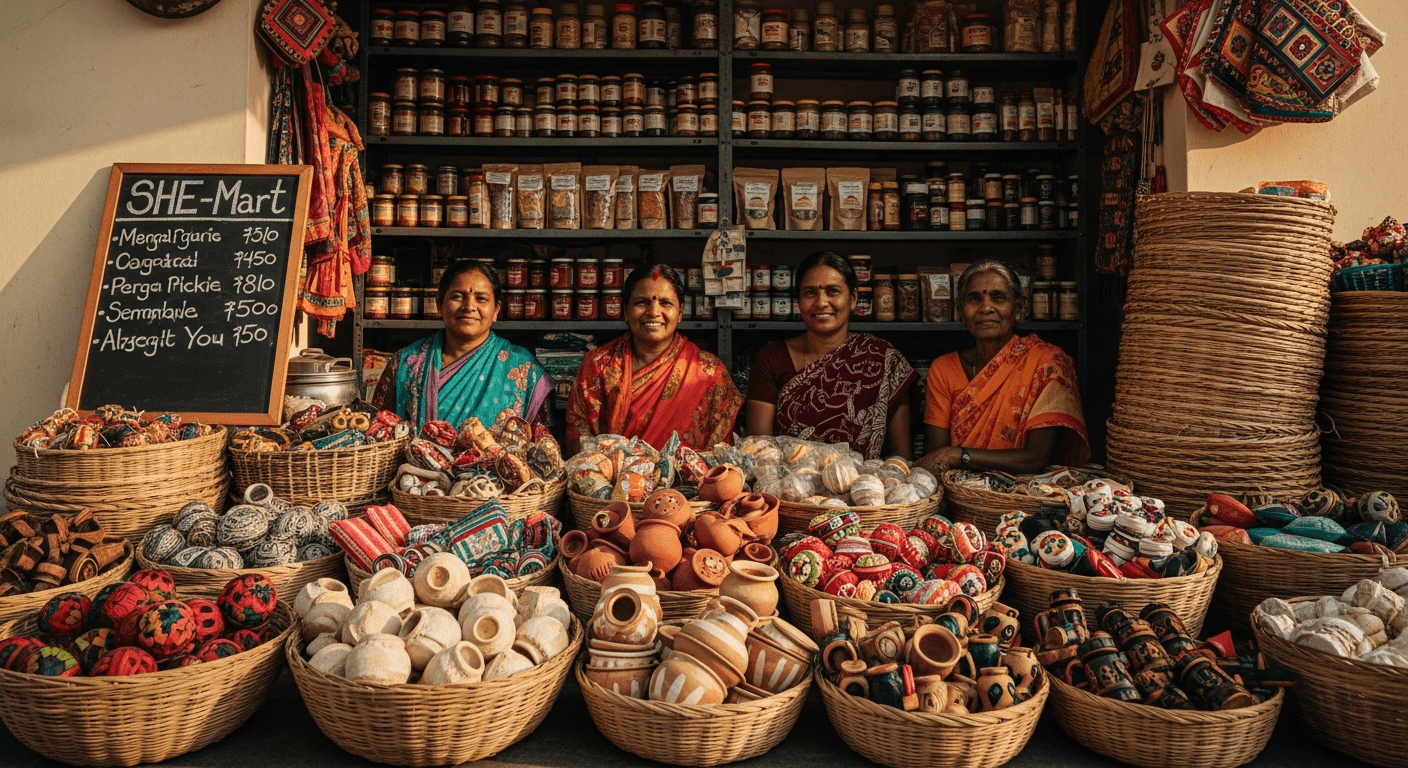
I remember the first time I wrote about the quiet power of self-employment: the way a single storefront, an online listing, or a better marketplace can change a household’s horizon. That thinking matters again today as the Union Budget introduces a new, concrete idea — SHE-Marts — meant to give women-led collectives a visible place in the market.
Read the explainer that prompted this reflection: CSR Journal explainer on SHE-Mart.
What is SHE-Mart — in plain terms
SHE-Mart stands for Self-Help Entrepreneur Marts. At its core it is simple: community-owned retail outlets run by women’s collectives (particularly Self-Help Groups and their cluster federations), offering a permanent, branded, and organised retail point for products made and curated by women.
This is not just a new logo for stalls; it is a nudge toward enterprise ownership rather than episodic, credit-linked livelihoods.
Why this budget announcement matters (to me)
I look at this through three lenses: economic, social, and systemic.
Economic: Permanent retail presence increases price discovery, reduces reliance on middlemen, and can improve margins. When products are visible and branded, buyers assign greater trust and are willing to pay fairer prices.
Social: Running a shop is entrepreneurial training. Inventory, billing, customer service, and local marketing build confidence and decision-making power inside households and communities.
Systemic: The move signals a policy shift — from solely credit-led support to market-led enterprise-building. If finance, training, and digital tools are aligned, this is a pathway from subsistence income to sustainable business ownership.
How SHE-Marts add to the Lakhpati Didi story
SHE-Marts are framed as the next step after schemes that helped women secure steady livelihoods. Where earlier interventions focused on skills and credit, SHE-Marts aim to create the infrastructure to convert those skills into visible enterprises — a shelf in a store, a price tag, repeat customers.
This is crucial: micro-credit without market access often keeps producers trapped in low-margin, irregular sales. A retail network changes that dynamic.
The practical promise — and where it can fail
SHE-Marts have clear potential, but outcomes will depend on implementation. Key issues I will be watching:
Funding and working capital: Innovative finance instruments are promised. They must reach cluster federations with minimal friction and predictable terms.
Supply chain and aggregation: Individual producers need help with packaging, quality control, inventory turnover, and replenishment planning. Aggregation at the federation level must be real, not nominal.
Training and business skills: Running a shop requires different skills than making a product. Continuous training (merchandising, customer relations, basic bookkeeping) is essential.
Location and footfall: A storefront without customers is a cost, not an asset. Placement strategy — near markets, transit nodes, or with co-marketing — will matter.
Brand and trust: A recognizable mark (She-Mark or similar) must stand for consistent quality. A bad experience at one SHE-Mart could harm the reputation of many producers.
Digital integration: Linking SHE-Marts to online marketplaces, digital payments, and an end-to-end loan approval system can amplify impact and make earnings visible for formal finance.
My suggestions (practical and immediate)
Start with pilots in high-potential clusters (agri-processed goods, textiles, natural products). Learn fast, iterate, document.
Pair SHE-Marts with a simple digital catalogue and QR-based payments so every product builds a transaction history that producers can use to access formal credit.
Invest in a small central team per district to help with packaging design, barcoding, consumer testing and seasonal merchandising.
Create a shared logistics pool or tie-ups with existing rural aggregation players to reduce distribution costs and ensure steady stock rotation.
Link success metrics to federations’ governance performance — e.g., transparent accounting, member rotation, and customer feedback loops.
Where this idea resonates with my earlier thinking
I have long argued that entrepreneurship — not perpetual subsidy — creates sustainable livelihoods. Years ago I wrote about converting underused assets and enabling small, visible businesses to flourish (My earlier post on entrepreneurship). SHE-Marts echo that logic: create places where value is seen, measured, and monetized.
A note of guarded optimism
Policy signals matter. Announcing SHE-Marts in the Budget is an important, positive nudge. But budgets are only the first step; the long arc of impact will be decided by how funds translate into well-located, well-run marts, and whether the ecosystem — finance, logistics, branding and digital tools — comes together.
If it does, we could watch thousands of micro-enterprises graduate into scalable, visible local brands. If it doesn’t, SHE-Mart risks becoming yet another promise that never gets organized into lasting livelihoods.
Regards,
Hemen Parekh
Any questions / doubts / clarifications regarding this blog? Just ask (by typing or talking) my Virtual Avatar on the website embedded below. Then "Share" that to your friend on WhatsApp.
Get correct answer to any question asked by Shri Amitabh Bachchan on Kaun Banega Crorepati, faster than any contestant
Hello Candidates :
- For UPSC – IAS – IPS – IFS etc., exams, you must prepare to answer, essay type questions which test your General Knowledge / Sensitivity of current events
- If you have read this blog carefully , you should be able to answer the following question:
- Need help ? No problem . Following are two AI AGENTS where we have PRE-LOADED this question in their respective Question Boxes . All that you have to do is just click SUBMIT
- www.HemenParekh.ai { a SLM , powered by my own Digital Content of more than 50,000 + documents, written by me over past 60 years of my professional career }
- www.IndiaAGI.ai { a consortium of 3 LLMs which debate and deliver a CONSENSUS answer – and each gives its own answer as well ! }
- It is up to you to decide which answer is more comprehensive / nuanced ( For sheer amazement, click both SUBMIT buttons quickly, one after another ) Then share any answer with yourself / your friends ( using WhatsApp / Email ). Nothing stops you from submitting ( just copy / paste from your resource ), all those questions from last year’s UPSC exam paper as well !
- May be there are other online resources which too provide you answers to UPSC “ General Knowledge “ questions but only I provide you in 26 languages !



No comments:
Post a Comment