
Introduction
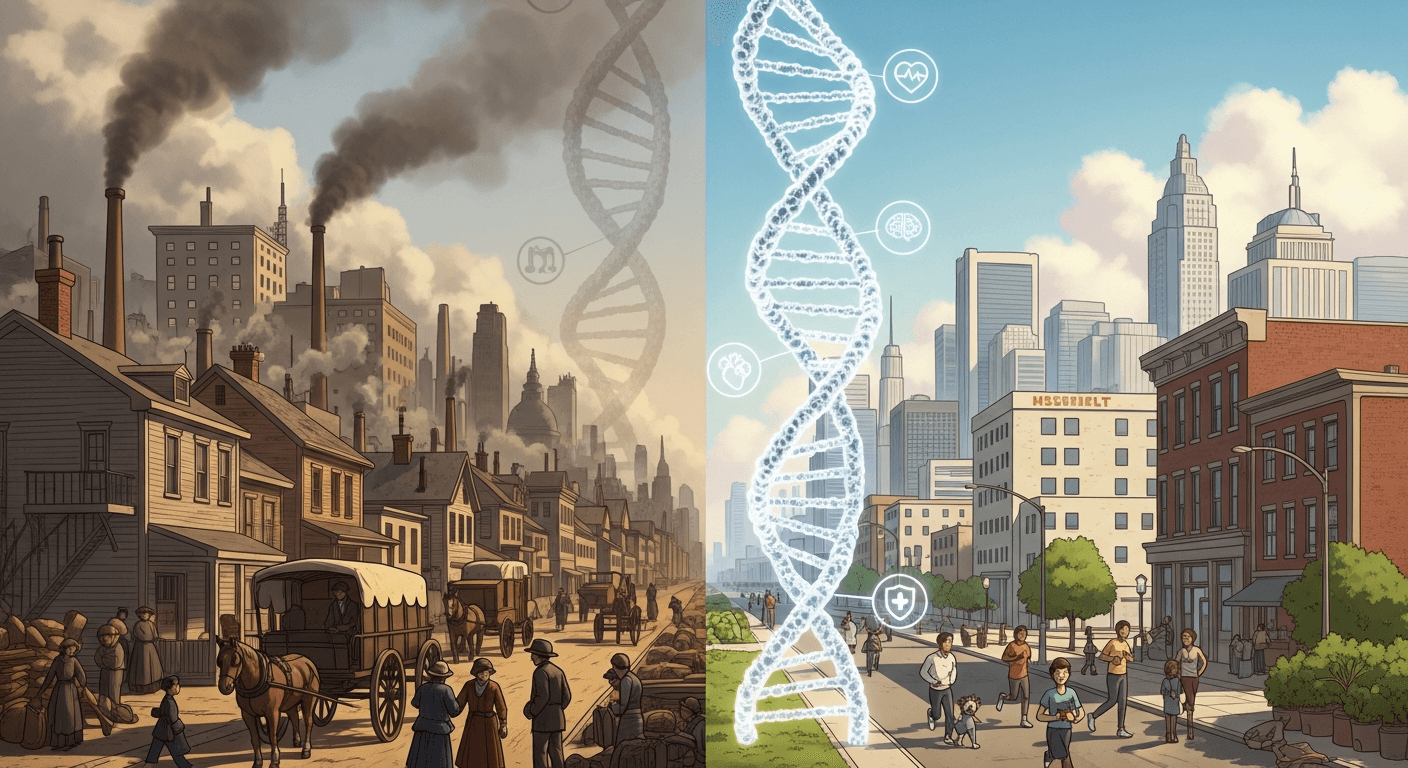
A century ago, your chance of reaching old age was determined largely by where you lived, what you ate, and whether you survived infections in childhood. I grew up reading that story again and again: public health and simple social changes drove the vast increase in average lifespan over the 20th century. That is true — but it also means something subtle and important for individuals today: the relative role of inherited DNA in determining who lives longest has risen.
In this post I’ll explain why genes matter more for lifespan now than they did a century ago, how that increased influence actually operates (genetic architecture, gene–environment interactions, medicine, and demography), and what this means for you. I’ll use specific examples — APOE, identified longevity variants, and polygenic risk — and finish with practical takeaways and cautious notes about interpretation and ethics.
The core idea, simply put
- In rough terms, the variation in lifespan we can explain breaks into genetic factors, environmental/exposure factors, and random (stochastic) effects.
- When the environment is harsher and causes many premature deaths (infectious disease, poor sanitation, high infant mortality), most lifespan variation is driven by those environmental risks — they swamp small genetic differences.
- As public health, nutrition, and medicine remove many of those early and mid-life causes of death, the residual differences in who lives longest are increasingly shaped by genetic susceptibilities that affect late-life disease risks and resilience.
Put differently: as we remove the “low-hanging” environmental causes of early death, the relative share of variation explained by inherited DNA goes up even if the genome itself hasn’t changed much.
The mechanisms: how and why genetic influence rises
1) Genetic architecture — many small effects add up
Lifespan is a complex trait. A few loci (notably APOE) have reproducible effects, but most of the genetic signal is polygenic — thousands of variants with tiny effects that, when aggregated, can meaningfully shift risk.
- Single genes with large population-level effects are rare. APOE is a clear, repeatedly observed example: the ε4 allele increases risk for Alzheimer’s disease and vascular disease and shortens average survival; ε2 is mildly protective for some outcomes [see the GWAS and longevity literature below].
- Polygenic scores (PGS) combine many small effects into a single estimate of inherited predisposition. Those scores were not available a decade ago; now they explain measurable variation for some diseases and for composite longevity measures [examples cited below].
(For reviews and GWAS evidence see: Human longevity: Genetics or Lifestyle? and recent large analyses of UK Biobank data [https://pmc.ncbi.nlm.nih.gov/articles/PMC11312667/].)
2) Gene–environment interaction (G×E) — the same genotype behaves differently in different worlds
Genes don’t act in a vacuum. A variant’s effect can be magnified or muted by environment.
- When environmental hazards fall (vaccines, antibiotics, clean water, reduced smoking and occupational hazards), the contexts in which genetic susceptibility matters shift toward later-life chronic diseases (cardiovascular disease, cancer, dementia).
- Cohort studies show that the impact of the same allele can change across birth cohorts as exposures change. In other words, the population-level effect of a genotype often depends on the world that genotype faces [see cohort analyses and conceptual work on G×E and the exposome].
Key conceptual work on gene–environment and stochastic contributions to aging is useful for framing these effects [see: https://pmc.ncbi.nlm.nih.gov/articles/PMC8436990/].
3) Medical advances change what kills us — and therefore which genetic risks matter
- A century ago, infections, maternal/infant mortality, and acute causes were major drivers of early death. Today the leading causes of death are age-related chronic diseases.
- Medical advances (statins and antihypertensives, cancer screening and treatments, intensive care) reduce the impact of some genetic risks (or delay their consequences) while magnifying the relative importance of others. For example, if cardiovascular deaths decline due to better treatment, genetic variants that predispose to neurodegeneration or late-life cancer become relatively more important for ultimate lifespan.
4) Demography and selection: more people survive to ages where genetic effects express
- Heritability estimates for lifespan rise at older ages in many studies. Twin studies report that genetics explains roughly a quarter of lifespan variance overall, and that genetic influence often increases in older age groups (because environmental causes of death have already removed many susceptibles) [see twin-study summaries in the literature].
- As more people survive to the ages when late-onset diseases appear, population-level differences between genotypes at those late ages become easier to observe.
Historical context: a century ago vs. today
A quick, comparative sketch:
Around 1900–1920: high infant and child mortality, widespread infectious disease, poor sanitation in many places. If you died young from infection or childbirth, your DNA for late-onset disease never had a chance to matter. Public health interventions produced the largest leaps in average lifespan.
Mid–late 20th century: vaccinations, antibiotics, better nutrition, and safer workplaces produced dramatic declines in early and mid-life death. Chronic diseases rose to prominence as leading causes of death.
21st century: advanced diagnostics, targeted treatments, and preventive care push more people into very old age. The causes of death cluster around age-related pathologies (Alzheimer’s, cancers, heart disease). In this environment, inherited susceptibility to those late-onset diseases contributes more proportionally to who becomes exceptionally long-lived.
Empirical studies support this view. Twin analyses and cohort comparisons consistently show modest overall heritability (~20–30%), with genetic influence more visible at advanced ages; cohort papers also document shifting allele effects across birth cohorts for genes such as APOE [see cohort studies and reviews cited below].
Examples that make it concrete
APOE. The apolipoprotein E gene (APOE) is the most reproducible common genetic influence on human survival. The ε4 allele raises Alzheimer’s and cardiovascular risk; ε2 is sometimes associated with a small survival advantage. Because Alzheimer’s and vascular disease are now major causes of late-life death, APOE’s population-level importance is more visible today than in an era dominated by early infectious mortality [see GWAS and cohort analyses: https://pmc.ncbi.nlm.nih.gov/articles/PMC11312667/ and https://academic.oup.com/aje/article/189/7/708/5714865].
Longevity variants and rare damaging genes. Large-scale sequencing and burden tests show that some rare loss-of-function variants (in genes linked to cancer predisposition or telomere biology, for example) can shorten lifespan. Conversely, a handful of loci (and likely many yet-undiscovered variants) are overrepresented in very long-lived individuals. As survival to older ages increases, the signal from these variants becomes easier to detect [see exome and GWAS analyses in recent UK Biobank papers: https://pmc.ncbi.nlm.nih.gov/articles/PMC11312667/].
Polygenic risk. A composite polygenic score for “longevity” — or for major diseases like coronary artery disease, breast cancer, or Alzheimer’s — can predict meaningful differences in risk. Aggregating tiny effects across the genome produces a predictor that explains more variance than any single common SNP. Polygenic risk is more useful now because: (a) large biobanks let us estimate many small effects precisely, and (b) modern environments expose or reveal those effects in late-life disease patterns [see integrative exposome-genetics work: https://pmc.ncbi.nlm.nih.gov/articles/PMC11922759/].
Practical takeaways — what you can do
- Lifestyle still matters — a lot
- Even when genetics explains a larger fraction of remaining lifespan variation, environmental and behavioral factors remain powerful determinants of disease and survival. Diet, exercise, smoking avoidance, vaccination, and air quality have huge population-level impacts and can change your personal trajectory.
- Genes are probabilistic, not deterministic
- A higher polygenic risk or an unfavorable APOE genotype increases probability of disease or earlier death, but it does not guarantee an outcome. Many people with “high-risk” genotypes live long, healthy lives; many people with “low-risk” genotypes develop disease because exposures matter.
- When genetic testing may help
- Clinical genetic testing is most actionable when it identifies high-penetrance variants tied to specific prevention or early-detection strategies (e.g., BRCA1/2 and enhanced cancer screening; some monogenic cardiomyopathies with family screening).
- Polygenic scores for major diseases can stratify risk but their clinical utility depends on context (age, ancestry, available prevention/treatment). They are better used as one input in a broader risk assessment than as a standalone verdict.
- If you learn your genetic risks
- Focus on actionable steps: optimize cardiovascular risk factors, screen appropriately for cancers, manage metabolic risk, and address modifiable exposures (smoking cessation, air pollution reduction, vaccination, exercise, nutrition).
- Use genetic information to target preventive care — not to create fatalism.
Cautious notes about interpretation and ethics
Population vs. individual. Much research reports differences at the population level. Translating that to an individual’s fate requires caution.
Ancestry and bias. Polygenic scores and GWAS have been developed largely in populations of European ancestry. Their performance can be worse in other ancestries. We must avoid exacerbating health disparities by misapplying tools trained on non-representative data.
Privacy and discrimination. Genetic data are sensitive. Concerns about insurance discrimination, employment misuse, or breaches of privacy are real. Laws differ by country; informed consent and careful governance are essential.
Psychological impact. Learning about elevated genetic risk can motivate prevention for some people and provoke anxiety in others. Counseling and framed clinical use are important.
Overclaiming. The media sometimes oversimplifies “genes cause disease” narratives. I try to avoid that trap: the genome matters more in our modern environment, but it’s not everything.
Closing reflections
I find the modern shift humbling and empowering at the same time. Humbling because it reminds me that most of what shaped human life a century ago was environmental and social; empowering because, in today’s context, we can measure inherited risks and often act on them. The rise in the relative importance of genetics for lifespan is not a cause for fatalism — it’s a call to better integration: better public health, better individualized prevention, and fairer access to both.
If you take one thing away: genes matter more now not because our DNA suddenly changed, but because we changed the world around that DNA. That opens opportunities to use genetic knowledge responsibly — to prevent disease, lengthen healthy lives, and reduce suffering — but doing so requires care, equity, and humility.
Selected references and further reading
- A conceptual review of gene–environment and stochastic contributions to aging: Gene–Environment Interactions and Stochastic Variations in the Biology of Aging.
- Integrative analysis of environment and genetics showing distinct contributions to mortality and disease: Integrating the environmental and genetic architectures of aging and mortality.
- Recent genetic analyses of longevity and lifespan in large biobanks: Genetic associations with human longevity are enriched for ….
- Historical and twin-study perspectives on heritability of lifespan and the special role of APOE: Cardiovascular Genes and Longevity (review/twin analyses).
- General consumer-friendly overview of genetics and longevity: Is longevity determined by genetics? (MedlinePlus).
Regards,
Hemen Parekh (hcp@recruitguru.com)
Any questions / doubts / clarifications regarding this blog? Just ask (by typing or talking) my Virtual Avatar on the website embedded below. Then "Share" that to your friend on WhatsApp.
Get correct answer to any question asked by Shri Amitabh Bachchan on Kaun Banega Crorepati, faster than any contestant
Hello Candidates :
- For UPSC – IAS – IPS – IFS etc., exams, you must prepare to answer, essay type questions which test your General Knowledge / Sensitivity of current events
- If you have read this blog carefully , you should be able to answer the following question:
- Need help ? No problem . Following are two AI AGENTS where we have PRE-LOADED this question in their respective Question Boxes . All that you have to do is just click SUBMIT
- www.HemenParekh.ai { a SLM , powered by my own Digital Content of more than 50,000 + documents, written by me over past 60 years of my professional career }
- www.IndiaAGI.ai { a consortium of 3 LLMs which debate and deliver a CONSENSUS answer – and each gives its own answer as well ! }
- It is up to you to decide which answer is more comprehensive / nuanced ( For sheer amazement, click both SUBMIT buttons quickly, one after another ) Then share any answer with yourself / your friends ( using WhatsApp / Email ). Nothing stops you from submitting ( just copy / paste from your resource ), all those questions from last year’s UPSC exam paper as well !
- May be there are other online resources which too provide you answers to UPSC “ General Knowledge “ questions but only I provide you in 26 languages !



No comments:
Post a Comment