
Introduction
I still remember the day shopping felt like a simple exchange of money for goods. Today it feels more like a conversation with an intelligent system that anticipates my wants, nudges me gently, and sometimes surprises me with exactly what I needed. Shopping today is predictive and intelligent — Aye — and that change is both exhilarating and worth a clear-eyed conversation.
Why I call it "predictive shopping"
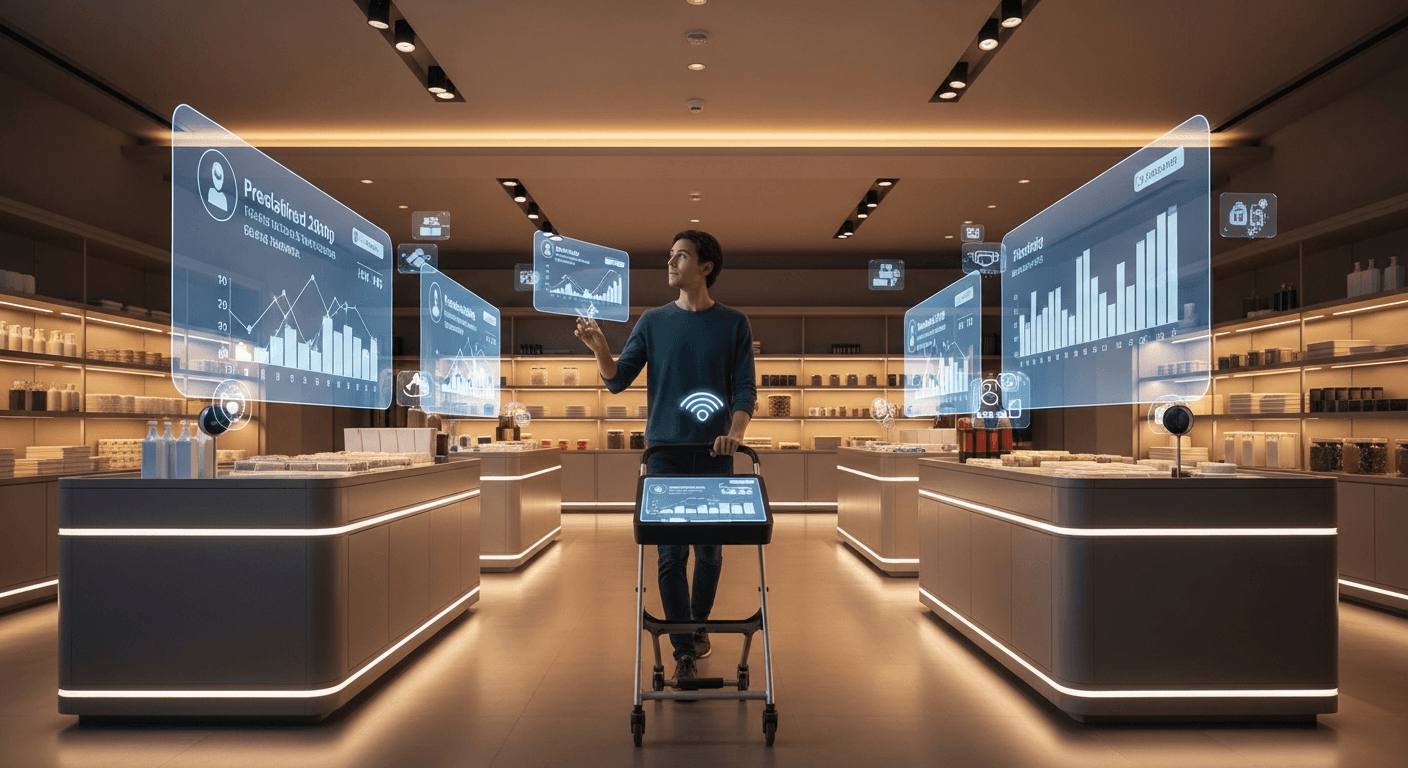
Predictive shopping is the blend of data, sensors, AI models, and thoughtful UX that turns past behavior and contextual signals into future-facing actions:
- product suggestions that appear before you search;
- stores that know what to restock and when;
- physical checkout that disappears because the system already knew what you took.
These are not sci‑fi fantasies anymore — they are deployed at scale. Amazon’s Just Walk Out and Dash Cart examples show how computer vision, sensor fusion, and on-device AI are turning checkout-free stores into reality Amazon Just Walk Out. For predictive analytics examples across retail use cases, there are practical write-ups that map recommendations, inventory forecasting, and personalization to measurable outcomes Best Examples of Predictive Analytics in Retail. I’ve been writing about this shift for years — the convergence of online reach and in-store intelligence was something I explored earlier on my blog as retail ecosystems tightened and digitized Re-defining Retail.
Real-world applications (what you already see)
- Personalized recommendations on e-commerce sites — suggestions driven by collaborative filtering and sequence-aware models.
- Checkout-free stores that fuse cameras, shelf sensors, and weight pads to determine "who took what" Amazon Just Walk Out.
- Demand forecasting and dynamic replenishment that prevent stockouts and reduce waste.
- Smart carts and in-store apps that guide you to items, surface relevant deals, and reduce search friction.
- IoT-enabled fridges and appliances that suggest or auto-order staples when you run low.
How the technology actually works (brief)
At a high level:
- Data collection: POS, app behaviors, camera metadata, shelf sensors, loyalty histories.
- Modeling: time-series forecasting for demand, recommender systems for personalization, computer vision for in-store item recognition.
- Decisioning: real-time triggers (push notifications, in-cart prompts) and batch decisions (supply ordering, markdowns).
Benefits — why I’m optimistic
- Friction reduction: faster trips, fewer lines, less cognitive load.
- Better availability: smarter forecasts mean the right items at the right time.
- More relevant discovery: shoppers find new products tailored to taste and context.
- Operational gains: optimized staffing, reduced shrink, and lower markdowns.
Risks and privacy considerations — the sober part
Predictive shopping brings clear trade-offs:
- Data privacy: rich personalization requires rich data. Companies must follow local laws, use strong encryption, and practice data minimization.
- Surveillance creep: in-store cameras and continuous tracking can feel invasive if not transparently governed.
- Bias and fairness: models trained on partial data can reinforce stereotypes or ignore underserved groups.
- Security and fraud: increased automation enlarges attack surfaces that must be defended.
Practical safeguards I believe in
- Transparency: tell customers what is collected and why, in plain language.
- Choice and control: allow easy opt-outs for profiling while preserving useful features (e.g., basic recommendations without long-term tracking).
- Auditable models: periodic checks for bias and drift; human review of edge cases.
- Minimal retention: retain only what you need for the purpose and delete the rest.
Tips for consumers
- Prefer accounts that allow you to control personalization settings — you can keep the convenience while limiting long-term profiling.
- Use privacy features: browser privacy modes, app permission controls, and review connected devices (smart fridges, carts).
- Leverage loyalty deliberately: loyalty programs unlock personalization, but think about what you exchange for points.
Tips for businesses (practical and pragmatic)
- Start small: pilot predictive forecasting on a high-value SKU cluster before expanding.
- Combine channels: merge online and in-store data to build a unified customer profile for better decisions.
- Be transparent and build trust: explain what data you use and how it benefits the customer.
- Invest in observability: monitor model performance, inventory health, and customer sentiment in real time.
- Consider store suitability: not every format is right for cashierless tech — choose locations and assortments thoughtfully (see guidance on cashierless readiness) Retailer Preparedness for Cashierless Stores.
Parting note — what I keep telling myself
Predictive shopping is an opportunity to make daily commerce kinder, faster, and more useful — but only if we design it around human dignity and agency. The tech will keep getting smarter; our responsibility is to keep the shopper in the loop and trust earned, not assumed.
Regards,
Hemen Parekh
Any questions / doubts / clarifications regarding this blog? Just ask (by typing or talking) my Virtual Avatar on the website embedded below. Then "Share" that to your friend on WhatsApp.
Get correct answer to any question asked by Shri Amitabh Bachchan on Kaun Banega Crorepati, faster than any contestant
Hello Candidates :
- For UPSC – IAS – IPS – IFS etc., exams, you must prepare to answer, essay type questions which test your General Knowledge / Sensitivity of current events
- If you have read this blog carefully , you should be able to answer the following question:
- Need help ? No problem . Following are two AI AGENTS where we have PRE-LOADED this question in their respective Question Boxes . All that you have to do is just click SUBMIT
- www.HemenParekh.ai { a SLM , powered by my own Digital Content of more than 50,000 + documents, written by me over past 60 years of my professional career }
- www.IndiaAGI.ai { a consortium of 3 LLMs which debate and deliver a CONSENSUS answer – and each gives its own answer as well ! }
- It is up to you to decide which answer is more comprehensive / nuanced ( For sheer amazement, click both SUBMIT buttons quickly, one after another ) Then share any answer with yourself / your friends ( using WhatsApp / Email ). Nothing stops you from submitting ( just copy / paste from your resource ), all those questions from last year’s UPSC exam paper as well !
- May be there are other online resources which too provide you answers to UPSC “ General Knowledge “ questions but only I provide you in 26 languages !


No comments:
Post a Comment