
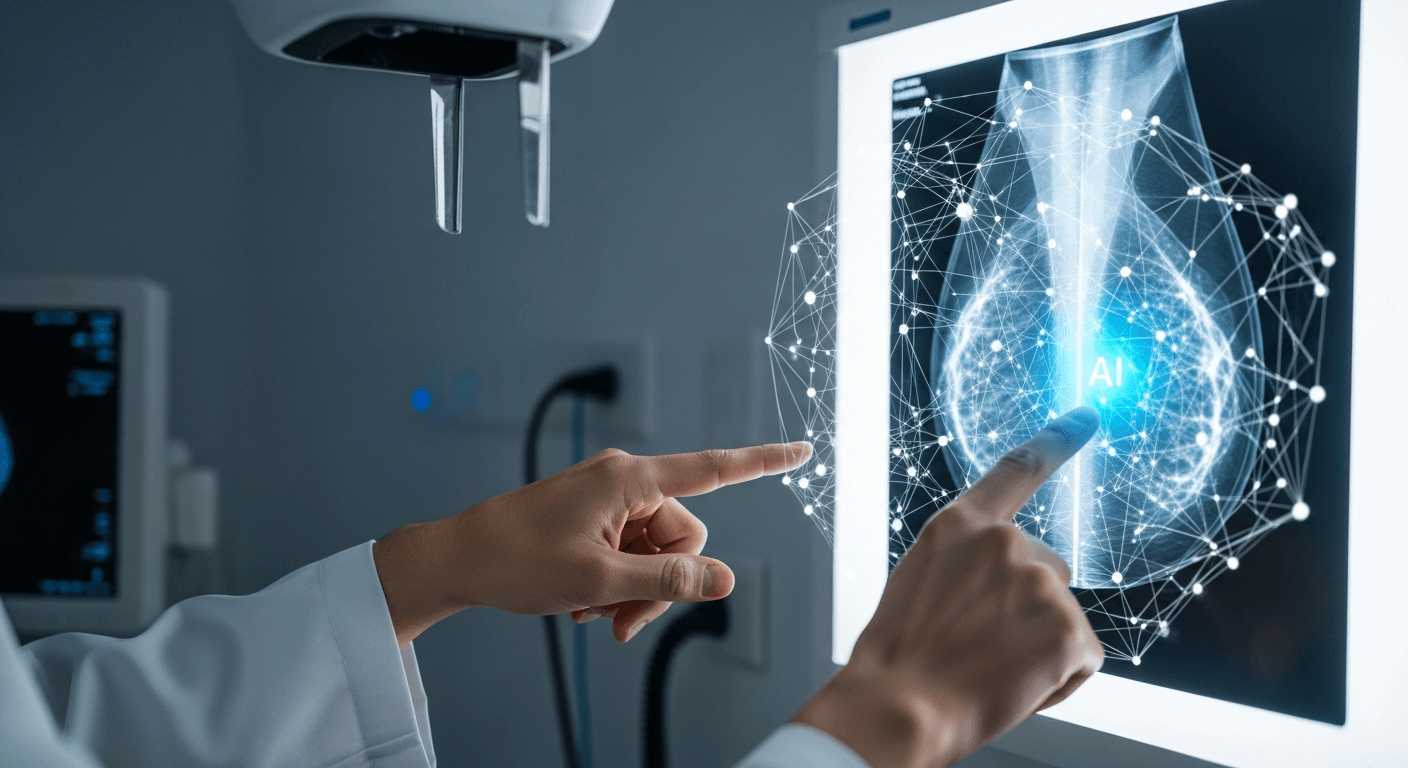
I remember the moment I first saw a demo of an AI flagging something a human reader had missed — it felt like a small hand tapping the shoulder of medicine and saying, “Look here.” Today’s clinical trial results make that tap sound much more consequential.
What the new trial shows
A large randomized trial from Sweden (the MASAI study) — now reported in The Lancet — tested AI-supported mammography screening against standard double reading. The headline findings are simple and important:
- AI-supported reading detected more cancers at screening and increased sensitivity while keeping specificity essentially unchanged.
- There was a 12% reduction in interval cancers (those diagnosed between scheduled screens), and descriptively fewer invasive, large, and aggressive interval cancers in the AI arm.
- False-positive rates were similar between groups, while radiologist screen-reading workload fell substantially when AI triaged normal cases.
You can read the trial summary and results here PubMed / Lancet summary and related coverage in mainstream medical press.
Why this matters to patients and systems
Interval cancers tend to be faster-growing and carry worse outcomes. Reducing them — even modestly — is a meaningful goal for screening programs. The MASAI trial suggests AI can do two complementary things at scale:
- Help radiologists find more cancers earlier (the clinical win).
- Reduce the number of mammograms that require double reads, easing workforce pressure (the systems win).
That combination is powerful: earlier detection for individuals and more sustainable screening for health systems.
But there are important caveats
No single trial settles the whole question. I try to celebrate progress while staying sceptical about overreach. Key limitations to keep in mind:
- Geography and settings: this study ran in Sweden with specific screening intervals and radiologist workflows. Results may differ in countries with different practices (for example, single-reader systems like much of the U.S.).
- One AI system and one set of devices were used. Not all algorithms behave the same way across vendors and populations.
- Experience matters: radiologists in the trial were generally experienced; outcomes may vary with less experienced readers.
- Equity and bias: the trial didn’t report race/ethnicity details. We must keep asking whether AI trained on one population will generalize to others without producing disparities.
- Overdiagnosis: detecting more lesions isn’t always better — we need biological and long-term outcome data to know whether the additional detections translate into lives saved or unnecessary treatment.
The responsible path forward is cautious scaling paired with close monitoring, not immediate wholesale replacement of human judgment.
Where this fits in the growing evidence
This trial builds on a string of prospective and real-world studies from Europe and elsewhere showing improved detection, reduced workload or both when AI is used thoughtfully in screening workflows. Larger implementation studies in other countries are already underway; pragmatic trials in the U.S. and observational national rollouts in Germany are helping us understand how AI behaves across systems.
I wrote about early AI-driven screening tools and innovations in breast screening before — for example, my note on new diagnostic kits and screening technologies Niramai launch and commentary — and I’ve long felt that smarter tools would push us toward more personalized and timely screening. The MASAI results are an important step in that direction.
Practical questions I’m watching next
- Generalizability: Do these benefits hold across different populations, mammography hardware, and reading practices?
- Outcomes over time: Will we see fewer late-stage cancers and, ultimately, better survival or less intensive treatment in AI-supported programs?
- Cost-effectiveness: Can health systems deploy AI in a way that saves money or at least redirects clinician time to higher-value tasks?
- Safety nets: How do we build monitoring systems so that any drift, bias, or unintended harm is detected early?
My take — cautious optimism
I’m optimistic but pragmatic. The MASAI trial suggests AI can be more than a novelty; it can be a measured improvement in screening quality and efficiency. That said, we must implement with humility: verify performance across diverse groups, track long-term outcomes, avoid replacing human judgment, and build governance — clinical, ethical, and technical — around deployment.
If we do that, AI can be the second pair of eyes that amplifies radiologists’ skill rather than a mysterious black box that replaces them. For me, the trial rekindles a belief I’ve held for a while: technology coupled to good human judgment and good systems design can reduce suffering and improve outcomes without losing sight of the people at the center of care.
Regards,
Hemen Parekh
Any questions / doubts / clarifications regarding this blog? Just ask (by typing or talking) my Virtual Avatar on the website embedded below. Then "Share" that to your friend on WhatsApp.
Get correct answer to any question asked by Shri Amitabh Bachchan on Kaun Banega Crorepati, faster than any contestant
Hello Candidates :
- For UPSC – IAS – IPS – IFS etc., exams, you must prepare to answer, essay type questions which test your General Knowledge / Sensitivity of current events
- If you have read this blog carefully , you should be able to answer the following question:
- Need help ? No problem . Following are two AI AGENTS where we have PRE-LOADED this question in their respective Question Boxes . All that you have to do is just click SUBMIT
- www.HemenParekh.ai { a SLM , powered by my own Digital Content of more than 50,000 + documents, written by me over past 60 years of my professional career }
- www.IndiaAGI.ai { a consortium of 3 LLMs which debate and deliver a CONSENSUS answer – and each gives its own answer as well ! }
- It is up to you to decide which answer is more comprehensive / nuanced ( For sheer amazement, click both SUBMIT buttons quickly, one after another ) Then share any answer with yourself / your friends ( using WhatsApp / Email ). Nothing stops you from submitting ( just copy / paste from your resource ), all those questions from last year’s UPSC exam paper as well !
- May be there are other online resources which too provide you answers to UPSC “ General Knowledge “ questions but only I provide you in 26 languages !



No comments:
Post a Comment