
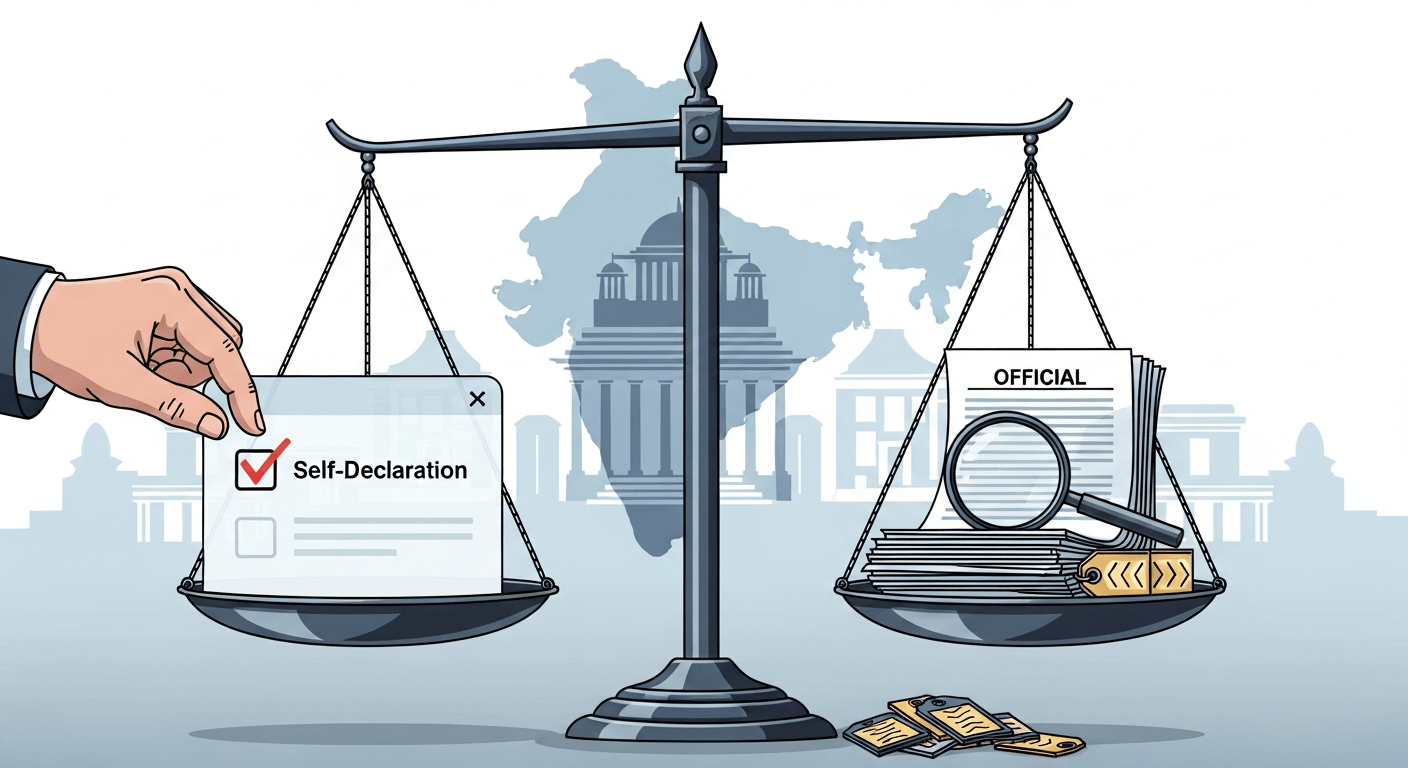
Why the Supreme Court’s observation matters
I write this as someone who believes good public policy needs good data. The recent observation by the Supreme Court of India — that mere self-declaration cannot be enough for a nationwide caste enumeration — is not a judgment against enumerating caste. Rather, it is a reminder that the stakes are high: census numbers will feed welfare design, reservations, political representation and research for decades For caste census, mere self-declaration cannot be enough: SC.
The Court disposed of the PIL without issuing binding directions, but asked census authorities to consider the concerns and to evolve a robust, expert-backed mechanism. That procedural nudging is important: it asks the technical experts to be transparent about methods and safeguards rather than letting processes remain opaque Accurate data key in caste census: SC.
What a caste census is — and why it’s contested
A caste census records the population by caste groups across the country. India has historically counted Scheduled Castes and Scheduled Tribes, but a full enumeration that includes Other Backward Classes (OBCs) and other caste sub-groups for the entire population will be the first of its kind since the pre-independence era. Advocates argue it provides the empirical foundation for targeted welfare, fairer representation and evidence-based reservation policy. Critics worry about politicisation, data misuse, and the administrative complexity of classifying heterogeneous local caste identities.
The conversation is not new: past socio-economic caste surveys faced questions about reliability and political context, and the Supreme Court’s response reflects both constitutional sensitivity and administrative caution LiveLaw coverage of the order.
Self-declaration in censuses: arguments for and against
Pros of self-declaration
- Respect for identity: letting individuals state how they identify avoids imposing categories from above.
- Practicality: large-scale surveys rely on self-response for feasibility and respondent dignity.
- International precedent: many countries collect ethnicity/race via self-identification (see below).
Cons of self-declaration
- Strategic misreporting: when benefits are linked to group membership, incentives to misreport may increase.
- Standardisation problems: local caste names, synonyms and overlaps can lead to inconsistent classification.
- Downstream policy distortion: incorrect counts can skew reservation ceilings, resource allocation and delimitation exercises.
The Court’s point is precisely that self-declaration without verification or methodological safeguards risks producing numbers that are politically consequential but methodologically weak.
Legal and administrative challenges
- Statutory mandate and domain expertise: census design falls under the Census Act and technical experts; courts typically defer to the executive’s technical competence.
- Classification rules: India lacks a single, universally agreed list of thousands of caste names and granular sub-castes, raising questions about coding and aggregation.
- Operational scale: a fully digital, house-to-house enumeration that also triangulates caste claims will be a logistical challenge and expensive.
- Long-term effects: census data may be used in litigation or policy changes for generations; mistakes are not easily reversible.
International comparisons
There is a range of practice internationally when governments collect identity-related data.
United Kingdom: the Office for National Statistics asks an ethnicity question as self-identification with standardised tick-box categories and write-in options; the ONS documents quality controls and post-processing to maintain comparability across censuses ONS — Ethnic group, England and Wales: Census 2021.
United States: race and Hispanic-origin questions have long been self-reported; the Census Bureau and the Office of Management and Budget publish standards and experimental research about question design and the impact of combining/ separating race and ethnicity questions. Administrative records are sometimes used to fill missing data, but core identity items remain self-reported Census Bureau discussion on race/ethnicity standards and methods.
Brazil: the IBGE collects “color or race” via self-declaration (white, black, brown/pardo, yellow, indigenous) and has shown how self-identification can change over time; Brazil’s experience highlights that identity categories are often fluid and sensitive to social context IBGE 2022 Census results.
None of these countries rely solely on third-party certification to record identity; instead, they combine careful questionnaire design, public consultation, and quality assurance.
Implications for policy and affirmative action
Reliable caste data could reshape affirmative-action targeting and the legal conversation about reservation ceilings and representation. But flawed numbers risk misallocating scarce resources and producing litigable outcomes. That is why the Court emphasised the need for verifiable and transparent mechanisms rather than an argument against enumeration itself.
Possible alternatives and safeguards
To balance feasibility with credibility, authorities can combine methods:
- Verification sampling: conduct in-depth verification on a statistically significant sample to estimate misreporting rates and adjust counts.
- Administrative triangulation: match self-reported responses with community registers, school/degree records, and publicly available caste certificate datasets where appropriate, with privacy safeguards.
- Questionnaire design: use standardised categories, guided write-in fields and interviewer training to reduce misclassification.
- Audit trails & transparency: publish methodology, codebooks and error margins so researchers and courts can assess data quality.
- Independent oversight: invite domain experts, statisticians and civil-society representatives to peer-review methods before rollout.
Concluding thoughts
I support the idea that we should count what matters — caste matters for social justice in India — but counting must be done in ways that earn public trust. Self-declaration can be a starting point, but the Supreme Court’s intervention rightly insists on safeguards. The middle path is not perfection; it is a transparent, expert-led approach that combines respect for identity with statistical rigor so that the numbers we use to design policy are credible and defensible.
Regards,
Hemen Parekh
Any questions / doubts / clarifications regarding this blog? Just ask (by typing or talking) my Virtual Avatar on the website embedded below. Then "Share" that to your friend on WhatsApp.
Get correct answer to any question asked by Shri Amitabh Bachchan on Kaun Banega Crorepati, faster than any contestant
Hello Candidates :
- For UPSC – IAS – IPS – IFS etc., exams, you must prepare to answer, essay type questions which test your General Knowledge / Sensitivity of current events
- If you have read this blog carefully , you should be able to answer the following question:
- Need help ? No problem . Following are two AI AGENTS where we have PRE-LOADED this question in their respective Question Boxes . All that you have to do is just click SUBMIT
- www.HemenParekh.ai { a SLM , powered by my own Digital Content of more than 50,000 + documents, written by me over past 60 years of my professional career }
- www.IndiaAGI.ai { a consortium of 3 LLMs which debate and deliver a CONSENSUS answer – and each gives its own answer as well ! }
- It is up to you to decide which answer is more comprehensive / nuanced ( For sheer amazement, click both SUBMIT buttons quickly, one after another ) Then share any answer with yourself / your friends ( using WhatsApp / Email ). Nothing stops you from submitting ( just copy / paste from your resource ), all those questions from last year’s UPSC exam paper as well !
- May be there are other online resources which too provide you answers to UPSC “ General Knowledge “ questions but only I provide you in 26 languages !



No comments:
Post a Comment