
On a night when joy became grief
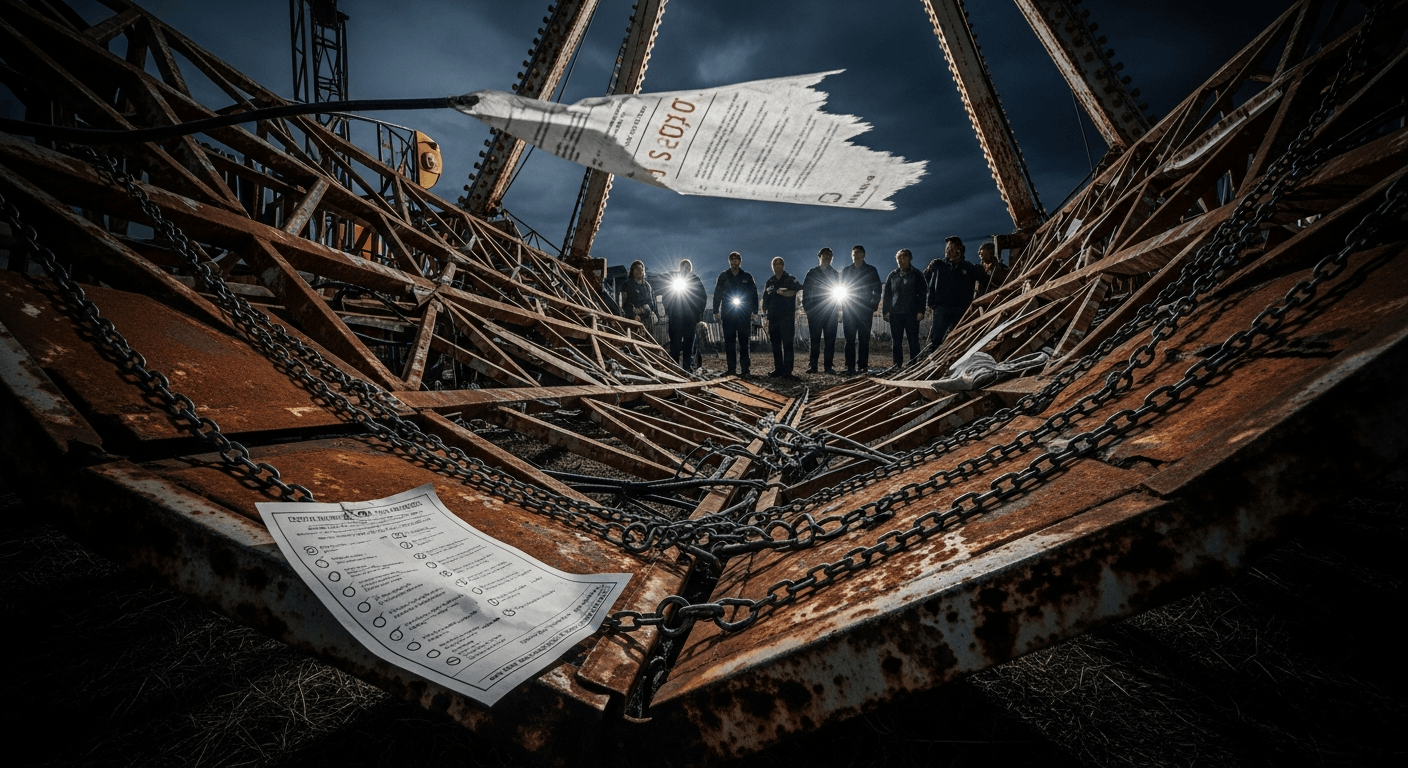
I write this with a heavy heart. At the Surajkund fair a giant ‘Tsunami’ swing snapped mid-air, collapsing onto the ground and turning an evening of craft and culture into a scene of trauma and loss. An on‑duty police inspector, who rushed in to help those trapped, later died; more than a dozen others were injured. The ride operator and at least one staff member have been arrested and a special investigation team has been formed to probe whether safety norms were ignored Times of India India Today.
What this incident forced me to think about
I keep returning to three plain truths:
- Public events are built on trust. Visitors trust organisers, and organisers implicitly rely on contractors and vendors to keep simple promises: that rides are certified, cables are inspected, maintenance logs are genuine, and training is real.
- Regulatory compliance without verification is theatre. Paperwork alone cannot be the measure of safety. When lives are at stake, certificates must correspond to reality — and that requires independent technical audits, physical checks, and real-time monitoring.
- Courage fills the void when systems fail. The bravery of those who rushed in to help — who put others first — reminds us that civic courage cannot be the system’s primary safety net.
The policy and technical gaps I see
This tragedy is an invitation to confront predictable failures:
- Tender and vendor vetting often privilege lowest cost over proven competence. The result: complex mechanical systems in the hands of poorly resourced operators.
- Pre-event inspections, when performed, are frequently procedural and not forensic. Visual checks miss metal fatigue, hidden corrosion, poor welding, or falsified maintenance records.
- There is limited mandatory use of simple digital measures — maintenance logs on tamper-evident cloud platforms, sensor-driven health monitoring (load, vibration, tension), or QR‑based inspection trails that link inspectors to photos and timestamps.
I have written before about the power of measured, technology‑driven approaches to make movement and infrastructure safer and more accountable; those same principles apply to temporary public installations and fairground rides (see my earlier reflections on transport and systems thinking) A Trail-blazing Urban Transport ?.
Practical steps that matter — not slogans
If we want fewer funerals and more festivals, here’s what I would press for, urgently and cheaply:
- Mandatory pre‑deployment technical certification by an independent, accredited mechanical‑safety lab for any ride that carries more than a nominal load.
- Real‑time sensor fitments on large rides: load cells, accelerometers, and cable‑tension monitors that trigger automatic shutdowns and alert control rooms when thresholds are exceeded.
- A tamper‑proof digital maintenance ledger, accessible to event authorities and safety regulators, that timestamps every inspection with geotagged photos and the inspector’s authenticated identity.
- Vendor performance bonds and insurance tied to objective third‑party audits — not just paper indemnities — so accountability has teeth.
- On‑site trained first responders and clear emergency access routes — because even the best prevention cannot eliminate all risk.
Beyond technical fixes: culture and accountability
We must also confront softer but deeper problems: the incentive structures that encourage cutting corners; the complacency that grows when events are routine; and the public expectation that every safety glaring fault will be punished after the fact. Accountability must be proactive: permits should be conditioned on compliance checks and public events should publish safety certificates and inspection summaries for transparency.
A plea, not a sermon
To the families affected, to the injured, and to the officers and first responders who stood between the crowd and catastrophe: my empathy, and my demand for better systems, converge. We owe them a future where a day out is not a risk assessment in disguise.
To event organisers and policymakers: let this be a pivot point. Replace ritual paperwork with real verification. Use sensors, cloud logs, accredited audits and enforceable bonds. These are not luxuries — they are minimal civic duties.
References & further reading
- News coverage of the incident and subsequent arrests: Times of India, India Today.
- My earlier thoughts on systems, transport and the role of technology in public safety: A Trail-blazing Urban Transport ?.
Regards,
Hemen Parekh
Any questions / doubts / clarifications regarding this blog? Just ask (by typing or talking) my Virtual Avatar on the website embedded below. Then "Share" that to your friend on WhatsApp.
Get correct answer to any question asked by Shri Amitabh Bachchan on Kaun Banega Crorepati, faster than any contestant
Hello Candidates :
- For UPSC – IAS – IPS – IFS etc., exams, you must prepare to answer, essay type questions which test your General Knowledge / Sensitivity of current events
- If you have read this blog carefully , you should be able to answer the following question:
- Need help ? No problem . Following are two AI AGENTS where we have PRE-LOADED this question in their respective Question Boxes . All that you have to do is just click SUBMIT
- www.HemenParekh.ai { a SLM , powered by my own Digital Content of more than 50,000 + documents, written by me over past 60 years of my professional career }
- www.IndiaAGI.ai { a consortium of 3 LLMs which debate and deliver a CONSENSUS answer – and each gives its own answer as well ! }
- It is up to you to decide which answer is more comprehensive / nuanced ( For sheer amazement, click both SUBMIT buttons quickly, one after another ) Then share any answer with yourself / your friends ( using WhatsApp / Email ). Nothing stops you from submitting ( just copy / paste from your resource ), all those questions from last year’s UPSC exam paper as well !
- May be there are other online resources which too provide you answers to UPSC “ General Knowledge “ questions but only I provide you in 26 languages !


No comments:
Post a Comment