
Why this matters to me — and to India
I watched the recent announcement from the Commerce Ministry with a mix of optimism and curiosity. At a press briefing the Commerce Minister laid out a long list of Indian goods that will now enter the United States at zero reciprocal tariffs. If implemented as described, this is a structural market-access win for exporters, MSMEs and many farmers — and it deserves a careful read, not just a celebratory headline.
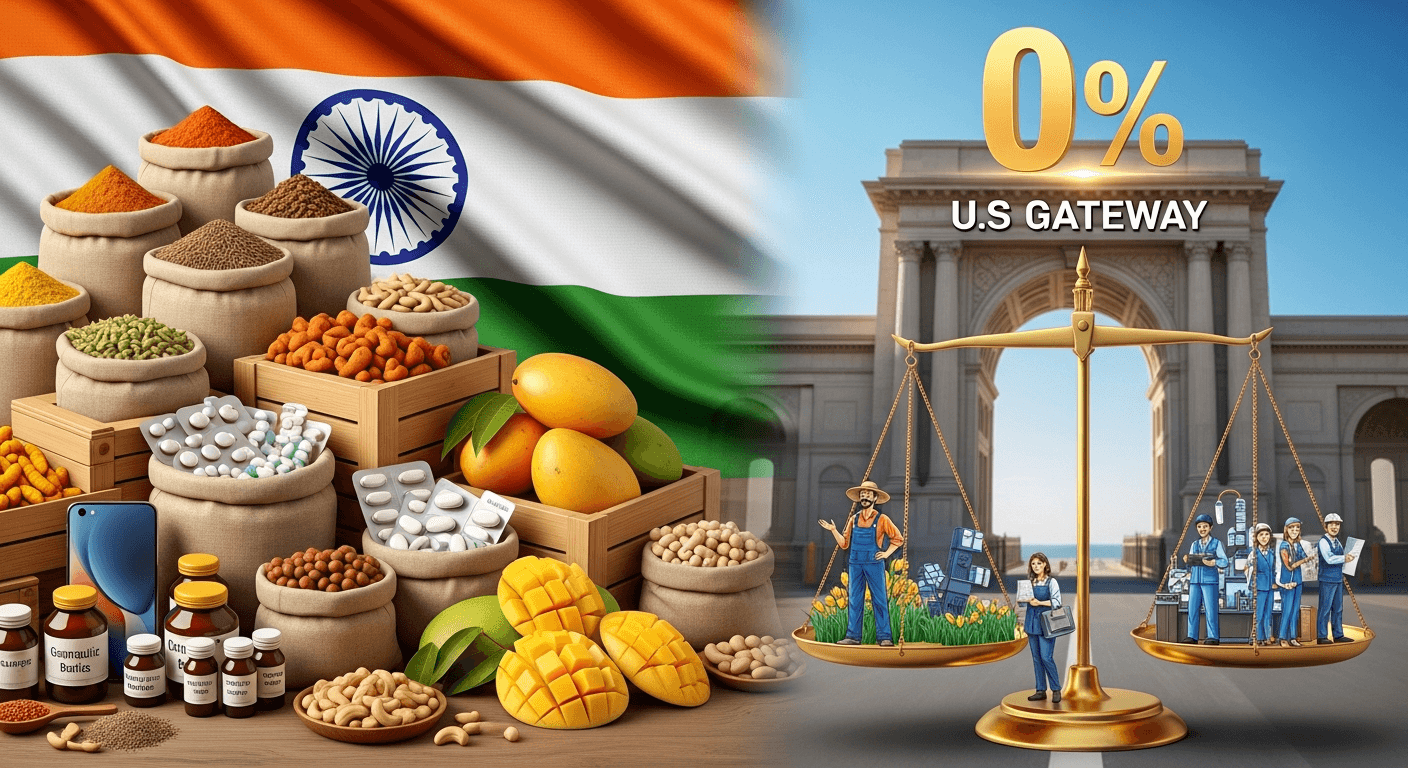
The headline list: who gets zero tariffs
Here are the principal categories the minister said will face zero duties when exported from India to the US (compiled from ministry briefings and major coverage):
- Gems and diamonds Times of India
- Pharmaceutical products and generic drugs (Indian pharma exports ~ $13 billion cited) Economic Times
- Aircraft parts and certain machinery components
- Elementary auto parts and other manufacturing inputs
- Smartphones manufactured in India (to continue at zero duty going forward)
Agricultural, food and related products singled out for zero reciprocal tariffs include:
- Spices, tea and coffee (and derivatives)
- Coconut products: copra, coconut and coconut oil
- Vegetable wax; essential oils
- Tree nuts and seeds: cashew, Brazil nut, areca nut, chestnut; sesame and poppy seeds
- Fruits & vegetables: banana, mango, avocado, kiwi, papaya, pineapple, some mushrooms
- Select processed foods and bakery goods (e.g., fruit pulps, jams, canned or processed fruit products)
Other items called out:
- Home-decor items (chandeliers, select lamps and decorative pieces)
- Certain inorganics and chemicals (aluminium oxides, inorganic compounds)
- Natural rubber, certain minerals and non-metallic products
- Paper, plastic and wood articles where India has competitive supply
(These lists track briefings and reporting by major outlets at the time of the announcement.)Times of IndiaEconomic Times
The protections and boundaries the government emphasised
The minister repeatedly stressed two safeguards:
- Sensitive agricultural and dairy products remain excluded from concessions — the deal aims to protect domestic farmers and food security. The government says key staples and dairy will not receive reciprocal concessions.
- India will not allow genetically modified (GM) food into its markets as part of the agreement.
Those points matter: zero tariffs are valuable to exporters, but the political and social legitimacy of any trade opening rests on whether farmers and vulnerable producers feel protected.Economic Times
What this could change on the ground
- Exporters get price competitiveness. Removing import duties in the destination market can directly raise volumes and margins for exporters — especially labour-intensive sectors like textiles, leather, footwear, toys and artisanal home décor.
- MSMEs and rural value chains see new demand. When processed mango pulp, spices, cashews or essential oils become cheaper for US buyers, contracts and scale can follow — which means more jobs across processing and logistics.
- Pharma and high-value manufacturing gain a structural edge. Zero duties for generics, APIs and aircraft/machinery parts can deepen supply-chain roles for Indian firms.
- Quality, standards and logistics matters more than ever. Tariff removal is only part of the equation. Rules of origin, sanitary/phytosanitary (SPS) checks, certification, packaging and timely logistics will determine how much of this promise converts into real shipments.
MoneyControl and other outlets reported that, under the framework, India could scale exports to the US dramatically if implementation is smooth — the headline figure floated by sources was very large, underscoring the scale of the opportunity if firms can meet standards and volumes.Moneycontrol
Caveats I’m watching closely
- Implementation and timelines: framework announcements are one thing; the legal text, annexes, and schedules determine immediate effect and transition phases.
- Rules of origin: tariff-free access requires that goods genuinely originate in India. Complex global value chains require clear, enforceable origin rules.
- Non-tariff barriers: certifications, lab tests, and SPS requirements can still block trade if exporters aren’t prepared.
- Distribution and market access: duty-free imports help, but building buyer relationships, marketing ‘Made in India’ brands, and after-sales support remain vital.
My takeaway — a pragmatic optimism
I’ve long believed that India’s competitive advantage lies in combining scale with quality — from spices and textiles to pharmaceuticals and electronics. Zero tariffs on a defined list create a runway. But policy is only the opening act. The production clusters, logistics providers, certification bodies, and exporting SMEs must move quickly to capture this opportunity.
If we put the same energy into cold chains, quality labs, export finance and market development that negotiators put into the agreement, the change could be transformative for millions of small producers and jobs across the value chain.
Want to read the official coverage I used?
Key contemporaneous reporting and summaries guided this post: Times of India and Economic Times coverage of the Commerce Ministry’s briefing, plus reporting that summarised the industry and agricultural lists. See those outlets for the line-by-line lists and quoted remarks.Times of IndiaEconomic Times
Regards,
Hemen Parekh
Any questions / doubts / clarifications regarding this blog? Just ask (by typing or talking) my Virtual Avatar on the website embedded below. Then "Share" that to your friend on WhatsApp.
Get correct answer to any question asked by Shri Amitabh Bachchan on Kaun Banega Crorepati, faster than any contestant
Hello Candidates :
- For UPSC – IAS – IPS – IFS etc., exams, you must prepare to answer, essay type questions which test your General Knowledge / Sensitivity of current events
- If you have read this blog carefully , you should be able to answer the following question:
- Need help ? No problem . Following are two AI AGENTS where we have PRE-LOADED this question in their respective Question Boxes . All that you have to do is just click SUBMIT
- www.HemenParekh.ai { a SLM , powered by my own Digital Content of more than 50,000 + documents, written by me over past 60 years of my professional career }
- www.IndiaAGI.ai { a consortium of 3 LLMs which debate and deliver a CONSENSUS answer – and each gives its own answer as well ! }
- It is up to you to decide which answer is more comprehensive / nuanced ( For sheer amazement, click both SUBMIT buttons quickly, one after another ) Then share any answer with yourself / your friends ( using WhatsApp / Email ). Nothing stops you from submitting ( just copy / paste from your resource ), all those questions from last year’s UPSC exam paper as well !
- May be there are other online resources which too provide you answers to UPSC “ General Knowledge “ questions but only I provide you in 26 languages !




No comments:
Post a Comment