
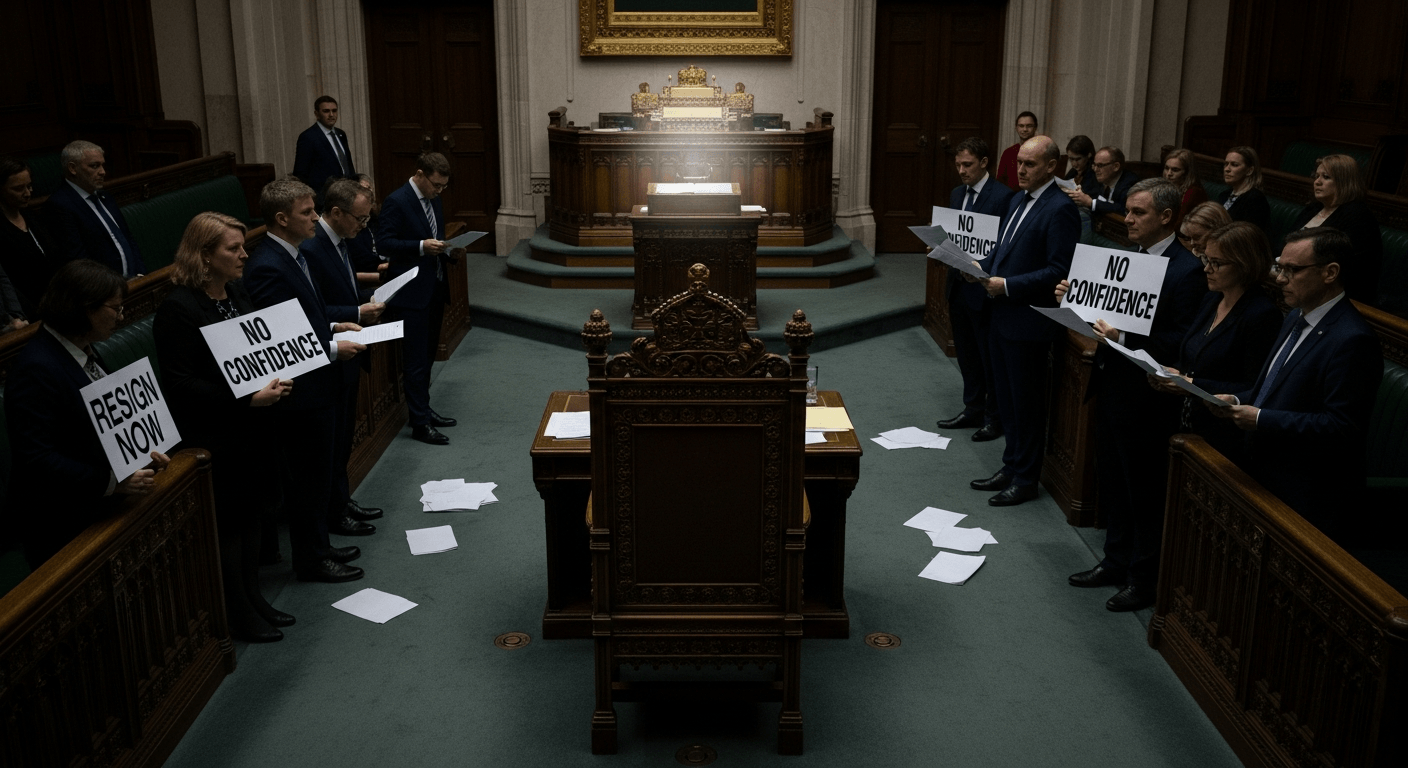
Warning Before PM's Address
Lede
I watched the Lok Sabha episode unfold with the same mix of concern and curiosity that many citizens felt: the Speaker said he had "concrete information" that members of the main opposition could attempt an "unexpected act" by approaching the Prime Minister's seat, and he asked the Prime Minister not to attend the House for the scheduled reply to the President's address. The remark — delivered as the House reconvened after repeated adjournments — set off a sharp exchange between the government and the opposition and prompted questions about procedure, safety and political strategy Business Standard Hindustan Times.
Context
Tensions in the Lower House had been mounting after opposition members tried to press for a debate on an unpublished memoir by a former Army chief. Women MPs from opposition benches moved into the Well near the front benches during one sitting holding placards, and proceedings were repeatedly adjourned. Against that background, the Speaker said he had credible inputs suggesting an escalation that would involve moving to the Prime Minister's dais; to avert what he characterised as a threat to parliamentary traditions he requested that the Prime Minister not come to deliver the customary reply Deccan Herald.
Quote attribution and immediate reactions
The Speaker warned that "if this incident had taken place, this would have left the democratic traditions of the country in shreds," and later thanked the Prime Minister for acceding to his request and avoiding "unpleasant scenes" Business Standard. The Congress called the move a manufactured pretext to silence dissent; in public responses the Leader of the Opposition accused the government and the Speaker of inventing threats to avoid debate. Leader of Opposition Rahul Gandhi (rahul.gandhi@inc.in) said the Prime Minister "took refuge in lies" and suggested the absence was political rather than security-driven New Indian Express.
The BJP and allied members defended the Speaker's decision as necessary to maintain decorum and protect the sanctity of the Chair; they pointed to the earlier rush to the Well and argued the presiding officer acted prudently to prevent disorder Hindustan Times.
Parliamentary rules on suspension and discipline
The Rules of Procedure and Conduct of Business give the Speaker broad powers to preserve order. Rule 373 allows the Speaker to direct a disorderly member to withdraw; Rule 374 enables the naming of a member and suspension for the remainder of a session; and Rule 374A provides for automatic suspension in cases of "grave disorder" (for example, entering the Well or persistent slogan-shouting) for up to five sittings or the remainder of the session, whichever is less Lok Sabha Rules (eparlib) Manorama Yearbook explainer.
Analysis: what could follow
There are several plausible outcomes. First, the House may pursue disciplinary action against individuals who entered the Well or flouted directions, leading to naming and temporary suspensions under existing rules. Second, the episode could be used politically by both sides: the government to underline disorder and justify firm measures, the opposition to argue democratic space is being constrained. Third, repeated adjournments and the absence of a Prime Ministerial reply weaken the performative aspect of parliamentary accountability and could erode public confidence in institutional functioning if such scenes recur.
Finally, legal or procedural challenges are unlikely to reverse a suspension quickly because Article 118 grants Houses autonomy over internal rules; nevertheless, past court interventions have cautioned against disproportionate or arbitrary punishments, suggesting any extreme step could face scrutiny Times of India explainer.
Conclusion
As a citizen and observer I register two simple points: parliamentary rules exist to protect debate and dignity, and their invocation must be proportionate and transparent. Whether the Speaker's preventive step reflected a real security risk or a strategic effort to manage proceedings will be debated in the days ahead — but the immediate task for all parties is straightforward: return to the House floor and test political arguments on the record rather than in the Well or the media.
Regards,
Hemen Parekh
Any questions / doubts / clarifications regarding this blog? Just ask (by typing or talking) my Virtual Avatar on the website embedded below. Then "Share" that to your friend on WhatsApp.
Get correct answer to any question asked by Shri Amitabh Bachchan on Kaun Banega Crorepati, faster than any contestant
Hello Candidates :
- For UPSC – IAS – IPS – IFS etc., exams, you must prepare to answer, essay type questions which test your General Knowledge / Sensitivity of current events
- If you have read this blog carefully , you should be able to answer the following question:
- Need help ? No problem . Following are two AI AGENTS where we have PRE-LOADED this question in their respective Question Boxes . All that you have to do is just click SUBMIT
- www.HemenParekh.ai { a SLM , powered by my own Digital Content of more than 50,000 + documents, written by me over past 60 years of my professional career }
- www.IndiaAGI.ai { a consortium of 3 LLMs which debate and deliver a CONSENSUS answer – and each gives its own answer as well ! }
- It is up to you to decide which answer is more comprehensive / nuanced ( For sheer amazement, click both SUBMIT buttons quickly, one after another ) Then share any answer with yourself / your friends ( using WhatsApp / Email ). Nothing stops you from submitting ( just copy / paste from your resource ), all those questions from last year’s UPSC exam paper as well !
- May be there are other online resources which too provide you answers to UPSC “ General Knowledge “ questions but only I provide you in 26 languages !


No comments:
Post a Comment