
Opening hook
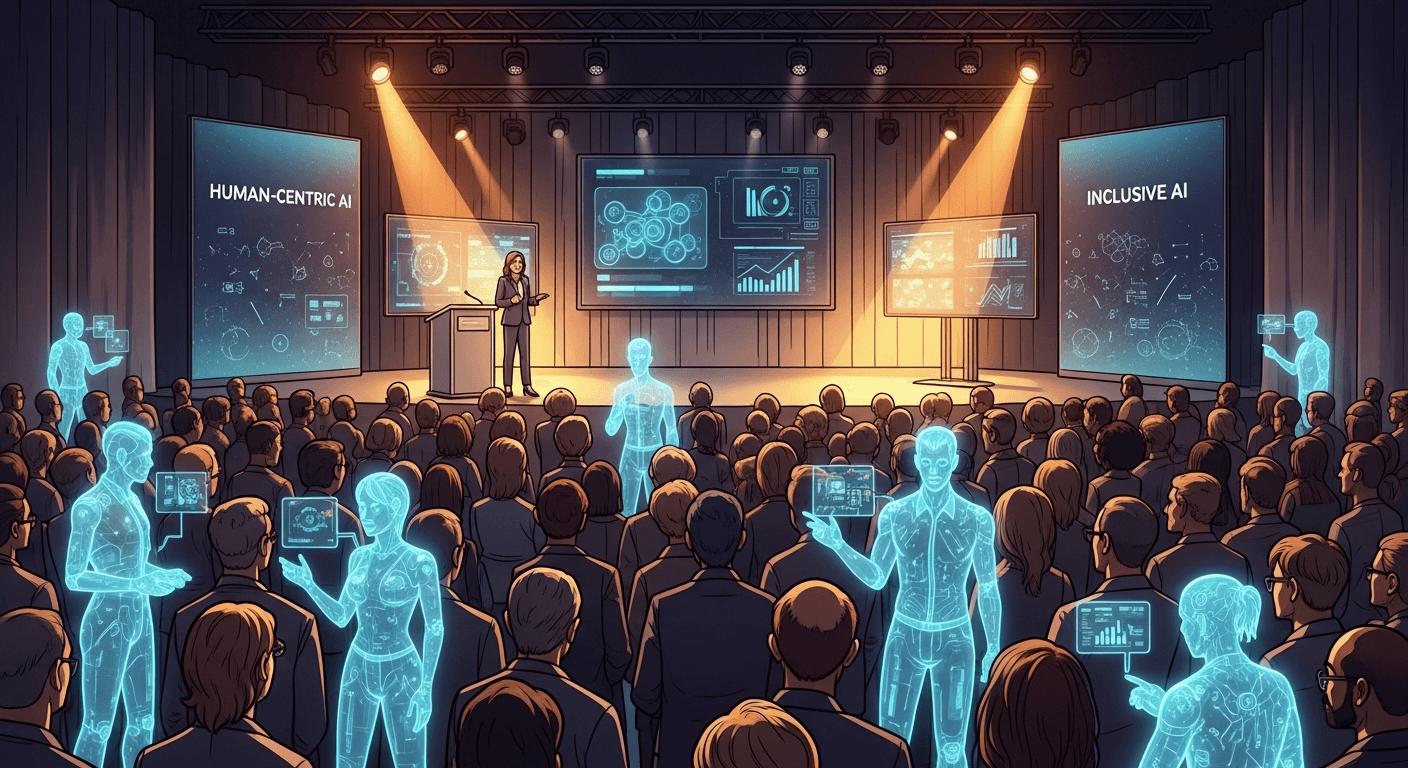
I remember sitting in a room years ago and watching a conversation about ethics and accessibility feel like an add-on—important, yes, but separate from the engineering roadmap. Today that divide is closing. The next AI summit I’m following is not just paying lip service to human values; it places "human-centric" and "inclusive" AI at the center of its program. That matters, because what we decide inside conference rooms ripples into products, laws, workplaces, and everyday lives.
What do we mean by "human-centric" and "inclusive" AI?
- Human-centric AI puts people—not models—at the center of design. It means systems are built to augment human judgement, preserve dignity, support autonomy, and include human oversight where it matters.
- Inclusive AI ensures that AI works for people across differences: disability, language, income, geography, race, age, and more. Inclusion requires intentional design choices so that benefits and protections are broadly shared, not concentrated.
Put simply: human-centric asks "Who does this serve?" and "How will people stay in control?" Inclusive asks "Who is missing from our tests, datasets, and design conversations?" and "How do we change that?"
Why a summit focus on these themes matters now
- Policy: Regulators are moving faster than many expected. When summits prioritize human-centric and inclusive approaches, they create practical bridges between high-level principles and implementable policy. Policymakers leave with concrete examples, not just manifestos.
- Industry: Companies are under pressure to demonstrate that AI products are safe, fair, and accessible. A summit spotlight accelerates concrete toolkits—audits, accessible design patterns, procurement guidance—that product teams can adopt immediately.
- Ethics: Ethical frameworks are plentiful; operationalizing them is hard. A summit that centers human needs creates cross-sector labs and shared playbooks that translate ethics into engineering checklists and governance processes.
- Social impact: AI shapes livelihoods, education, health, and civic life. A summit focused on inclusion helps ensure technologies reduce inequalities rather than amplify them.
Notable sessions and themes you should expect
Organizers often craft tracks that move from principle to practice. Expect sessions like:
- Accessibility by design: concrete patterns and metrics that make interfaces and outputs usable by people with disabilities.
- Bias mitigation clinics: hands-on sessions showing auditing tools, data strategies, and organizational processes to reduce unfair outcomes.
- Workforce transition & reskilling: panels and workshops on practical programs for upskilling workers and redesigning roles collaboratively.
- Participatory design & co-creation: methods to bring lived experience into model design and evaluation—beyond token consultation to meaningful partnership.
- Governance & governance-in-practice: how to embed human oversight in product lifecycles, procurement, and post-deployment monitoring.
These themes are not hypothetical. Recent convenings have used participatory, AI-assisted storytelling to turn single panels into durable knowledge assets and policy-ready outcomes (see the "Accessible Futures" convening and its follow-up materials) Amplifying Impact with AI-Powered Storytelling.
What organizers and experts might say (paraphrased)
- "We can’t treat accessibility like a checkbox after launch; it must be a design principle from day one."
- "Regulation helps set guardrails, but industry and civil society need tangible tools to implement those rules in product teams."
Those are the kinds of practical, action-oriented reframes you’ll hear—focused less on abstract blame and more on doing the work.
Concrete examples and case studies
Participatory panels that become lasting assets: A recent panel used a combination of structured listening, human facilitation, and AI-enabled synthesis to surface community priorities and produce accessible outputs like podcasts and infographics. The process showed how live events can create ongoing resources for policy and product teams rather than being one-off conversations Accessible Futures case study.
Accessibility-focused product work: Designers and engineers have increasingly used simple design rules—plain language, alternative text, keyboard navigation, voice interfaces—and AI to personalize interfaces for neurodiverse users, people with low vision, and those using low-bandwidth connections. The result: higher engagement and, often, better outcomes for everyone.
Workforce examples: Companies that combine human-led reskilling programs with AI-enhanced coaching show faster redeployment of staff into higher-value roles. These programs pair clear competency maps with hands-on practice and human mentors.
Calls to action (concrete next steps)
For researchers: Publish reproducible audits and make datasets and evaluation scripts available so others can test claims. Collaborate with community groups for evaluation, not just with peer labs.
For policymakers: Fund multi-year, multi-stakeholder pilots that link regulation to measurable outcomes—accessibility metrics, audit trails, and real-world impact studies.
For companies: Adopt participatory design practices. Require accessibility checks and bias tests before launch. Invest in reskilling programs tied to clear career pathways.
For civil society & communities: Insist on seats at the table. Ask not just for representation but for decision-making power in design and procurement choices.
Practical language for teams to adopt right away
- Start every product brief with a short people impact statement: who benefits, who may be excluded, and how inclusion will be measured.
- Use simple accessibility checklists in every sprint review and pair them with a small, real-world usability test with diverse users.
- Create a human oversight playbook that specifies when a human steps in and how they get the context they need.
Conclusion
A summit focused on human-centric and inclusive AI is more than an event: it can be a catalyst for durable change. It helps shift conversations from lofty principles to tangible steps—tools that engineers can use, policies that protect people, and social programs that make inclusion real. I’m cautiously optimistic: the momentum is real, but the work is granular and long-running. If the summit leaves us with practical toolkits, funded pilots, and stronger partnerships between communities and technologists, then it will have done its job.
Connect with me: Hemen Parekh (hcp@recruitguru.com)
Regards,
Hemen Parekh
Any questions / doubts / clarifications regarding this blog? Just ask (by typing or talking) my Virtual Avatar on the website embedded below. Then "Share" that to your friend on WhatsApp.
Get correct answer to any question asked by Shri Amitabh Bachchan on Kaun Banega Crorepati, faster than any contestant
Hello Candidates :
- For UPSC – IAS – IPS – IFS etc., exams, you must prepare to answer, essay type questions which test your General Knowledge / Sensitivity of current events
- If you have read this blog carefully , you should be able to answer the following question:
- Need help ? No problem . Following are two AI AGENTS where we have PRE-LOADED this question in their respective Question Boxes . All that you have to do is just click SUBMIT
- www.HemenParekh.ai { a SLM , powered by my own Digital Content of more than 50,000 + documents, written by me over past 60 years of my professional career }
- www.IndiaAGI.ai { a consortium of 3 LLMs which debate and deliver a CONSENSUS answer – and each gives its own answer as well ! }
- It is up to you to decide which answer is more comprehensive / nuanced ( For sheer amazement, click both SUBMIT buttons quickly, one after another ) Then share any answer with yourself / your friends ( using WhatsApp / Email ). Nothing stops you from submitting ( just copy / paste from your resource ), all those questions from last year’s UPSC exam paper as well !
- May be there are other online resources which too provide you answers to UPSC “ General Knowledge “ questions but only I provide you in 26 languages !




No comments:
Post a Comment